A Micro-Blog from Swami Vimokshananda – earlier at Durban, Singapore and Dublin – now at Yelagiri Hills, Tamil Nadu, India – "A private diary for public consumption!"
South Africa joins the comity of nations in celebrating the International Mother’s Day on the ensuing 11th May. A Happy Mother’s day to everyone! Last Tuesday at our Glen Anil Main centre we handed over gift packets to a group of mothers from Greenbury Project.
Today is Sita Jayanti. The Hindu culture has iconic mothers in plenty, but there was never “another” like mother Sita, in the words of Swami Vivekananda.She was found when King-sage Janaka furrowed the land for cultivation. She is the Divine Mother Mahalakshmi incarnate on the earth. Four quotes from Swami Vivekananda’s Complete Works:
The Miracle Medicine
It is not without any reason that our sages in the past had described this ‘samsaara‘ – the cycle of birth and death – as immensely vast as (bhava saagaram) the ocean. They have even detailed in the most frightful terms how difficult it is to cross over this ocean. When you are almost on the verge of losing hope some other saint compares this samsaara with a mere river. But not an ordinary river, forsooth. He calls it ‘rana-nadi‘ – a ‘battle-river’ – whose waters are infested with terrible crocodiles and alligators all living in its forceful current that produces strong whirlpools! And lo! just imagine how dangerous it would be to attempt to cross such a river not to speak of the ocean! How many of us have in real life have even thought of attempting to cross such river or ocean?
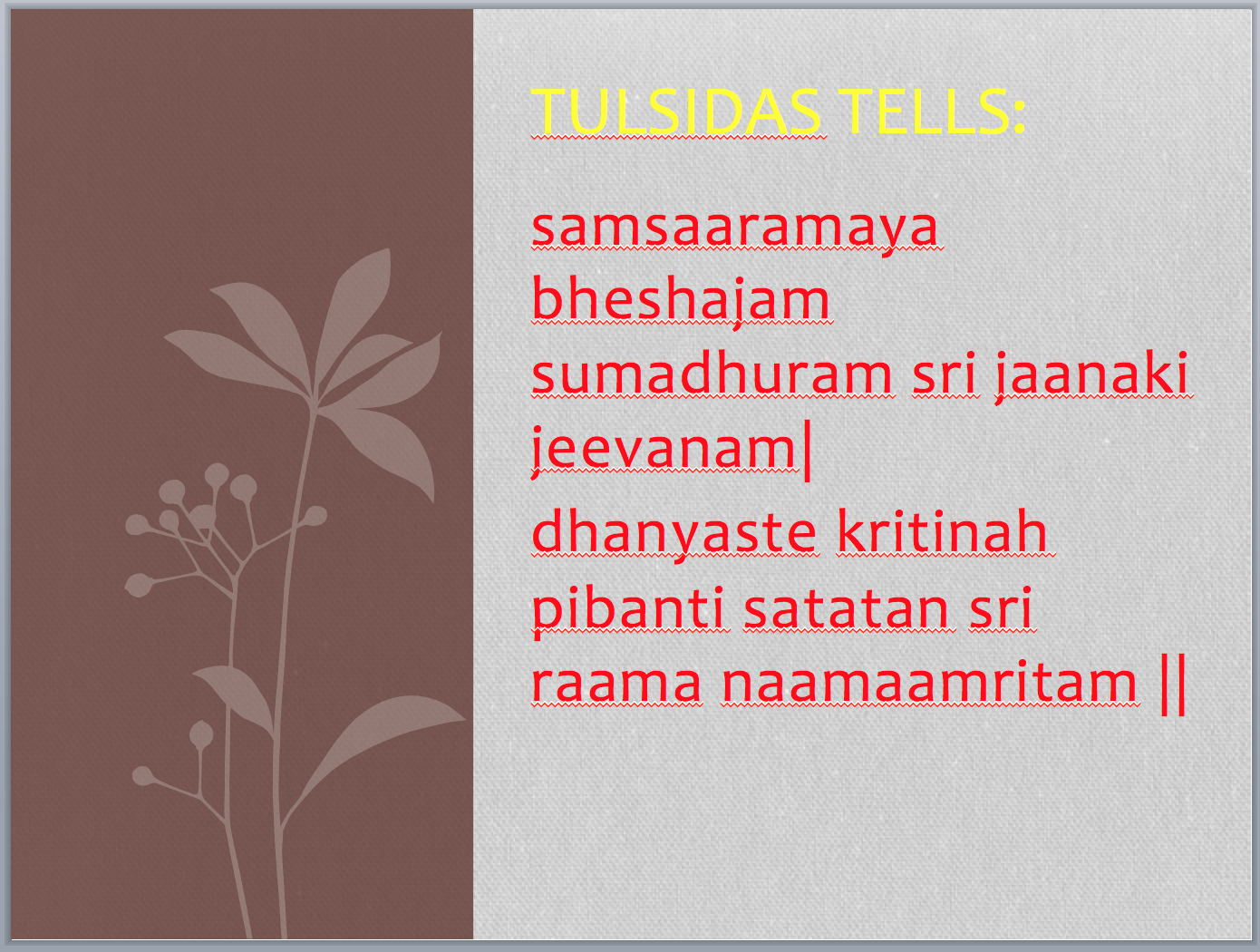
Tulsidas, of course in his saintly way makes samsaara a little less fearful. He calls it a disease. If that can be wisely diagnosed, it can be well treated too. This brings us some kind of relief in knowing that my disease is curable and the condition is that I should take proper medicine. Does taking medicines indeed bring about the cure of the disease? Not necessarily! We have experienced in our lives that many a time the medicines not only fail to have any curative effect but to our chagrin add some disturbing side-effects.
If samsaara is a disease, then is there any medicine? Yes, there is, declares Tulsidas. While expressing the greatness of the life of Mother Sita he considers her life story as nothing but a ‘medicine’ for the ‘worldly disease’. No one likes to take medicines as the chemical compositions generally make them bitter in taste. But this medicine, he adds, is exceedingly sweet. Normally after taking medicine one requires plain water to clear the throat. Here of course the very nectar is itself given! So Tulsidas opines that those that drink nectar of Sri Rama’s name, are indeed ever blessed! Yes, the story of Sita is a miracle medicine.
Sita in Sundarakandam
The holy book Ramayana is divided into seven kaandams. The fifth division called Sundarakaandam has gained much popularity among the devout Ramabhaktas. I do remember once when I was young, my mother was advised to recite Sundarakaandam verses with love for 41 days to ward off certain evil effects in the family. She gained such an unshakeable conviction about the marvel of this scripture that all problems got resolved within that period of paaraayanam.
What does Sundarakaandam teach? It speaks about in large measure the valour of Sri Hanumanji who undertook the work of Sri Rama in searching for and finding Mother Sita. Scholars of Ramayana say confidently that Sundarakaandam is all about Sri Hanumanji. Though I am not a scholar in Ramayana, purely from the point of view of a devotional angle I offer my two cents: I prefer to look at this way viz., that Sundarakaandam is all about Mother Sita.
Whenever I had the opportunity to read this scripture (of course I didn’t read it for 41 days like my mother!) my mind was thrilled no doubt at Sri Hanumanji’s heroic sports. A great veneration swelled up in my heart that made me to remember him as an ideal for my monastic life. But more than that what was fascinating to me in this magnum epic – especially in Sundarakaandam – was the character depiction of Mother Sita. Swami Vivekananda was in awe of Mother Sita and exclaimed, “What to speak of Sita? You may exhaust the literature of the world that is past, and I may assure that you will have to exhaust the literature of the world of the future, before finding another.” I find her simply unique. In another place Swamiji says, “… the character was depicted once and for all. There may have been several Ramas, perhaps, but never more than one Sita.”
– Her dealing with King Ravana was indeed so majestic; in spite of his great offering of material temptations, she nonchalantly turned down his advances.
– Her interaction with her demoness guards especially with Trijata has no comparison; the care and concern for Trijata‘s welfare even though she had been appointed to spy over her, singularly exhibiting her divine compassion.
– Her polite refusal to Sri Hanumanji’s proposal to carry her away stealthily from Lanka and proudly speaking about her husband Sri Rama’s necessity to win the battle with Ravana and then only she would be ready to return with him in all glory.
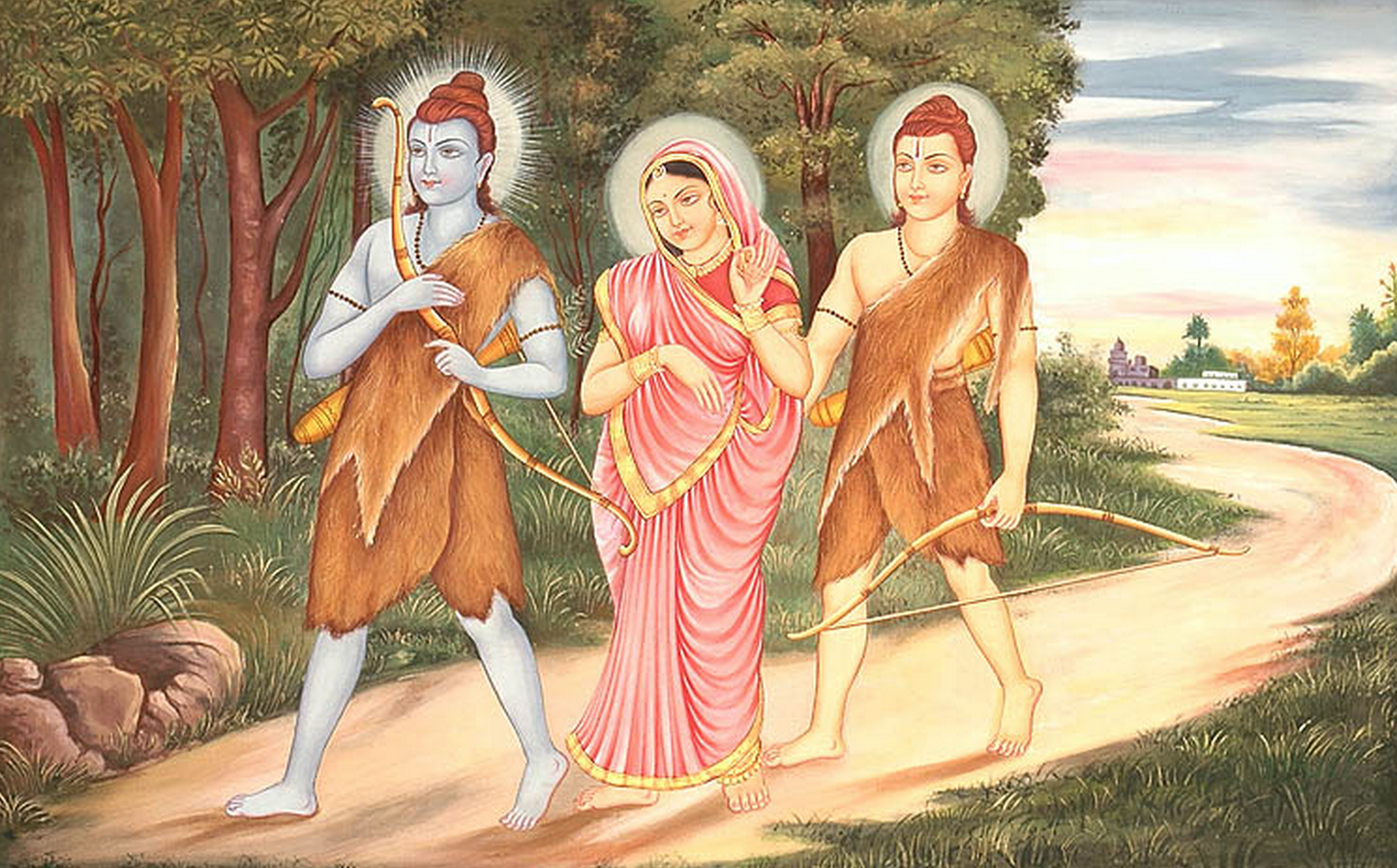
Sri Rama walking in the forest followed by Mother Sita and Lakshmana
In this Sundarakaandam Sita is not a mere loyal wife only to toe the line of her husband; she comes out in her own right (and in the absence of the physical presence of Sri Rama) that amazes me as I see her personality looming large into a bright towering one that demands not only an adorable worship with love but also absolute surrender at her feet.
Sita and Sarada
Thus, devotion to one form of Mother, if cultivated from a young age does not preclude love for other forms of Mother. Rather it definitely helps in transposing one’s devotion easily on another form of Mother, if needed! The variety of names and forms of Mother in Hinduism may bewilder anyone who is not acquainted with the philosophy of Vedanta. But a devotee in this tradition accepts the Divine Mother as ‘ananta roopini, ananta gunavati, ananta naamni girije maa’ – O Girije Ma! thou art infinite forms, infinite qualities and infinite names, says a poet-devotee.
Hence the transition from Sita to Sarada was smooth enough in my life. Ma Sarada’s experience in the Rameshwaram temple vouchsafes that she is no different from Ma Sita.
This slideshow requires JavaScript.
When Holy Mother visited Rameshwaram temple, Tamil Nadu in 1910, she was directly taken to the sanctum sanctorum and was allowed to worship Lord Shiva in the form of uncovered Shivalingam. The Mother offered 108 golden leaves shaped like the real leaves of the bel (vilva) tree. She stayed in that small town for three days and every morning and evening she would visit the temple and perform worship with flowers, chandan (sandal) and vilva leaves. The Holy Mother observed all customary traditions of the temple.
It is said that Brahmachari Krishnalal who was an attendant to Holy Mother heard Mother uttering in a mood unaware of the external world: ‘It is just as I had left.’ After a few weeks in Kolkata when once Kedar babu enquired of Mother about her visit to Rameshwaram, she uttered once again, ‘He is just as I had left Him, my son!’
O Mind! Drink the honey that flows from the lotus feet of the Mother…best remedy for worldly disease!
Swami Gambhiranandaji in his authoritative biography – ‘Holy Mother Sri Sarada Devi‘ – explains thus. “The devotees believe that the same personage who incarnated in the Treta yuga as Sita, the ever faithful consort of Ramachandra, descended again as the all-enduring and ever gracious Holy Mother, so that the sudden sight of the uncovered image carried her mind unconsciously across the vast span of thousands of years and the past appeared as a vivid present; and forgetful of her immediate environment she made that spontaneous remark.” Swami Abhedananda, one of the Direct Disciples of Sri Ramakrishna, in resemblance to the ‘worldly-disease’ mentioned in the beginning of this post, follows the footsteps of Saint Tulsidas. What is the remedy? Abhedanandaji goes on to say that the remedy for this ‘bhava-roga‘ – worldly disease – is to sip the honey flowing from the lotus of the Mother’s feet.
On this Mother’s Day, let us take a vow to surrender at Her holy feet!
May Mother Sarada who is no other than Mother Sita fill our hearts with her sterling qualities!
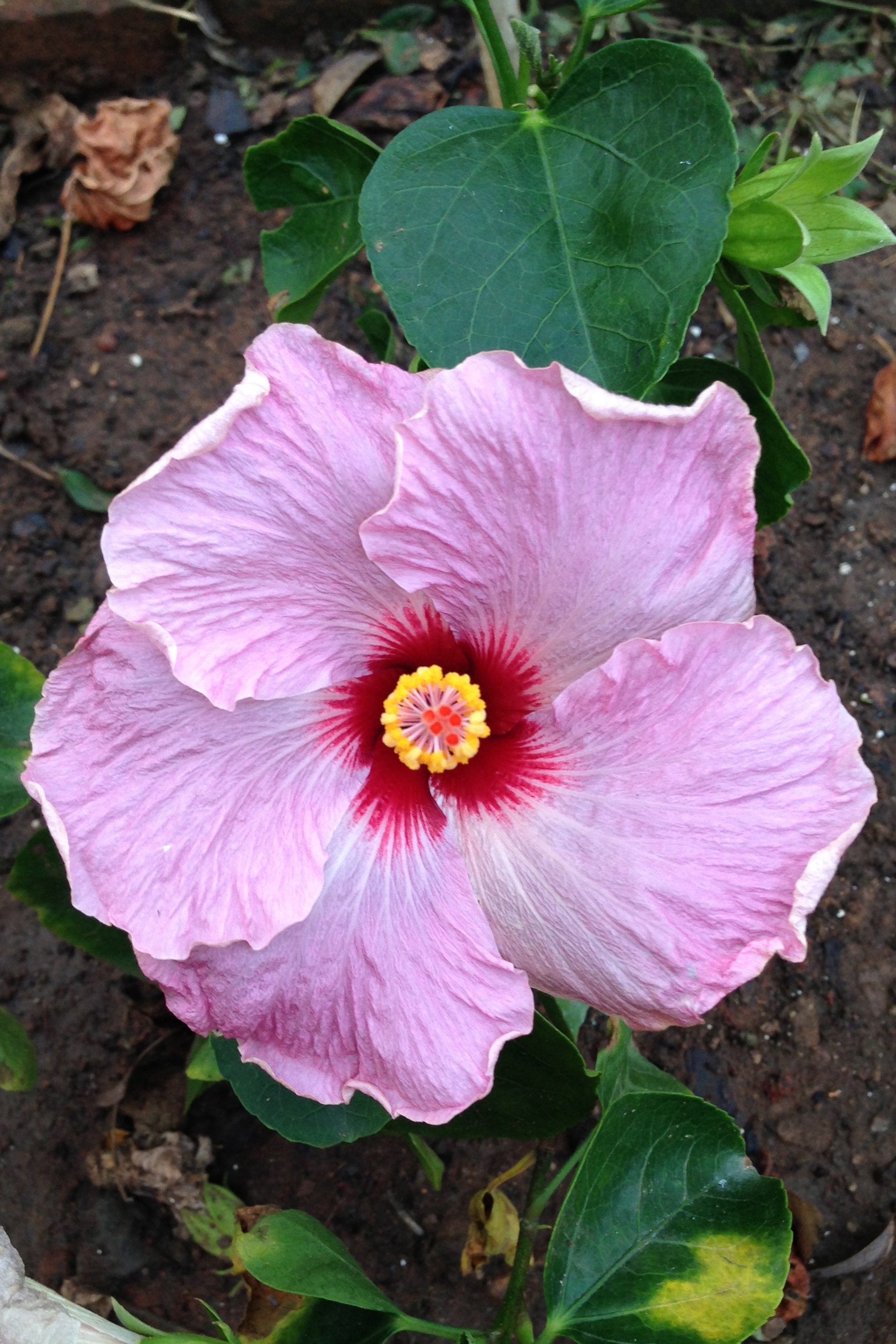
Ceaseless Cosmic worship by flowers…hibiscus in charming colours in our temple garden
Guru’s guidance
The 23rd April of this year is a red-letter day for the Ramakrishna Movement in South Africa when K K Pillay returned from India after embracing sannyasa. He had acquired a new ‘yoga-patta’ – a formal title – Swami Chandikananda.
Sri K K Pillay is an old devotee of our Master, Mother and Swamiji. He has been associated with this organization from 1964 as a young man of 17 years when he, in due course, came under the spiritual influence of late revered Swami Shivapadanandaji, the second President of the Centre. Besides his getting diksha, he was sent to Kailash Ashram where he studied Sanskrit and some Vedanta scriptures staying as a resident there for three years. He has been Chairman of our Chatsworth Sub-centre for 8 years off and on at different times.
On the last Maha Shivaratri night (27th Feb 2014) he was blessed with sannyasa initiation from Sadhana Sadan, Hardwar. This was approved by Belur Math also. It seems his Gurudev had instructed him to get into sannyasa ashrama after 65 years and hence his keen interest in embracing monastic way of life now.
Intro to insight
He was accorded a cordial welcome during our weekly Satsang on 26th April, 2014. Dan Maharaj, one of the Treasurers of our Exco garlanded him. Anand Mahabeer of the Functions Committee welcomed him and requested me to introduce the new Swami.
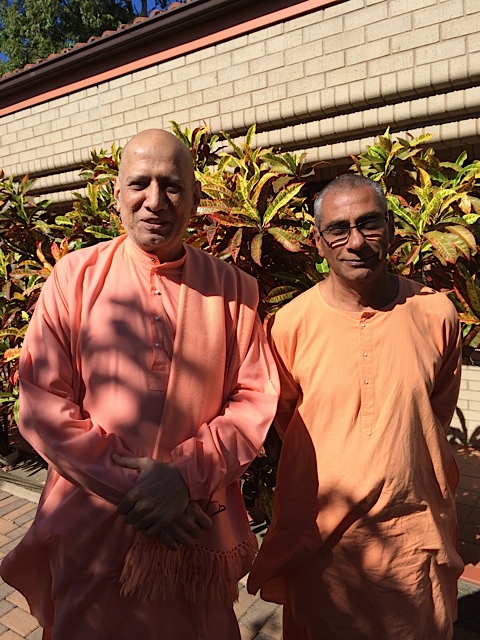
Swami Chandikananda (right) with me…
In my intro, I traced the Vedic system of life of an individual spanning the four ashramas and sannyasa being the fourth and ultimate ashrama that enriches one’s last leg of life called a journey towards the Goal. One person getting into sannyasa ashrama would make his family’s seven generations in the past and seven generations in the future be endowed with progressive spiritual life. Wherever Chandikananda would stay and travel, he would spread the fragrance of thoughts of the principles of Vedanta as exemplified and enumerated by Master, Mother and Swamiji. His life would be an example to all those who aspire to reach the last stage of Vedic life. I then requested him to address the satsang audience.
Swami Chandikananda while thanking our Centre for all the kindness extended to him, gave a short account of his recent pilgrimage to India. He explained how on the cold shivering night of Maha Shivaratri, he and sixteen other brothers from various parts of India had gathered at the bank of river Ganga in Hardwar and went through the initiation ceremony. The ceremony included an half an hour standing in the icy waters of mother Ganga while the mantras were being chanted. When the ceremony was completed he put on a warm jersey that was, he nostalgically recounted, presented to him lovingly by his GurudevSwami Shivapadananadaji many years ago.
He felt blessed when the ochre robes were presented to him by his sannyasaguru Sri Swami Vishwatmanandaji Maharaj, the Mahamadaleshwar of Sadhana Sadan, Rishikesh. In this connection he also felt elevated in spirits when he found the robes were handed over to his Guru by one of the senior monk of the Ramakrishna Mission, Kankhal who remained there for the ceremony. He expressed his gratefulness to all the monks of the Ramakrishna Mission, Kankhal who extended all help.
Pilgrim’s progress
Thereafter he enjoyed solitude at our Dehradun ashram which is situated amidst beautiful woods. He did stay in Belur Math also where he had the opportunity to meet all the senior Swamis. Most Revered Swami Smarananandaji Maharaj, the senior Vice-President of the world-wide Ramakrishna Order blessed him during his stay by giving him audience three times.
He also reminisced his experience in attending a rural celebration of Master’s birthday function in Tamil Nadu when he visited our Coimbatore Educational complex centre. Swami Abhiramanandaji, the Head of the Coimbatore Mission, who endeared himself to South African devotees here during his recent visit, asked him to hand over a Cow to a poor family. In Thiruvanantapuram, he visited a few traditional temples too. In this India pilgrimage he covered other places of pilgrimage like Bhubaneshwar, Puri, Varanasi, Vrindaban, Belur Math, Chennai, Bangalore, Hyderabad also.
———————————————————-
Here is a slideshow of five pictures of Swami Chandikananda at the Ramakrishna Centre of South Africa Durban main centre during his reception on 26th April 2014.
Today is varuthini ekadashi when Lord Vishnu is worshipped in His avatara form as Vamana. Hence I pay my loving homage to one sadhu of our Order who was an ardent devotee of Sri Hari.
Swami Purananandaji Maharaj, a spiritual torch – Image Courtesy: Dr J S Shukla, Kanpur
SwamiPurananandaji (Sunil Maharaj) passed away on 12 February at 2.15 am at Seva Pratishthan, Kolkata. He was 84 and had been suffering from chronic kidney disease and diabetes for some years.Initiated by Swami Shankaranandaji, he joined the Order in 1951 at Belur Math and had Sannyasa from his Guru in 1961.Besides Belur Math, he served at Patna, Mumbai and Gol Park centres as an assistant, and Kanpur, Mauritius (for a short period), Puri Mission, Cossipore and Barasat centres as Head. He had been living a retired life for about six years at Gol Park centre.The Swami was a good singer and an impressive speaker and was known for his gentlemanly manners.Soft spoken and amiable by nature, he endeared himself to all those who came in contact with him.
– Source: Belur Math website
About a sadhu
from nondescript to nonpareil
Even after seeing many deaths in close proximity during my more than four decades of organisational life (all along I was somehow posted in hospital centres), the inevitable always holds my attention in a mysterious manner. The news of the passing away of the respected Swami Purananandaji Maharaj made me more introspective.
It was my good fortune that by the grace of our Master, I could join Kanpur ashram and could live, albeit a short four and half years, with a sadhu who appeared to be unparalleled to me. I asked him before leaving for my learning at Brahmacharins’ Training Centre to tell me about some of his personal anecdotes before he came into the Order. He said sweetly that I should not bother about knowing of his past as he was merely a nondescript.
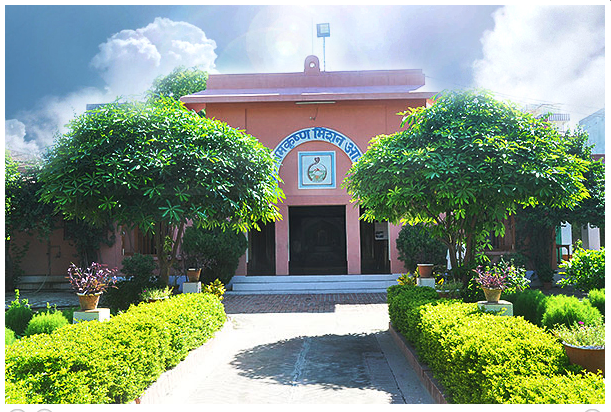
Kanpur Ashram temple…
If he was really nondescript as he claimed, the Order then made him nonpareil. The foremost characteristic of this sadhu that comes to my mind is his utterly humble nature. When I would in my audacity comment on his humility as bordering the vaishnavite, he would never fail to rejoin “How can I explain the joy of Harinam?”. It made sense to me much later that unless one gets the joy in repeating the name of God, humility can never be one’s possession.
Learn from living
As a new entrant into the Order, I was as often happens asked to take up the puja work to develop devotion to Master. There was an elderly Pujari Maharaj who needed assistance too. He was an expert in the art of decoration of the holy altar. Performing puja in the shrine gave me immense satisfaction. And Purananandaji taught me the intricate rituals only after I learnt by heart all the puja mantras. It was a joyful experience to learn under him as he would not only explain the rituals but also expound the inner meaning of those rituals.
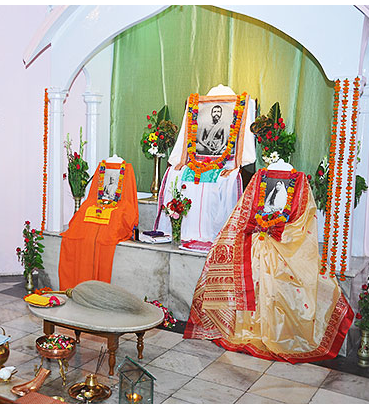
The beautiful shrine of Kanpur ashram
One day after the lunch prasad, when I had retired to my room for the usual quota of noon siesta, I heard a knock on my door. It was highly sultry in the summer, and as there was no electricity the fan could not be turned on. So with just a ‘gamcha‘ around me I opened the door. There he was standing. He was the Head of the centre during those days. He asked me “Would you mind please going to the Bank now as some urgent matters have to be attended?” I replied, “Maharaj I am only a Brahmachari. Why should you be so polite to tell me like this? Just please order me and I would gladly do any work at any time.” His humble way of not disturbing a Brahmachari after the lunch hours made a deep impression on me.
A discussion came up at one night class among the brahmacharins as to what one should pray. Obviously every one agreed including a few senior sadhus that we all should pray for only devotion, detachment and knowledge. It was Revered Maharaj who pointed out that we should also ask for secular knowledge – only to that extent which can be put to use in the performance of Master’s work.
Taste of Tulsidas
Hindi was not my subject in school days. Hence I found it hard to communicate with devotees and also the public who frequented our Kanpur ashram. Those were the years when there was not only an apathy but also some sort of ‘hatred’ towards speaking English in public places. Understanding my difficulties, Revered maharaj taught me the conversational Hindi very quickly.
He made me go through the writings of Sri Hanuman Prasad Poddarjiwhose articles used to appear in the famous monthly magazine Kalyan published by the Gita Press. I think I have not come across any other person, writing on spiritual subjects, in Hindi so clearly, in a simple style and understandable even to the learners of Hindi. They were fascinating in meaning as well as in the use of language. I found joy in learning the language by studying the magazine! Even today by the munificence of Sri Nandlal Tantia, one of our devotees in India, I receive a copy of the Kalyan every month by post!
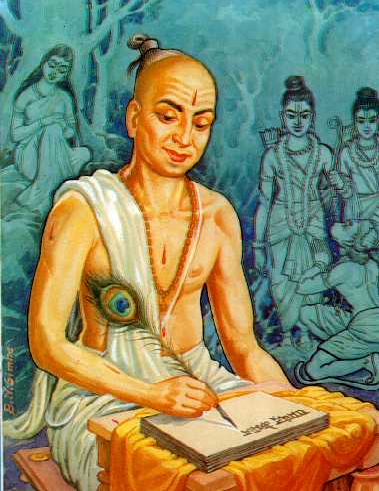
Saint Sri Tulsidasji
I noticed that Revered Maharaj had scholarly interest in Tulsi Ramayan as well as in Adhyatma Ramayana as he was equally facile in Hindi and Sanskrit. I would avidly attend all his classes at the Kanpur Ashram’s beautiful shrine hall as they would open to me the doors of insights into the scriptures. One thing I could understand was this: the words of shastras have always an internal meaning that can be communicated only when a person is a sincere sadhaka. A scholarly exposition many can make (I felt it was like eating saltless meal!) but revealing the spiritual import is possible only for a profound striver. His set routine to sit and meditate was a classic example for all the brahmacharins there.
For the first time I heard from him about a saint by name Sri Ramkinkarji. I am eternally indebted to this Swami for this generous act of goading me to study the books of Sri Ramkinkarji. Effortlessly I became a ‘fan’ of him because his fabulous explanations ‘fanned’ my interest in learning a few concepts from the Tulsi Ramayan. They help me in my personal spiritual practices.
Later from Ranchi I used to visit Gol Park centre in Kolkata only to see Revered Maharaj and whenever it was coincided, I would not fail to attend his class. He was of course greatly pleased with my presence and would always tell other devotees painting me in the most (undeserving) glorious terms!
mahaprasad mahatmyam
I had an opportunity to visit Puri when he was the Head of the Mission branch. Undoubtedly he was very pleased to have me at his centre. He instructed the respected Ashram Panda to take me for the darshan of Lord Jagannatha. I thanked Revered Maharaj for all the arrangements that he did for me and quipped to him that he was in the right place as he was a vishnu-bhakta! He replied solemnly that Lord Jagannatha in His infinite mercy brought him there to savour His mahaprasad daily. He explained to me at that juncture about the utmost veneration that Master and Mother had for Jagannath mahaprasad. So forceful was his narration that it made deep impression on my mind. Even now staying in far away South Africa, I do partake one or two dana (grains) of that mahaprasad which is also called ‘Nirmalya’.
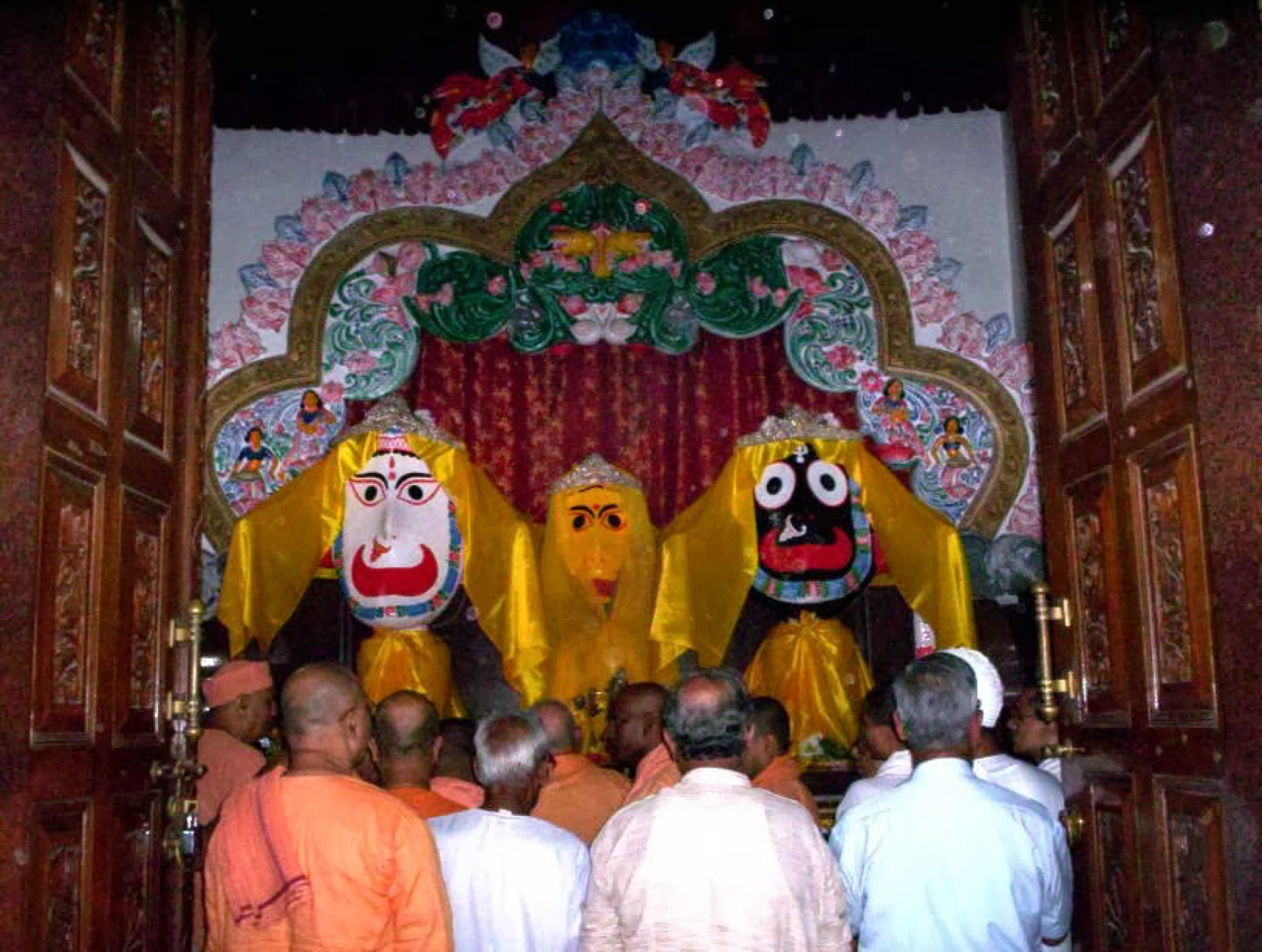
Sri Jagannatha Swami, the two siblings – Subhadra and Balabhadra at Ranchi Jagannatha Temple
Whenever I would come to Kolkata from Itanagar or when I was posted in Seva Pratishthan in Kolkata itself, it was my pleasure to be with him in Cossipore and spend at least three nights there just to have his holy company. The conversations were never of worldly nature but always centred around Master, Mother and Swamiji.
Listening pleasure or pain?
Once I travelled to Mumbai from Itanagar. I was there in connection with the import of some medical equipment that had to be taken delivery of at the airport. At the ashram the Swami was happy to receive me and showed me my room. Somehow I would rush from my work before the evening arati started only to listen to his mellifluous singing. During my Kanpur stay I had really enjoyed his singing style which was layered with his love for the Master.
This slideshow requires JavaScript.
So I just lamented to him saying that how I was deprived of the listening pleasure while the Mumbai devotees were blessed to hear him day in and day out! In his unique jocular way he smilingly replied that after finishing two or three songs, he would just turn around to see whether devotees were pleased or not and invariably they would sport a broad smile by which he understood that they had enjoyed his music. Only after a long time, he added covering his mouth by his palm, that he realised to his dismay the smile on the devotees’ lips was not due to their liking his singing but to the reliefthey felt whenhe concluded his singing!
It took me some time to understand why my mind during my visits to Kolkata would not be set at rest until I met him. I would often wonder whether our generation could rise to such high levels of humility, practice of swadhyaya (self-study) and above all in pouring unbounded love to the recalcitrant juniors!



 Vedanta in Practice