A Micro-Blog from Swami Vimokshananda – earlier at Durban, Singapore and Dublin – now at Yelagiri Hills, Tamil Nadu, India – "A private diary for public consumption!"
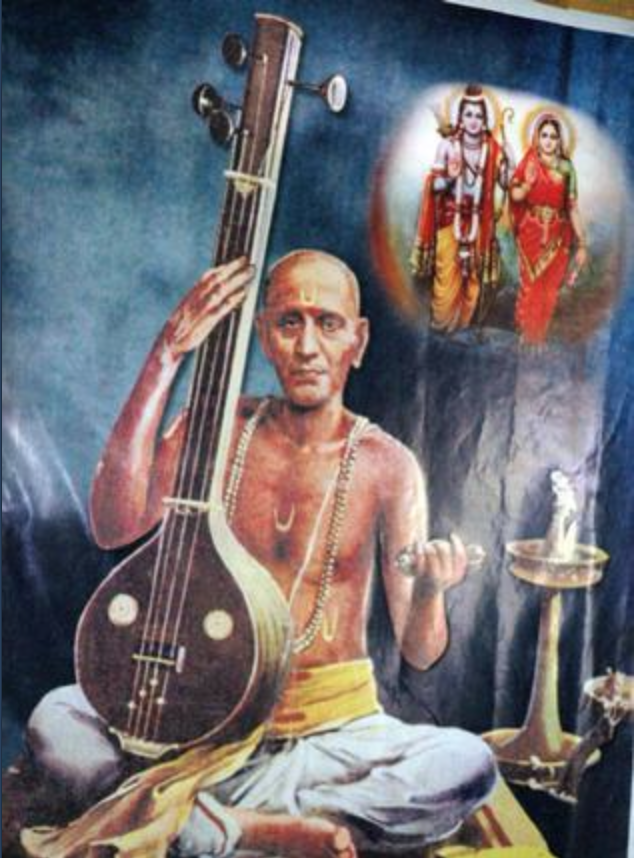
Bhagawan Shri Rama and Mother Sita flanked by brothers, rishis and devatas…Courtesy: Sri Ramakrishna Vijayam, the Tamil monthly magazine from Chennai Ramakrishna Math
“Ram Ram!” is a religious way of greeting one another generally among the Hindus in all the Hindi-speaking areas in India. I noticed this when I was living in Kanpur and also while travelling in many places of North India. In this country too, our South African devotees have a way of greeting one another with “Aum Namo Narayanaya!“.
Taking the name of the Lord at the start of every aspect of our activity is indeed a spiritual method well recognised and advocated by our sages and saints. We, as devotees, in spite of our good intentions tend to forget His name. It is in this context that we are advised to utilise the naama as a tool to further our quality of spiritual life. Some reflections here!
On this auspicious Shri Rama Navami period beginning from 31st March to 8th April, my hearty greetings to every one of you : ‘Ram Ram!‘
Verve and vigour
Yesterday the Rama Navami parv began with all solemnity at the ashram and its branches. The celebration generally continues from the first day that is this year from 31st March and completes on 8th April on the holy navami tithi.
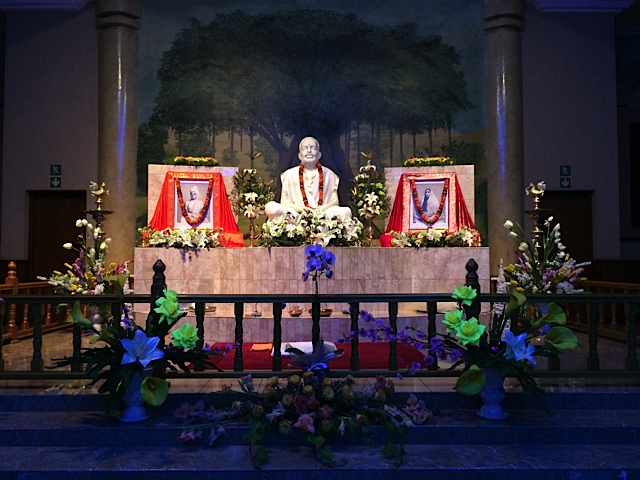
Satsangs here have a definite pattern. Every evening a large number of devotees attend who sing bhajans and kirtans. Selected passages from Sri Ramcharitamanas are recited every day. The temple altar stands decorated beautifully. The devotion of the devotees is worth noting; what a verve and vigour in singing bhajans! And faith and fervour in performing worship! And the day-long fasting and sitting in the temple for such long hours – absolutely maintaining utmost discipline – no chitchat, no gossip and all are tuned to the discourses and songs.
Tale of Two letters!
In my first-day discourse at the Glen Anil temple the point that such a short two-syllable name ‘Raa Ma‘ has in due course of time acquired a powerful connotation came up for discussion. Speaking on the subject “Ramayana – the Scripture Par excellence”, I explained how the famous saint Tyagaraja has remarkably pointed out the significance of the name “Rama“.
“Ma” is the very life of the Shiva mantra,”Ra” is the very life of Vishnu mantra. The Shiva mantra refers to the famous one called panchaakshari (five-lettered) mantra : Aum namasshivaaya. The Vishnu mantra refers to ashtaakshari (eight-lettered) mantra : Aum namo narayanaya. If we think deeply it will be clear that without these two syllables the two respective mantras loose all meaning.
Take out “Ma” – the mantra will read now na shivaaya – nothing auspicious! Take out “Ra” – the mantra will read na ayanaaya – no royal road!
Hence these two syllables “Ra” and “Ma” become the life force of these mantras. They are called beeja (seed) and hence by constantly repeating any of these holy mantras, the beeja would one day start sprouting, which means to say that the significance of the mantra would become clear like daylight. The word ‘Rama‘ therefore represents the power of Lord Shiva and Lord Vishnu together! Saint Tyagaraja takes delight in telling us that he would salute those great men who understand this detail !
Less is equal to more!
There is another way of looking at the glory of the name Rama. The single word is equal to one thousand names of Lord Vishnu!
“O Varaanana (lovely-faced woman), I chant the holy name of Rama, Rama, Rama and thus constantly enjoy this beautiful sound. This holy name of Ramachandra is equal to one thousand holy names of Lord Vishnu.”
Worthy name without love?
Sri Ramakrishna advises that the name of the Lord is no doubt highly proficient capable of providing Divine realisation. But Master asks, “is it sufficient without Love?”. Master continues, “the soul must hunger for God. What will it avail if I repeat His ‘name’ while I allow my mind to be attached to ‘woman and gold’? Mere muttering of magic incantations will not heal up a scorpion-sting. You must also apply the smoke of burning cow-dung.”
Swami Gitanandaji was born in Arial village of Dhaka district (now in Bangladesh) on 17 April 1924.
An initiated disciple of Swami Virajanandaji Maharaj, he joined the Order at Chennai Math in 1946, and had Sannyasa from Swami Shankaranandaji Maharaj in 1956. Besides his joining centre, he served at the Headquarters and Kanpur centre as an assistant and Ranchi Sanatorium, Varanasi Home of Service and Kankurgachhi centres as head. He also served Swami Virajanandaji Maharaj as a personal attendant, and was a Secretary to Revered Shankaranandaji Maharaj for some time.
In April 1973, he was appointed a Trustee of Ramakrishna Math and a Member of the Governing Body of Ramakrishna Mission. In June 1974, he was elected an Assistant Secretary of the twin organizations, and in April 1975, he was elected Treasurer of the Math and Mission. In 1985 he was re-elected an Assistant Secretary in which capacity he served for a decade.
He was elected a Vice-President of the Ramakrishna Order in April 2003, which office he held till the end. During his spiritual ministry, he blessed many devotees with mantra diksha (spiritual initiation) in different parts of the country. He has two Bengali books to his credit: Sri Ramer Anudhyan (Contemplation on Lord Rama) and Bhagavat Katha (Selections from the Bhagavata).
–source: Belur Math Website
The Kanpur-connect
The news of mahasamadhi of Most Revered Gitanandaji reached me in the morning of 14th March when I opened my laptop to check my emails. Bowing to him mentally, I re-read the news. Immediately my mind was occupied with nostalgia about my brief joyful association with this holy monk.
Widely known as ‘jaapak sadhu’, he was a veritable inspirer in our spiritual life. The very first time I met him in Belur Math at the start of my Training Centre session, he lovingly enquired about my stay at Kanpur. He was once working as Assistant Secretary in the Kanpur ashrama. I told him that the shrine in that ashram was exceedingly beautiful. He then went on telling me how he would love to do his sadhana in that shrine where he found Master ‘living’.
Due to perhaps ‘Kanpur-connect’ there was no bar even if I go and sit at his office just to exchange a few loving words. He was one of the Assistant Secretaries then. I was able to go to his room too whenever I was pleased to. In those out of office hours, I had found him in his room sitting straight, doing japa with his mala in his hand. The screech of the door opening would make him realise that someone was in and slowly as if he was awakened, he would so welcomingly invite me to take my seat. There was not a single time I found any expression of “you fellow disturbed me”!
The Telling Tears
Two times in my association I had seen his tears flowing down his cheeks. The first time I was stunned at his shedding tears. I innocently enquired of him whether he was finding any physical discomfort. He affirmed no and said that the only discomfort was that he could not do ‘enough’ japa!
The second time was a memorable travel with him in the same car from Jamshedpur to Ranchi Sanatorium. I should mention here that he was once the Head of Ranchi Sanatorium and my being Head there somehow brought me closer to him as I would always convey the pranams of the old employees especially of the tribal ones for whom he had great love. In the car of course his Secretary was also present. As I knew that Revered Maharaj was fond of stories of Shri Ram, I picked up the subject of his then recently released Bengali book on Shri Ram. I did read it and I could start the discussion on the relationship that Shri Hanuman had with Shri Ram. And in a childish way I asked him whether he knew that once Shri Ram was about to ‘kill’ his greatest devotee Shri Hanuman.
I could see his face on the front small mirror of the car instantly changing pensive. “Tell me, tell me” he quickly responded with perhaps some sort of anguish. He exclaimed loudly how Shri Ram could even think of annihilating his own servant-devotee Shri Hanuman! Lo! It was impossible! Continuing the story I built up the climax scene when Shri Ram had strung the brahmaastra onto his bow and that he was just ready to aim on his ‘dearest’ target, tears swelled in Revered Maharaj’s eyes and he could not stop sobbing! His Secretary and self were just amazed at the emotional involvement of Revered Maharaj had while listening to the story where he could not ‘accept’ the fact that Shri Ram would kill Shri Hanuman. Of course the story as usual had a happy ending with Shri Hanuman being embraced by his Lord Shri Ram. He was greatly relieved at the turn of the events in that story and he was much appreciative of this wonderful legend.
A Treat to Tribals
One more thing that touched my heart about him was his loving nature towards tribals. At Ranchi Sanatorium he would sit on a bench kept outside in the entrance verandah. Next to him would be our Durga maharaj. But both would remain silent and would not have any conversation for a long time. While Durga maharaj would be immersed in his loving prayers, Revered Gitanandaji would continue in his japa in spite of the cushioned sofa set kept apart for the ‘Vice-President’ in the lounge. If pointed out by any monk, he would assert that he was happy to sit in a bench. Then quickly he would ask that monk whether he was keen in ‘his’ happiness! The monk had no other option but to allow his own way.
Besides the treatment facilities for the TB patients, the Sanatorium had by then expanded into many types of rural development activities wherein the tribal – old men and women and also children – getting direct benefits. I took him to some of the nearby villages where he was extremely happy to see those old people whom he knew personally. He was charmed at the welfare measures that go directly to the service of the poor. He encouraged all of us to perform these welfare activities thinking that Master and Mother are being served.
Indeed he was always an inspirer to the monks and brahmacharins.
——————————————–
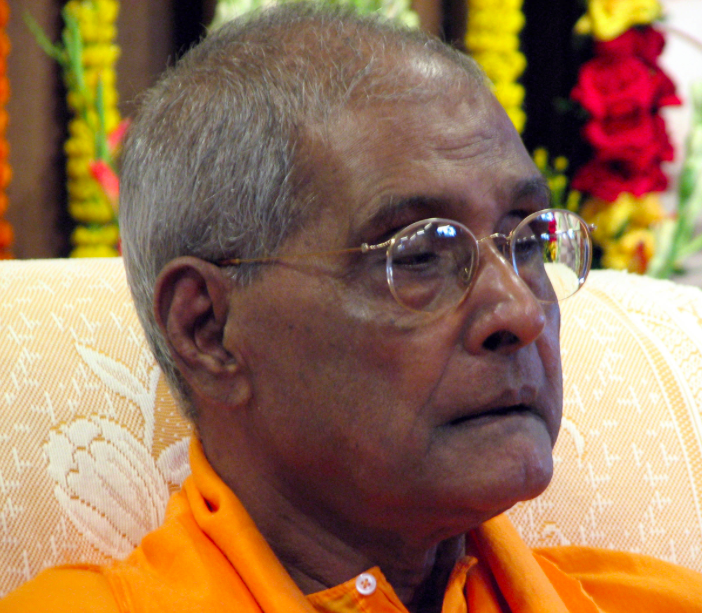
Here is a slideshow of four pictures of Swami Gitanandaji when he visited Ramakrishna Mission TB Sanatorium on 19th September 2004.
It is easy to do great deeds, the deeds that bring name and fame. But it is by his small, everyday actions that a man’s character is known. The true karma Yogi does not work to gain publicity. No matter how insignificant his work may be, he throws himself wholeheartedly into the task, because, for him, his work has become worship of God.
Life, like a stream, is ebbing fast away. The day that is once gone can never be recalled. Make the best use of your time. If you leave it to the last moment, it will be too late to cry, “Alas, alas!”
– from The Eternal Companion
A fort of protection
The reason why I was reminded today of this quote from the famous Ramakrishna-Vivekananda devotional literature is the news of the demise of one of the senior devotees from Ranchi. He was Ranjit Sinha. My Gurubhai too. Rather his entire family had mantra-diksha (initiation) from my Gurudev.
I don’t think I have sufficient words to soothe hearts of his wife and daughters as I myself beset with grievance. He was indeed a fort of protection not only to the immediate family but also to many monks and brahmacharins. His influence as I had seen him in Ranchi and elsewhere made a palpable effect on every one who came into contact with him.
What I understand now is that he passed away with peace in the heart. He had an inexplicable feeling of his closeness with Holy Mother and Ma would take care of his soul. I recall several meetings with him on many an occasion, his discussions about our Gurudev and what a tremendous faith that he had on him! Well, as a monk I would wonder in those days and continue to do so even now, if only I had one tenth of this house-holder’s faith!
The greatest surprise
In Mahabharata, the narrated story about Yudhishthira is a case in point. When the Yaksha asked him what was the greatest surprise, Yudhishthira replied that so many people die everyday. Yet, human beings want to somehow avoid death. That, he said, was truly surprising. Knowledge again and again gets eclipsed by ignorance!
I don’t know how all my Gurubons (Guru-sisters – his wife and three daughters) are coping with. One thing I am sure is that in spite of the irrepairable loss, they would see through the impermanence of this world and its beings as his entire family was nurtured on spiritual insights that he generously provided especially influenced by the spiritual teachings of Swami Brahmanandaji.
His home looked a veritable temple. Not only he saw to the external neatness of the place but also insisted upon noble vibrations of thoughts. “The Eternal Companion” was his favourite book. He used to discuss passages from this book with me and we both would forget how the time passed. He would never let go an opportunity to serve sadhus.
‘Preferred treatment’
However, is ‘Death’ to be dreaded or be desired? How many can get a host of monks and brahmacharins around them during death? Here is the touching account of one of his daughters who wrote to me in detail the ‘preferred treatment’ that her father got. Was this due to his extraordinary devotion?
“He was on ventilation since 29th Nov ’13. He was taken to Morhabadi ashram at 9.30 pm and 10-15 sadhu-brahmacharis chanted shanti mantras and Revered Shashankanandaji offered charanamrit and Thakur’s nirmalya. On reaching home at 10.30 pm we found 3-4 Swamijis including Revered Prayag Maharaj from Sanatorium were already waiting. They then recited verses from Bhagawad Gita. At 2 am we all started for Kolkatta for cremation at Cossipore Ramakrishna Mahaasmashaan (Grand Cremation-ground). We arrived there by 11.45 am and to our surprise we found therein Srimat SwamiVagishanandaji Maharaj waiting for us.
I had briefed him about baba’s condition on 20th morning itself and to my surprise he asked me what you intend to do for his cremation and he said “Raater journey te ektu kosto hobe taachaara sob thik hobe” – There will be a little difficulty in night journey but everything will be alright. I said, “Maharaj, baba is still alive!!”. But he said nothing. Evening around 6 he again rang me up saying “Shibani ratre ektu kosto hobe tobe tuee niye chole aasis. – There will be a little difficulty in night journey but you bring him.”
And at 7 pm my father passed away.
All rituals were done there under Revered Vagishanandaji’s supervision. From 11.45 am to 5.30 pm he was there till his asthi visarjan (ash-immersion) in Ganga. It was due to the Divine presence of a very senior monk who is also Trustee of the famous Belur Math that we all including my Mother overcame our greatest loss.”
What a glorious divinely demise that this wonderful devotee had!
December known as ‘silly season’ aptly or not, is a month of merry-making with holidayers dotting different places around the globe. Children and equally elders too, joyfully look forward to the prospect of school-closing followed by festival-booms and the most eagerly expected New Year. They tire themselves out with routine partying extending to midnight on the 31st December. They are overwhelmed too receiving gifts galore.
And finally the New Year peeps in. At the stroke of midnight bells, unperceived by many in the din and bustle of all the hullabaloo and unmindful of the karmic effects that this same New Year is going to thrust upon. Year by year may pass; none can escape from the karma–phala – the fruits of action. So the old saying ‘as you sow, so you reap’ stares at the face as time rolls on. The moments of despair gnaw each one of us. Fortunate are those who are brought under the gracious umbrella of divine personalities. They are made to realise what is the ultimate purpose of life that meanders sans any meaning.
Saving Message
In Ramakrishna tradition, the beginning of the New Year brings in a new awareness of our goal. The moving incident that happened on the 1st of January in the life of Sri Ramakrishna is still a beacon light to all his followers over the globe. That day, every year is called Kalpataru Day. The message of Master on that day was “may you all be illumined”.
He was undergoing treatment for throat cancer. He came down the stairs on the 1st January, 1886 and started moving in the lawns. Many devotees had assembled there. They bowed down to Master.
To Girish, the Master said, “Girish, what have you seen that makes you glorify me publicly before one and all?” Girish at once fell at the Master’s feet and said with folded hands and choked voice, “What more can I say of Him, even a fraction of whose glory Vyasa and Valmiki miserably failed to express in their immortal epics and Puranas?”
Master heard these words of Girish, Seeing the divinely illumined face of the Master, Girish cried out joyously, “Glory unto Ramakrishna! Glory unto Ramakrishna!”. The Master looked at all present and said smilingly, “What more shall I say to you? May you all be spiritually awakened!”
Kalpataru Tree of Grace
How and when can this Kalpataru grace turn our own life towards progress in spiritual life? Undoubtedly, unconditional is the divine grace. Yet, in our heart of hearts, we do feel that without some sort of readiness to receive the grace, we make ourselves unfit for it. Why not we take a Resolution – a strong one at that – to attend satsang once in a week faithfully and uninterruptedly ? Let us begin with this one.
Kasipur event reminds us to go beyond the physical episode and makes us deeply think about its spiritual implication. If this was valid on that day, it is still valid today.




 Vedanta in Practice