Vedanta in Practice

A Micro-Blog from Swami Vimokshananda – earlier at Durban, Singapore and Dublin – now at Yelagiri Hills, Tamil Nadu, India – "A private diary for public consumption!"

  • To any blogger, queries from readers are indeed valuable. ‘Comments’ section in blogs admirably fulfills the need by actually facilitating two-way communication between the writer and the reader. I try to answer many of the queries that come to me as response to what was written earlier in this Blog.

    It is not uncommon also to get fresh queries unconnected to any of the Posts that I wrote. Perhaps the reader feels a sort of comfort in asking those questions that are not discussed about but indirectly reading my responses written with a personal touch, is encouraged to ask.

    Recently AG, one devotee-reader (?) (because I do not know yet this person!) asked a one-line query:
    “Is it true that morality has nothing to do with Divinity?”
    Why this question arose in her mind was because she “was told this by another…..on Facebook…”. Fair enough! 

    I am giving below what I replied to her.

    Dear AG-
    According to Vedanta, the Divinity is within us and is pure, untainted, immutable, etc. Therefore, no karma, good or otherwise, will affect it. It is thus easy (most of the times wrongly) to conclude that there can be no connection between morality and the divinity of the soul.

    1. From the point of view of sadhana:
    Sri Ramakrishna does not tell us so. A man who led an immoral life still said that his soul could not be affected in any way, giving the above principle as defence. Sri Ramakrishna was irritated ‘I spit on that Vedanta that teaches so!’

    2. All our great Teachers and spiritual luminaries were men and women of great moral and ethical standing. In fact, one may say that their greatness lay in no small measure upon their moral basis of their existence.

    3. It is therefore that we find in the ancient Upanishads, Gita, Ramayana, and the modern scriptures like the Gospel of Sri Ramakrishna, etc, such an emphasis on right conduct.

    4. In the Yoga Sutras of Rishi Patanjali: Yama and Niyama (the do’s and don’ts of spiritual life – the basic moral code of conduct) are presented first, and then only the the other steps (asana, etc ) follow.

    5. The recommended steps in any spiritual practice does nothing more than reveal the Divinity that is hidden from us. Just as scum covers the surface of the pool and we cannot see the water, so too ignorance / attachments / desires /actions (good / bad) / egotism, cover the atman. Sadhana is a means of removing ignorance – as much as one sees the clear water only when the scum is removed.

    6. The instruments to do this are the very same instruments that will bring about release from the samsara chakra – cycle of births and deaths.
    Cf: the chariot image in Katha Upanishad. The soul is the master of the chariot, the body is the chariot, the intellect is the charioteer, the mind, is the rein.
    In the ordinary being, as Swami Yatiswarananda says (in Meditation and Spiritual Life – I hope and wish that you must get a copy through RH) that the soul is drunk; intellect, the charioteer, has fallen unconscious; the reins, the mind, have become slack; the horses, the senses, are running wild. And a great disaster awaits .
    Unless we do something. That is lead a controlled life based on moral principles.

    7. Our natural tendency is for us to revolve towards the world… for gain, name, fame, etc. When we turn away from this tendency, then begins religion and morality (Swami Vivekananda ~ : Non-attachment is complete self abnegation)

    8. That which is selfish is immoral, and that which is unselfish is moral.

    9. All great teachers and social reformers had this in common — all were unselfish; had turned away from their little self to the rest of the world identifying with the Universal Self.
    -Swami Vivekananda

    Swami Vivekananda

    According to the Advaita philosophy, the differentiation of matter hide the real nature of man; but the latter really has not been changed at all. In the lowest worm, as well as in the highest human being, the same divine nature is present. The worm form is the lower form in which the divinity has been more overshadowed by Maya consisting of the three gunas; that is the highest form in which it has been least overshadowed. Behind everything the same divinity is existing, and out of this comes the basis of morality.

    “Do not injure another. Love everyone as your own self, because the whole universe is one. In injuring another, I am injuring myself; in loving another, I am loving myself.” From this also springs that principle of Advaita morality which has been summed up in one word – self-abnegation.

    The Advaitin says, this little personalised self is the cause of all my misery. This individualised self, which makes me different from all other beings brings hatred and jealousy and misery, struggle and all other evils. And when this idea has been got rid of, all struggle will cease, all misery vanish. So this is to be given up. We must always hold ourselves ready, even to give up our lives for the lowest beings. When a man has become ready even to give up his life for a little insect, he has reached the perfection which the Advaitist wants to attain; and at that moment when he has become thus ready, the veil of ignorance falls away from him, and he will feel his own nature. Even in this life, he will feel that he is one with the universe. For a time, as it were, the whole of this phenomenal world will disappear for him, and he will realise what he is.

    All that we call ethics and morality and doing good to others is also but the manifestation of this oneness. There are moments when every man feels that he is one with the universe, and he rushes forth to express it, whether he knows it or not. This expression of oneness is what we call love and sympathy, and it is the basis of all our ethics and morality. This is summed up in the Vedanta philosophy by the celebrated aphorism, Tat Tvam Asi, “Thou art That”.

    Lord is pure; therefore those who have this sameness for all, and are pure, are said to be “living in God.” This is the gist of Vedantic morality – this sameness for all.

    May Master be with you and bring you peace and prosperity!

    With love and best wishes
    Swami Vimokshananda

  • Points to Ponder

    To a practicing ‘mild’ Hindu in our country, modernity presents multifarious challenges. South Africa, being a rainbow nation, is particularly, in a unique position, where society with diverse races and religious beliefs, is trying to balance tumultuous lifestyle changes with the traditional family values. How problematic ‘parenting’ can actually be is anybody’s guess.

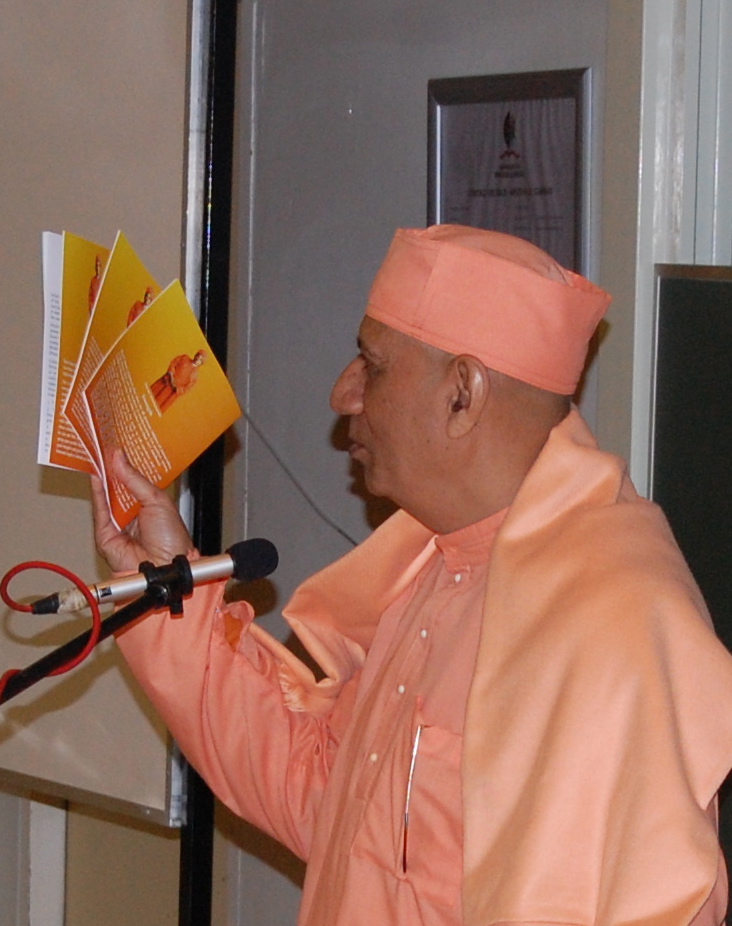
    The present Post is reproduced from a booklet on ‘Parenting – A Hindu Perspective’, containing articles on many interesting Hindu ideas on parenting skills. It was freely distributed to the delegates who attended a seminar hosted by Sri Sarada Devi Ashram, Asherville in commemoration of Holy Mother’s 156th birth anniversary celebration at KZN University on Sunday, 13 December 2009. It was a great success with 500 delegates from even distant places attending with enthusiasm. I was given the honour of releasing this booklet on that important occasion. My grateful thanks to Sister Pravrajika Ishtaprana mataji.

    Healthy balance?

    First let us see the dynamics of parenting with regard to individuals who constitute a ‘family’. The adults in very many cases make themselves the focal point of their attention. Parents who are prisoners of their own predilections such as careers, extra-marital relationships, or just in their own heads all of the time, often have lonely, depressed children who doubt their parents’ love and affection.  Studies have already shown a very high percentage of teens experimenting with drugs and alcohol are from homes where the parents are too self-absorbed to notice or to pay attention to what is happening with their own kids.

    On the other hand, let us consider the sacrificing parents whose uppermost aim is the greater good of the family. This dynamics becomes the breeding ground to resentments and underlying tensions found in most households. In their enthusiasm, the adults often give up their dream jobs, drop out of higher education, or stop having a social life outside of the family. Because, at some point along the way, it perfectly seemed to provide the probable answer to some predicament. For whatever reason, there is no time, energy, or money left for the adults even to visit temples and ashrams when all is said and done. The parents unwittingly try to become martyrs to their kids or ‘The Family’.  Indeed, It is very difficult for the parents to find a healthy balance between these two extremes.

    Inter-connect disrupted?

    Take another scenario. How many times we hear that the children should always come first – at any cost. Well, this has too a negative effect. Children who are raised to be the blue-eyed favorites, grow up to be adults with a firm belief that they have a rightful place as the center of everyone else’s universe too. Is it fair to teach the children that they are more important than everyone else?  Don’t they become self-esteemed monsters and bullies? The world out there is going to teach them a very different lesson. People will not like them no matter how special Mommy and Daddy think they are. What is at stake here is everyone is equal in regards to needs, hopes, dreams, responsibilities, and other aspects of getting along in the world. Madhu’s need to jump, run and play is in no way less than Mommy’s need for mental peace.

    Now what happens when families start focusing on each individual’s needs, schedules, etc.? Parents are busy conducting their own lives while the teenagers are living independent lives – dropping by the house to eat and sleep, communicating only through emails or cellphones. And lo! the little ones are so busy with soccer leagues and music lessons and play ‘dates’ with their friends that they have no real sense of what family is all about. Everyone is happy, busy, flourishing individuals, but ‘The Family’ as a unit has almost completely disappeared; the inter-connection among the members of the family is absolutely lost!

    Safe and Secure?

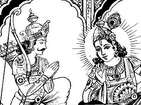
    Is there any remedy? In comes the Hindu perspective of parenting. Though copious examples can be quoted from the vast scriptural literature, I would in brief, like to stress on the first three verses of the glorious Gita as contained in Chapter 16. These verses give us a behavioral dictum that can make every member of the family enriched with the necessary tools to face the challenge of about-turn modernity versus abiding old values.

    Bhagawan Sri Krishna enumerates a total of 26 noble qualities (see box) that can lead each and every one of us to be a responsible citizen of the society. The spiritual view of parenting includes not only the elaborate preparation of wedding, giving birth to children but also the manner in which the children are brought up. Children start learning from the womb. It is essential that would-be-parents adapt their life as per the 26 noble qualities. Then only they would be able to transmit them to their children. These three verses should be read on a daily basis by both parents and children and be given to byheart. Children learn by example, therefore the role of parents is vitally important in their upbringing. A home that radiates love and warmth will automatically make children feel safe and secure.

    Pray and stay?

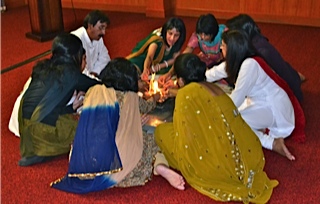
    I have seen some parents very reluctant to talk certain religious subjects and make the children feel that these topics are taboo! Healthy discussions amongst children and parents should be the keynote to every family life. Collective living-in should be cultivated and to begin with, a common daily prayer is of utmost importance in every household: A family that prays together stays together as they say.

    Parents as devotees of the Ashram must ensure that children take note of the activities and allow their children to be familiar with them. They should be encouraged to assist adults in providing meals, clothing, gifts, medical help, etc to the less privileged. A feeling of compassion with humility, and at the same time an overwhelming sense of joy in serving the poor will contribute to the furtherance of the social fabric that will ultimately lead to universal love.

    It is the duty of parents to present a bright and shining example of a morally well-balanced and spiritual living to pave the way for their children to follow.

    ==================================================

    The 26 divine qualities that should be cultivated by every one:
    sri-bhagavan uvaca
    abhayam sattva-samsuddhir jnana-yoga-vyavasthitih |
    danam damas ca yajnas ca svadhyayas tapa arjavam ||
    ahimsa satyam akrodhas tyagah shantir apaisunam |
    daya bhutesvaloluptvam mardavam hrir acapalam ||
    tejah ksama dhrtih shaucam adroho nati-manita |
    bhavanti sampadam daivim abhijatasya bharata ||

    “The Lord said:
    1 – Fearlessness;
    2 – purification of one’s existence;
    3 – cultivation of spiritual knowledge;
    4 – charity;
    5 – self-control;
    6 – performance of sacrifice;
    7 – self-study;
    8 – austerity;
    9 – simplicity;
    10 – non-violence;
    11 – truthfulness;
    12 – free from anger;
    13 – renunciation;
    14 – tranquillity;
    15 – not fault-finding;
    16 – compassion for all living beings;
    17 – free from covetousness;
    18 – gentleness;
    19 – modesty;
    20 – steady determination;
    21 – vigour;
    22 – forgiveness;
    23 – fortitude;
    24 – cleanliness; 
    25 – free from envy and
    26 – free from the passion for honor —
    these divine qualities, O son of Bharata, belong to godly men endowed with divine nature.”

    ===============================================

  • Vedanta Retreat
  • Master and Mahadeva

    A very happy, auspicious Maha Shivaratri to every one here!

    A few years back, over a cup of cappuccino, one devotee came to meet me. As usual I asked him who was he! And he went on to give an elaborate reply such as that “firstly, he was a devotee of the latest Incarnation who brought the idea of harmony, love, peace and sacrifice to Society – Sri Ramakrishna”. He added that he also presents “a radio program on Hindvani, an Indian community based Radio station in South Africa”. He “had written a Religious Review on Sri Ram‘s Puja method”.

    He in all seriousness continued to say that he was “a schoolteacher by profession – with some thirty years of experience. That is – two generations”. So he proudly announced to me that he has “a fair idea of how the older ones thought, and how the younger ones are thinking now”.

    In a striking way he concluded, “That is how most people see me – from the distance. A closer look – how I see myself – Not just a mass of cells, not just a mind-intelligence complex – but a spark of the Divine. My journey of inquiry is still continuing
    – who am I?”

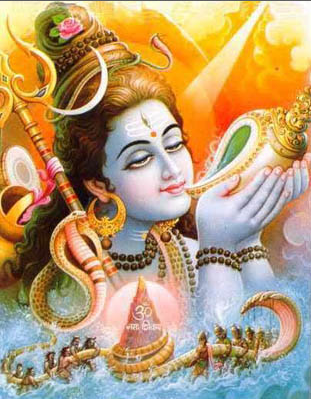
    Yes, its a treat to discuss with him on many philosophical matters and of course English, the language. He does come often to ashram and is extremely helpful in busy Puja schedule of mine. The other day he quickly brought out the charming similarities between Master and Mahadeva. I thought by placing here the same, our minds would be absorbed in thinking about Shiva and Shambhu on this wonderful Shivaratri night !

    “There are many occasions in the life of Sri Ramakrishna that connect him with Lord Shiva.

    In the Shiva Purana, Lord Shiva manifested as a column of light when Lord Brahma and Lord Vishnu were each proclaiming himself as the greatest among the deities. This particular manifestation of Lord Shiva is known as Lingodbhava-murti.

    In Kamarpukur, Chandramani, the mother of Sri Ramakrishna, saw a flood of light emanate from the Shivalinga and enter her body. And she felt that she was with child! Thus, Sri Ramakrishna was born in this age as the lingodbhava, the light of Shiva.

    Sri Ramakrishna was born three days after Shivaratri, on 18 February 1836, a few minutes before the sunrise. Just as at the birth of the incarnation of this age, a light spread over the world, so, even today, the light of knowledge is spreading to every corner of the world, dispelling the hordes of darkness in the forms of ignorance.

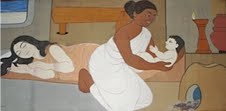
    As soon as the baby Ramakrishna was born, Dhani, the midwife, placed him on the floor to attend to the mother. On turning her attention to the child, she was surprised to find that he had somehow rolled into the fireplace, and was lying there all covered with ashes – like Lord Shiva! If our goal is God, the ashes symbolise the turning away from (or burning of) the sensual, a renunciation of the worldly to attain the spiritual. One Puranic story tells how Lord Shiva burnt to ashes the god of love (that is, sensual delights). Describing Sri Ramakrishna, Holy Mother said that renunciation was the jewel of Sri Ramakrishna.

    Kshudiram, the father of Sri Ramakrishna, named the child ‘Shambhuchandra’, one of the names of Lord Shiva.

    Sri Ramakrishna performed various sadhanas and re-affirmed the validity of each. But he realised Lord Shiva without any effort. When he was nine, Sri Ramakrishna was asked to play the role of Lord Shiva in a dramatic performance on the night of Shivaratri. As he was adorned as Lord Shiva, he soared into a divine consciousness. And the devotees themselves were transported, as it were, to the very abode of Lord Shiva. Sri Ramakrishna remained in that ecstatic state for three days!

    In the samudra-manthana episode, Lord Shiva took in the poison that emanated from the churning of the ocean by the gods and demons to obtain the nectar of immortality. At the end of his earthly life, Sri Ramakrishna had throat cancer. One viewpoint is that it was the result of Sri Ramakrishna’s swallowing the poison of the karmas of the millions of struggling souls who were seeking his shelter. Both drank the poison and kept it in the throat for the welfare of the world.

    Sri Ramakrishna used to say: Jiva is Shiva, and Shiva is jiva. In other words, we ordinary beings are really Shiva but ignorant and bound. Our goal in life should be to reclaim our Shivahood.”

    ================================