A Micro-Blog from Swami Vimokshananda – earlier at Durban, Singapore and Dublin – now at Yelagiri Hills, Tamil Nadu, India – "A private diary for public consumption!"
===================================== Hearty, Happy Diwali Greetings to every dear reader-devotee! May this Diwali lighten up your life, may it lighten down your burden and may it enlighten your intellect and lead you from dark alleys to Lighted path!
I owe an apology to all of you for not meeting you through this blog in the past four months. Well, its not fourteen years as Sri Rama’s exile! To return to blog writing is absolutely not only a pleasure but also a personal e-sadhana for me which I must nourish and cherish. This Diwali post is 101st and barely 2900 hits are required to reach one hundred one thousand hits! Enquiries from ever-loving readers evoke in me enough encouragement and I do hope at least once a month I shall, by His grace continue to visit your inbox without fail! Thanks for your wonderful support in keeping the lamp aflame! ======================================
Five-day Festival
Our world today is at the crossroads. While charity to help the poor and needy is delightfully increasing, it is disconcerting to see the rise of violence – domestic or national, crime, obscenity, corruption and other expressions of ill-gotten wealth. Serious people devoted to God and godly means of living are indeed worrying about the future prospects of their children. Is there, among the gloomy cloudiness, any shiny ray of hope?
It is in this context that the various celebrations that have come to us from time immemorial from the spiritual land of Bharat hold the clue. One of the most loved celebration of all the Hindus the world over, is the Festival of Lights – Diwali, also called Deepavali.
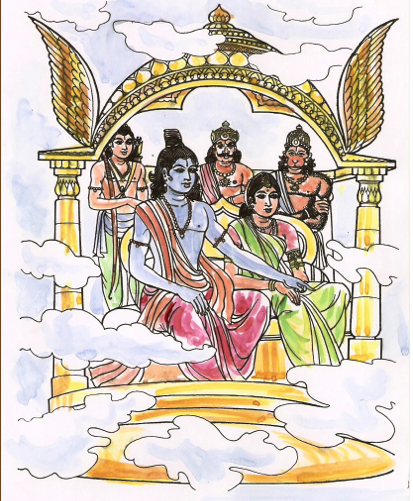
Sri Rama with Sita and Lakhshmana returning to Ayodhya by pushpak-vimaan
Diwali signifies lighting of lamps in every household on the Amavashya night that follows the bright fortnight after Vijaya Dashmi. No doubt this occasion marks joy and merriment. On the Diwali night, rows of lamps decorate the houses and presents are exchanged. Diwali, in the north of India, is associated with the coronation of BhagawanSri Rama when he returned to Ayodhya (in Uttar Pradesh) by pushpak-vimaan after vanquishing the demon King of Ceylon, Ravana on the day of Dasshera. Sri Ram had been in exile for fourteen years and the people were pleased to see and welcome back him with rows of lit lamps.
This festival of five days gives us, Hindus, an opportunity to go beyond all external extravaganza. First day marks Dhanteras meaning the thirteenth day of wealth. It is also called Dhanwantari Triodashi indicating the adoration of Dhanwantari. He is the God of Medicine for the devatas and originator of Ayurveda science. The importance of keeping one’s physique in a healthy way cannot be over stated. As the ancient Sanskrit dictum says, “shareeram aadyam khalu dharma saadhanam” – body is the best means for practising dharma, taking steps to improve one’s health becomes mandatory.
Sri Krishna releasing 16 000 princesses from prison…
From here, with strong body, one has to ascend to the state of strong mind. Thus the second day, called naraka chaturdashi, is the fourteenth day signifying release of 16,000 princesses from prison by Sri Krishna. BhagawanSri Krishna encountered the demon Narakasura and killed him after granting his wish that on his death day people must celebrate with lighting of diya (lamps) in rows, taking oil bath, distributing sweet meats and burning firecrackers. We all do the latter part but do not pay attention in removing the darkness that has come to reside in our hearts! As Swami Vivekananda says, darkness in a sealed room over one thousand years will instantly vanish the moment a matchstick is lit. Knowledge of God is light. The ignorance inside is darkness – a prison. 16,000 women are none but our 16,000 nadis to be liberated from impurity.
If body and mind are kept free from impurities, then only this life can be truly enjoyed. As the Isha Upanishad says “ tena tyaktena bhunjeetaah” – this life can be enjoyed when detachment comes. The mind searches for the purpose of life and it tries to fix the goal. Lakshmi word comes from lakshya meaning goal. Thus the third day which is the most important day of the five days of festival is spent in the worship of Goddess Lakshmi whose dazzling luminosity is represented by rows of lamps. What is the ultimate goal of life? BhagawanSri Ramakrishna clearly spells out the purpose of human birth. He says that a man is born in vain who inspite of having a human body, does not attempt to realise God! In eastern parts of Bharat, Goddess Kaali is worshipped. She is evidently invoked in order that our rakta (blood-attachment) is dried up (swallowed) and our munda (ego-head) can be cut asunder by Her grace.
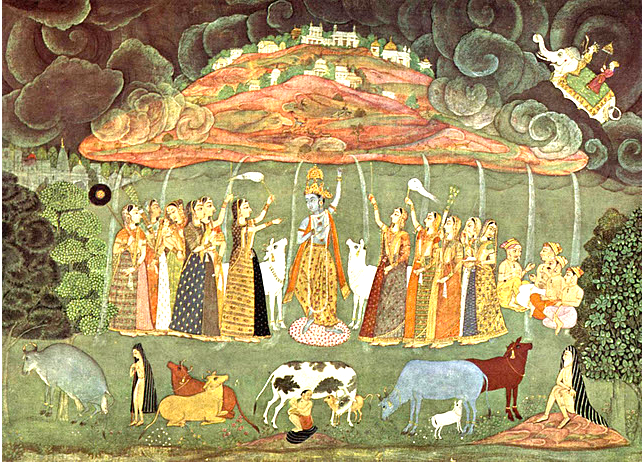
Sri Krishna holding mount Govardhan – painting of Bikaner School of Art – Circa 1690
When God becomes the focus, all obstructions, sufferings, troubles come to an end. Did He not assure in Gita that His devotee is never destroyed? – na me bhaktah pranashyati. Thus the fourth day is important milestone in the spiritual development of a sadhaka when he/she is rest assured of the protection of the Lord. This day is remembered as Govardhanpuja signifying how BhagawanSri Krishna lifted with his small finger the massive Govardhan mountain in order to protect his people from the deluge of rain.
Progress in spiritual life has some definite signs. One of them is the cheerful attitude with which one serves all brothers and sisters. The amity that is brought forth among the sisters and brothers is practised on the final fifth day as bhaidhuj. As per puranas Yama, the Lord of Death has assured that he would not bother those mortals who spread the message of love to their sisters. A perfect harmony leads to moksha, the ultimate liberation.
Thus this ‘Five-day Festival’ traces the spiritual expansion of human growth culminating in the gaining of knowledge of God. It offers an opportunity to dive deep into one’s heart and search for all types of demonic qualities residing inside. Thus, the need is felt to clear the darkness from the heart. To dispel away the internal darkness we have to light the lamp of knowledge. When a lamp is lit on Diwali, just pray to your chosen ideal that the darkness of ignorance be removed from your heart.
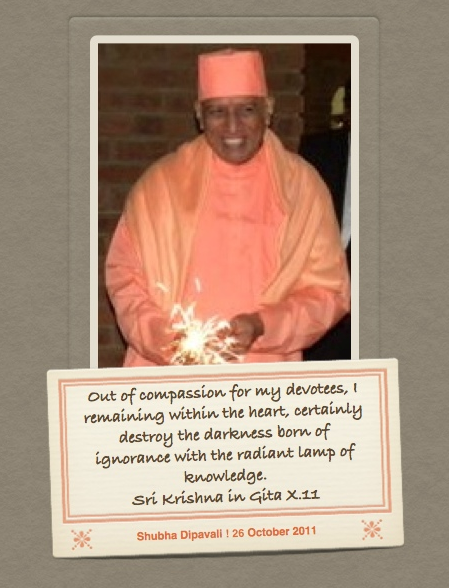
In the Bhagavad Gita, BhagawanSri Krishna says that out of compassion for the devotees, He, residing within their hearts, certainly destroys the darkness born of ignorance with the radiant lamp of knowledge. (Ch X.11). Hence, while celebrating Diwali, let us pray to the Divinity (in whatever form one may believe in) to bestow the right knowledge by which we can lead a peaceful and prosperous life with service to the poor and needy.
Reading Sri Ramacharitamanasa of Tulsidas is always a rewarding experience. Indeed the original verses are so sweet that are no less a symphony stilled into the scattered words. They are not merely poetic in the sense you enjoy the structure and meaning and say ‘wow’! The work is undoubtedly a grand epic poem but the poem that is pro-active in putting an end to your slumber, in awakening you from dreamy sleep, and in instructing you on your way up. Can we have that same magic in its translated version? Very many people affirm a big NO!
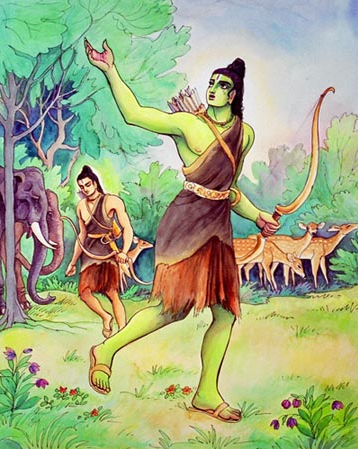
Sri Rama talking to Lakshmana, while in search of Sita
I have of course read prosaic translation in English that does not, in my humble opinion, do justice to the original. And how difficult is to translate the original in English verses? Will that make an appeal to your heart? These were some random thoughts when I received a response in the Comments section, the following from Skendha. Who is she? A young lady from New Delhi, she is a regular visitor to this blog. In her own words, somewhere else on the internet, “I’m more a mind demon, love reading, writing, eating!…Idealistic and spiritual and sensitive…” Her favourite quote is always from Swami Vivekananda.
After reading her creation, I was, to say the least, stunned. I read it out to a few others who were equally stunned and said that the translation has taken newer heights in understanding the original’s beauty. I am happy to place her ‘offering’ in my blog thus sharing the joy that I felt. (Incidentally this is the 100th Post in this blog!)
Skendha wrote:
Revered Maharaj,
I hope it will not be an impudence but since you made that kind suggestion, I am bringing it up… I had translated the passage into verse some years ago. And I am reproducing it here, just as an offering . Please kindly accept it. With warmest regards,
Sincere pranam,
Skendha, New Delhi
===================================
Epic of Ram: The Season of Rains
Translated from Goswami Tulasidasji’ SriRamCharitMaanas.
Lakshman behold the peacocks !
Dancing for the darkened skies;
Rejoicing as the devotee who
Discovers a Vaishnava monk in sight.
The rolling thunder of stormy clouds strains against the shadowy skies,
And in the absence of My precious Sita, bereft of all peace am I;
The lightning bolt tearing the clouds wilfully whirls across the horizon,
Darting and flitting as do the sentiments of a rake, loyal to no one.
The raining clouds are strung over the earth, bowed with their burden,
Humble as him who, toiling for years attains to divine wisdom;
How these great mountains do face the onslaught of pitiless torrents,
With calm fortitude as the saints, who endure the fool’s comments.
The sated streams blossoming into rivers, frolic along their shores
Glorying in their noveau riches, just as the knave who must make a show.
The embrace of the earth stains the fair, bright showers from heaven,
Muddied, as if they were the soul of man tarnished by dark delusions.
The streams rush on, and filling the lustrous lake are lost in it’s bosom,
Drawn unerringly as the divine qualities are towards a holy one;
The wild course of the heedless rivers ends in the placid expanse of the seas;
Sojourning like the soul which, merging with Hari, attains eternal peace.
Four quarters of this forest are dripping with croaks, chirps, many songs,
Blissful as when the bramhacharins, chant the Vedas, to herald the dawn.
The wet branches of dark brown trees which bring forth leaves of glossy green,
Are beautified as the mind of a seeker which, blessed by intellect, becomes serene.
Oh look Brother! how the stars are challenged by this brave battalion of fireflies!
Ill-advised as the gathering of cheats who make a hollow show for all eyes.
And here and there lie weary travellers, broken down and pining for rest,
Ravaged as the senses of a man, in whom discrimination has made conquest.
Lo! it is day as Divakar smiles,
But He is hidden again and lo! it is night.
As the cloud-bank, so is company, My Son,
It fires or smothers our Eternal Light.
Dr Hiru Mukherjee, a resident in UK met me in Patna once during one of his pilgrimage trips to India. Indeed a very amiable personality. He left a deep mark in my mind as a person with serious spiritual quest. Later coming to South Africa, I continue to have intermittent email contact with him. His every mail, as is his wont, speak always about the grace of Master, Mother and Swamiji. And also of many other sagely monks of our Order. He was initiated into spiritual life by Swami Vishuddhanandaji Maharaj whose birthday is TODAY. On June 6, 2011 he wrote to me thus:
Param Pujaniya Maharaj,
Please accept my sastanger pronam. Hope you are keeping well. I have not heard from you for a long time. This is causing some anxiety to me. Please reply.
My gurudev’s birthday is on 9 June . Please accept my pronam. Life is a continuous struggle, Maharaj. Path is so slippery Maharaj. It is a continuous battle between one step forward & then ten steps backward. Need sadhu sangha always, Maharaj
Pranams
Hiru Mukherjee
I felt an uncontrollable urge to read about Vishuddhanandaji today and found to my surprise a wonderful article on this Guru who knew God well. It makes interesting reading as the author, late Swami Lokeshwaranandaji Maharaj has intermixed his personal experiences with the sage’s life incidents. Hence I am happy to share this article with all avid readers of this blog. This article was originally published in Vedanta Kesari of May, 1971 and I am grateful to Swami Atmashraddhanandaji, the present dynamic Editor for making it available from the archives.
SWAMI VISUDDHANANDA: AN APOSTLE OF GOD·AWARENESS
SWAMI LOKESWARANANDA
Swami Lokeswaranandaji Maharaj, the author of this article
I do not remember when I first saw Swami Visuddhananda – it was, I think, sometime in the late twenties. Long before I saw him I had been hearing people refer to him as a great contemplative. Being young I liked men of action and thought rather poorly of a contemplative. Why should a man spend all his time thinking of God? I would argue, why should he not do something for the good of society also? Did not Swamiji preach service to man as a kind of worship?’ Yet I found people refer to Swami Visuddhananda with great respect and admiration. This rather puzzled me. How could people be so much enamoured of a man who was a mere contemplative’?
I did not have to wait long for my answer, for I soon came to know Swami Visuddhananda personally and having once known him, had no difficulty in discovering the secret of his charm. I remember the first time I saw him. He was then head of the centre at Ranchi and had just come down to the Math to attend a meeting. Without knowing who he was, I felt drawn towards him at first sight. It was his fine chiselled face, auburn complexion and poise that attracted me. He was not imposing, not even striking by any standard, but there was an aura of sweetness around him which one could not but notice.
When I was introduced to him, I was a bit nervous, but he soon put me at ease by treating me with utmost affection and by speaking to me as if he had known me a long time. He was a soft-spoken man who knew also the real art of conversation, for he never spoke much himself, but made others speak as much as they wanted to speak, himself putting in a word or two when he must. Having known him once I began to watch him closely, for I wanted to know what exactly was the distinctive quality he had that made him the object of universal love and respect. The first and most distinctive among all the qualities he possessed, as I observed, was that he led an organised and well-regulated life. Nothing could happen that would make him deviate from his well-thought-out routine which included, among other things, three-hours’ meditation in the morning and evening. I also noticed how tip-top everything in his room was. Not only was there not a speck of dust there, but the few articles he bad in his room – his clothes, books, bottles of medicines, one or two pieces of furniture, etc., all were well arranged. I also liked the way he dressed. There was a distinctive taste which was unmistakable. Another striking thing was his disinclination to talk about mundane affairs.
The famous modern scripture for all spiritual
He would gladly discuss a religious topic, but if the topic was non-religious, he would probably refrain from making any comments. It was also interesting to note that whenever he talked about religion, he would talk about it from the practical point of view and not so much about its theories. He would make religious experience seem not only the most desirable thing in life, but also a thing easy of attainment, as if even you and I could have it if only we tried. In his religious talks there would always be a fair sprinkling of quotations from popular religious books, specially the Gospel of Shri Ramakrishna and anecdotes from the lives of saints of all religions, so that it was always interesting to listen to him. He would disclaim any pretension to being a good speaker, but, in reality, he was a very interesting speaker, always to the point, brief and inspiring. He never made any attempt at oratory; he in fact spoke as if he was talking to a group of friends across the table. He spoke from the heart and his simple words, backed by conviction, appealed to monks and laymen alike.
II
Swami Vishuddhanandaji Maharaj
Swami Visuddhananda was born at a village in Hooghly District about 50 miles from Calcutta in the year 1883. Having lost both his parents at an early age he was brought up by the relations of his mother. As a boy he was quiet, introspective and deeply religious. The question that often troubled him was: ‘What is the purpose of life?’ The question became more and more pressing as he grew in years. When he finished his school education in 1900 he became quite restless looking for an answer to this question. He often spent the whole day at what was then known as the Imperial Library (now known as the National Library) rummaging among books for what he thought might provide the answer he was looking for. The British Librarian, John McFarlance, struck by the young man’s seriousness of purpose, often helped him choose the sort of books that would help in his quest. It is not known if he directed him to it, but once Swami Visudhhananda came upon Maxmuller’s Ramakrishna – His Life and Sayings and this proved a turning point in his life. He went through the book with bated breath. He was elated to discover that Dakshineswar, the place where Shri Ramakrishna lived, was only 4 miles to the north of Calcutta. He lost no time to visit Dakshineswar and kept visiting it again and again. The place, hallowed by its associations with Shri Ramakrishna filled him with inspiration. Every time he went there he spent the whole day thinking of God. He soon came to know Ramlal, Shri Ramakrishna’s nephew, who was then the Chief Priest at Dakshineswar, Ramlal’s company gave him much impetus in his religious endeavours. Not long after this he came to know also M, the compiler of the Gospel of Shri Ramakrishna, when the latter came on a visit to Dakshineswar. M, in his inimitable way, talked to him about Shri Ramakrishna, adding further to the intensity of his longing for God. Previously, he used to have his meals at the temple of Dakshineswar, but M pointed out that it was wrong that he should thus tax the hospitality of the temple authorities. From then on the only food he would have was a one-anna worth of meal consisting of some flattened rice mixed with sugar and lemon-juice. While Swami Visuddhananda was once on a visit to Dakshineswar, Sarat Chakravarty, the disciple of Swami Vivekananda who compiled the book Swami-Shishya Samvad i.e., conversations between Swami and Disciple came there. Ramlal Chatterjee introduced Swami Visuddhananda to Sarat Chakravarty and the latter held him spell-bound by telling him stories about Swamiji.
Holy Mother Sri Sarada Devi's marble image at the Temple sanctum sanctorum of Jayrambati Sri Matri Mandir ashram
Once while he was thus talking to him, Sarat Chakravaty turned to Ramlal and asked him, ‘How is Mother? ‘ This led Swami Visuddhananda to enquire who this Mother was and when he discovered that this was Sarada Devi, he at once resolved to take the earliest opportunity to visit her at Jayrambati to pay his respects to her. So one day, not long after this, he started for Jayrambati following the route via Burdwan, walking most of the way. When, travelweary and dust-laden, he finally arrived at Jayrambati, Mother received him as if he was her dear child whom she was long expecting. She asked, ‘How are you, my child? Has the journey been very difficult?’ The warmth with which Mother said these words was a balm to his body and mind. He had never known Mother’s affection, but now he felt as if he had found the Mother he had lost as a child. He spent a happy week with Mother and then returned to Calcutta. Before he left Jayrambati, Mother graciously initiated him.
The initiation increased his longing for God-realisation tenfold. It now became an all-consuming passion with him. He decided to leave home in search of God, but felt he must have Mother’s blessings before he did so. He, therefore, returned to Jayrambati for Mother’s consent within a few months. This time he walked the whole distance and had two friends with him who later came to be known as Swamis Girijananda and Shantananda. Mother was as warm as before, but when they declared that it was their firm resolve to live the lives of wandering monks depending upon what chance brought them, she firmly ruled it out. At their request, she, however, gave them Gerua cloth, but directed them to go to Varanasi to have their monastic names from Swami Shivananda who was then there. She handed them a letter introducing them to him and asking him to look after them. This was in 1907.
Armed with her blessings they started for Varanasi walking the whole distance. It took them three months to reach Varanasi. Swami Shivananda welcomed them and they stayed there almost a year. It may be mentioned here that Swami Visuddhananda had his formal monastic vows from Swami Brahmananda at Varanasi in 1921.
Sometime in 1908 he proceeded to Madras to assist Swami Ramakrishnananda in his work. Later he worked at Bangalore also for some years. In 1916 he was transferred to Mayavati where he served for nearly four years. While at Mayavati he was in charge of accounts for some time. Referring to his work as accountant Swami Madhavananda once remarked, ‘He had a wonderful power of concentration. He totalled up figures without ever making a mistake; he would get the correct total at the very first attempt. He was so sure of himself that he would not care to check a second time.’ After a brief interlude in Calcutta when he lived in close touch with Swami Brahmananda and when he was appointed a member of the Governing Body of the Mission and a trustee, he was again sent to South India for some years. After a year’s stay at Bhuvaneswar as the head of the monastery there, he was posted to Ranchi where he served continuously for a quarter century from 1927 to 1952.
The Temple at Morabadi Ranchi Ashram where Swami Vishuddhanandaji Maharaj lived a life of solitude for long years
His life at Ranchi was the life of a recluse. He seldom, if ever at all, left the monastery or received visitors. Only one or two select devotees could come once in a while to read with him the Gospel of Shri Ramakrishna. Most of the time he would keep himself immersed in meditation and study. There are people living who bear witness to the austerity of his life and the state of God-consciousness in which he lived there. Some of them feel blessed that they knew him then and refer to those days with joy and gratitude as if they themselves were privy to the religious experience of this great soul. A road bears his name as a tribute of the people of Ranchi to his memory.
From 1952 onwards a marked change was discernible in Swami Visuddhananda. He was appointed Vice-President of the Ramakrishna Math and Mission this year and in that capacity, he had many responsibilities, chief of them being to meet people and attend to their spiritual needs. Gone were the happy days of seclusion for him! From now on he spent at least a couple of hours daily meeting people and replying to their religious questions. Hundreds of people came to him, people of all ages and all communities. He was patient to all and his answers were simple, straightforward and convincing, Once a person came to see him he would come back again and again, very often with friends and relations. Soon his reputation as a religious teacher spread. He was in demand all over the country and he in his turn, travelled far and wide ministering to the religious needs of the people. It was at this time that an Indian barrister-at-law who also happens to be an all-India political leader once declared in a public speech, ‘I deem Swami Visuddhananda to be the greatest saint in India today.’ When this was reported to Swami Visuddhananda he was embarrassed and visibly annoyed. He said, ‘What does he know of saints?’
Swami Visuddhananda visited Assam more times than any President or Vice-President of the Ramakrishna Math and Mission before him did. Mentioning this with pride many people in Assam claim that their State occupied a special place in the heart of Swami Visuddhananda. Whether this is true or not, the fact remains that his visits created a religious ferment in both Bengali and Assamese populations, large sections of whom flocked to him as if drawn by a magnet. People who saw him then still remember him as if he was a symbol of a great experience. If there are today a large number of Ramakrishna Ashramas throughout Assam, it may be attributed largely to the influence of Swami Visuddhananda. He set in motion the powerful Ramakrishna Movement which is now sweeping through Assam and its neighbouring States in the Eastern Region.
Bhagawan Sri Ramakrishna's marble Image at Belur Math sanctum sanctorum
In the year 1962 Swami Visuddhananda succeeded as President of the Ramakrishna Math and Mission following the death of Swami Sankarananda. He was already eighty and his health was indifferent, yet when the call came to him. to shoulder the responsibilities of the office of President, he did not demur. As President he stayed mostly at Varanasi where he had begun his monastic career sixty years earlier. He was now at the zenith of his monastic virtues. As usual he had many visitors every day. However taxing it might be for him to talk to them in his feeble health, he never turned away anybody. He continued to exhort people to try to realise God. So inspiring were his talks and so kind and affectionate he himself was that many people visited Varanasi from Calcutta and other far-off places merely to see him and listen to his talks.
For some years he had been having trouble with his urinary system and doctors had advised an operation. At first he was unwilling to have the operation, but when the trouble persisted he decided in favour of it. He came down to Belurmath and soon entered a nursing home. Before leaving for the nursing home he approached almost everybody at Belurmath with folded hands and begged for forgiveness for any offence he might have given him. The behaviour was unusual, but no one thought that this was his final leave-taking. On June 13, 1962, he had his operation performed by the best surgeons of Calcutta. Contrary to everybody’s expectations his condition began to deteriorate from the midnight of the 15th and on the 16th morning he passed away. His lips were seen moving and his hands were joined together across his chest. Even his last moments were marked by his God-awareness.
Two incidents may be mentioned here which serve as a pointer to what made Swami Visuddhananda the man he was.
Once a vain young man who had atheistic leanings asked him, ‘Sir, have you seen God?’ Swami Visuddhananda, instead of giving him a direct answer, told him that since religious men of all countries and all ages had claimed that God existed and He could also be seen, it was wrong to have any doubt about His existence. The young man was not satisfied with this, but asked, ‘I want to know, Sir, if you yourself have seen Him.’ Again Swami Visuddhananda spoke at some length about how God answered one’s prayers, if one was earnest enough and how if one sincerely wanted to see Him, one could surely have His vision. Swami Visuddhananda thus parried the question a few times, but the young man was insistent and kept asking if he himself had seen God. At this impertinence of the young man, the atmosphere became tense and people present held their breath, worried about how Swami Visuddhananda was going to react. As people looked, they were amazed to see a great change slowly come over Swami Visuddhananda; he looked as if a halo surrounded his body. In words ringing with conviction he said, ‘I have seen God as I see my own limbs.’ A hush fell over the awed audience. The cheeky young man sat speechless. Without a further word, Swami Visuddhananda retired to his room and was not seen for the rest of that evening. People returned home with a sense of having experienced something breath-taking.
The next incident happened when Swami Visuddhananda was staying at Varanasi towards the close of his life. A leading surgeon of the town happened to lose his son, and this so upset the surgeon that he was no longer able to attend to his patients. He in fact was so distraught with grief that he was not even his normal self. Everybody in the town felt distressed at this because the surgeon was extremely popular. Also, there was nobody in the town who could match his skill as a surgeon which meant that the entire population in the town felt helpless without his services. Swami Visuddhananda who knew the surgeon felt sorry that the surgeon should thus suffer and with him also the citizens of Varanasi. He was so moved that he declared that he would gladly forgo the fruits of his life-long prayers if that would make the surgeon normal and enable him to serve the community as before. Strangely enough, the surgeon began to show signs of recovery soon after this and within a week be was able to resume his work. One day he appeared before Swami Visuddhananda and said, ‘Sir, I have just completed a very difficult operation and I think it is going to be successful.’ He came to give him this news as if he knew that his recovery was due to Swami Visuddhananda. The happiest man on hearing this news was Swami Visuddhananda.
Image courtesy: Sri Ramakrishna Vijayam, Tamil monthly magazine brought out by Sri Ramakrishna Math, Chennai
The Ramayan is a masterpiece of Divine Love to Sri Ram. Throughout the verses of the Ramayan, the learned find knowledge, the singers get celestial music, the writers revel in rich poetry and the righteous, a storehouse of Dharma. In this respect the Ramayan is a repository of all sarva-mangala without parallel.
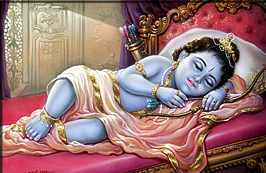
Here, my mind is humbly reverting to Sri Hari as Sri Ram, beautifully described by Saint Tulsidas (AD 1532-1623) in his magnum opus Sri Ramcharitmanas. Mother Kaushalya’s devotion to Lord Hari was unique in that she wished in her previous birth that Lord Hari be born to her as her son. That was the great benefit that she derived. And when Lord Hari indeed appeared, He came with shankha, chakra, gada, padma in his four arms. That was stunning to her. Immediately Kaushalya went into raptures and started singing hymns to Him. The most funniest thing she felt was that Sri Hari, being birthless, eternal and all pervading was in her womb all these days! This very incomprehensibility of Lord getting a birth for her sake would even shake the steady minds of munis, she wonders!
Lord Hari, the ever compassionate and merciful 'appearing' as baby Ram…
But she would rather have the Lord as her baby and therefore she prays to Him with both hands folded. “O Lord! Vedas say that you are beyond maya, attributes and knowledge and that the whole universe in all its manifestations resides in your body. Who would ever believe that such as you, resided in my womb for nine months? Please O Lord, give up this appearance and become a newborn child, because that is what will give me infinite joy.” And then the Lord, the King of the divine kingdom, smiled, became a baby and started to cry in the lap of mother. Tulsidas in the last line of this lovely piece says that whosoever sings this passage, would be liberated from this world and will never be reborn.
Every devotee is precious to the Lord, and He is ever ready to help us succeed.
Every Hindu home must have a copy of the Ramayan, and regular reading of this sacred Book will enable us to emulate the exemplary and immaculate lives of Sri Ram, Mother Sita, Hanumanji and a host of bright and wonderful characters found in this gem of our scriptures.
So, dear devotees, on this very auspicious Day of Sri Ram Navami, let us all take a resolve to cultivate faith and love for our dear Lord Ram. Did not our Master say over and over again that “The One who became Rama and Krishna, has now come into this case (showing his body)”? May all who are tuned to our Master be Blessed with spiritual love and enlightenment!
In this entire journey of life – our merciful Master is with us, eager to help when we stumble, forgive us when we make mistake, and encourage us when we falter.
Swami Saradaprabhanandaji also joins me in wishing everyone of you, abundance of love and healthy life.
It is not uncommon that some true aspirants who are leading a sincere spiritual life do get some siddhis. A few readers of my Blog have sent queries about ‘siddhis’. They want to know whether it is eventually good to possess these siddhis, if they come unasked. Or, are siddhis positively harmful?
What is Siddhi? In plain Sanskrit it means ‘success’. Siddhi also means ‘perfection’. In spiritual world, ‘siddhi’ connotes mystical Powers.
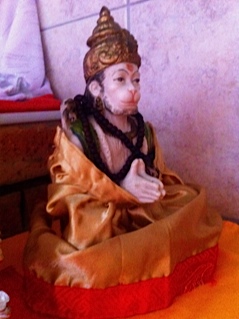
Sri Hanumanji as worshipped in homes
Saint Tulsidas, in his famous ‘Hanuman Chalisa’, praises Sri Hanuman as the ‘giver of eight kinds of ‘siddhi’ (mystical Powers) and nine kinds of ‘nidhi’ (wealth)’. What are they? One authoritative source to know about siddhis is definitely Rishi Patanjali’s Yogasutras. Swami Vivekananda’s lucid exposition of these sutras is indeed popular throughout the world.
According to a traditional view contained in Mahabharata, Siddhis are in eight in number and they are:
anima, mahima, laghima, garima, prapti, prakamya, istava and vasitva. These are the eight powers that one gains by a control one acquires over the elements.
Anima is the power by which one becomes very small. Mahima is the power by which one becomes very big. Laghima is the power by which one becomes very light. Garima is the power by which one becomes very heavy. Prapti is the power by which one can contact anything anywhere, whatever be the distance of that object. Prakamya is the capacity to fulfil any wish that is in the mind. Isatva is the capacity to bring anyone under one’s subjection. And vasitva is the mastery over the whole universe. These are the powers, says Rishi Patanjali, that one can get by ‘samyama’ (absolute concentration) on the five elements.
In his famous lecture on The Vedanta in all its Phases, delivered in Calcutta, Swamiji says: All powers and all purity and all greatness — everything is in the soul. The Yogi would tell you that the Siddhis – Animâ, Laghimâ, and so on — that he wants to attain to are not to be attained, in the proper sense of the word, but are already there in the soul; the work is to make them manifest. Patanjali, for instance, would tell you that even in the lowest worm that crawls under your feet, all the eightfold Yogi’s powers are already existing. The difference has been made by the body. As soon as it gets a better body, the powers will become manifest, but they are there.
How much helpful?
Are these Siddhis really helpful in one’s spiritual life? Yes, they are indeed helpful provided – the Powers are used for the good of others and if Guru’s permission to use them is obtained.
boats anchored in Midmar Dam in South Africa
But every saint true to his salt, has warned us from using these Powers as they can easily promote egoism and then make us fall from the chosen spiritual path. Some times the Powers are so useless in one’s spiritual development; Sri Ramakrishna would ridicule in gaining these Powers after much penance. He once remarked about a monk returned to meet his brother. When the brother questioned about what had he got after leaving the home and practicing strenuous tapasya, the monk proudly answered, “Look, I can walk on the river waters”. And he actually showed his brother how he could walk on the waters! The brother exclaimed, “Oh! Only for ‘walking on the waters’ you spent 12 long years! See by paying to the boatman half a rupee I can cross this river!”
The Mahabharata episode
Nevertheless, Siddhis have captured the minds of aspirants from ancient time and by following any or in combination of all the four yogas namely, Raja Yoga, Jnana Yoga, Bhakti Yoga and Karma Yoga, the siddhis can be obtained. One illustrative story that we find in Mahabharata is about an ascetic who meditates in a forest. Once he was doing his sadhana when a bird’s droppings fell on his shaven head. Utterly disturbed and consequently irritated, he cursed that the bird be burnt to death. And lo! The bird immediately fell from the tree dead. The ascetic understood that he has already developed a siddhi and became proud of it.
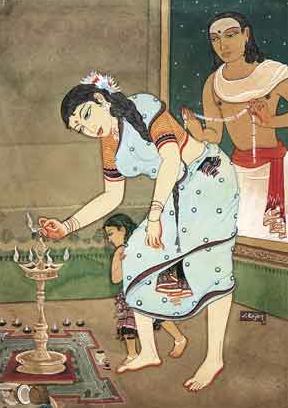
an ideal householder
When the time came for taking alms, he ventured into a nearby village. It is an ancient practice in India that the renunciates stand in front of homes and call loudly the mother of the house to give them the required alms. A few minutes passed and there was no response from that home. Again he knocked at the door and called a little more loudly. Still there was no response. The third time he called with disgust and became angry. He was aware that he had got ‘siddhi’ the mystical power and hence thought would use that same power that he had used in the morning in a forest. At that juncture, a sweet voice of the house lady came through the still closed-door. She in a warning note, replied from inside, “Look! My boy! Don’t ever think that I am that bird which you burnt it to death! Hold on! I am coming now!”.
Obviously the ascetic was dumb founded as the morning incident of his burning a bird in that forest was not known to any one. How could this house lady who was in a distant village knew what happened earlier. Now, more than alms, he was curious to know about her. She opened the door and welcomed him in her home. While giving this ascetic boy the meals, she explained the cause for the delay in her response.
She showed him how her ailing husband was in the bed and he needed all services that she lovingly rendered to him. The knowledge of knowing about this ascetic was part of gaining a siddhi. She further informed him that such mystical powers could be obtained not only by meditation but also by performing one’s duties with love, respect and dedication.
Selfless action and Siddhis?
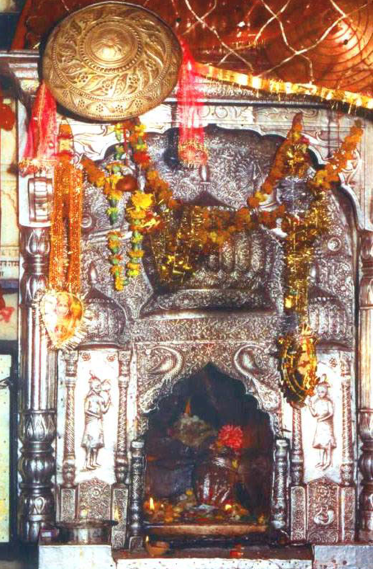
30 kms south of Kangra valley in the lap of Shivalik range and 56 kms from Dharamshala, the Jwalamukhi temple is dedicated to the "GODDESS OF LIGHT". One of its own kinds of temples, there is no idol in it. An eternally burning and shining blue flame emanating from a rock sanctum is only worshipped here as a manifestation of the goddess. Dedicated to the deity of Flaming Mouth or goddess Jwalamukhi, the temple is one of the 51 power spots or Shaktipeethas of India. One of the most revered temples of the Hindus, the temple possesses a golden dome, gifted by Mughal Emperor Akbar. The temple is at its best during Navratri festival in early April and mid October.
Once during my three-month ‘wanderings’ in North India, I reached Jwalamukhi, a place of pilgrimage in Himachal Pradesh where Divine Mother is worshipped in flames of fire. It was about evening. Getting down from the bus, I sauntered in that small sleepy town searching for one night accommodation. I saw a guest house run by Gita Bhavan. The receptionist gladly welcomed me and gave a key and two blankets. He showed me a spot in the verandah of the upper floor where there was a cupboard in which I could keep my bag and even lock it. I spread the blanket on the clean floor. Locking the cupboard, I went down to take bath before proceeding to mandir for darshan.
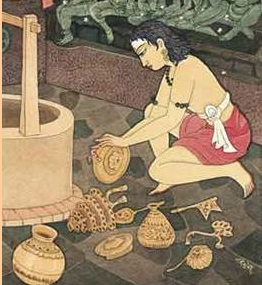
I found several common bathrooms and toilets in the corner of the buildings. There was a huge well. A small bucket has been tied with a rope. By throwing the small bucket in the well, one can easily draw water and pour it in a bigger bucket and use it for bath and other purposes. While I was taking the small one in my hands, readying to place it in the well by sending it down, someone came to me and forcibly took the ropes in his hand, saying sweetly, “Baba! Please don’t! I am here to serve you! I shall fill this bucket with water and place it in a bath room. Please wait!”.
I thought why at all I should take the help of another person when drawing water from a well was not a difficult task. I looked at the person who offered help to me. He was a middle-aged man, robust in health and having a turban on his head signifying that he belonged to the Sikh faith. So quickly that the Sardarji drew water I had to accept his seva willy-nilly as I was getting late for the evening arati in the temple and had no time to argue with him.
Karma Yoga – selfless service
Once the temple arati was over, I returned to Gita Bhavan. That Sardarji was still there near the well and I was surprised to see him, drawing water from the well for everyone else too. One after another the pilgrims were served by him. I do not know how many buckets of water he must have filled in serving all those who came there!
When he became free, he slowly came to me and sat with me to converse. After the initial exchange of pleasantries, he told that he was very happy to meet me. I too expressed my happiness for his unasked seva. He strangely told me was I not coming down from the Himalayas? Did I not stay with a highly evolved monk for a few weeks? Did I not learn such and such things from him?
To say the least I was indeed surprised. I thought how he could exactly point out even what I had studied under a monk and where I was in past weeks. Naturally I enquired with a tinge of suspicion, how did he know about me. In a most disarming way, the Sardarji replied that once he saw any one, he could instantly come to know of all personal details about that person. What was striking about him was his utter humility. In sweet intonation, he described how he had undertaken the seva to pilgrims in that holy town several years before. He had a small shop for his income to take care of his family. Once the shop hours were over, he spends his time at this guesthouse where hundreds of pilgrims come and go. He continued further to say that it was his privilege to serve them in a spirit of Karma Yoga!
Each is great in his own place?
All spiritual aspirants are familiar with karma Yoga. Karma Yoga is a plan of action for betterment. It provides certain values in our life. It makes us pure by stripping off our selfish motives. It has such wonderful practices that make us work for others in a spirit of service. Self-sacrifice becomes inherent and it elevates the individual who is attuned to it. In short Karma Yoga contributes for the making of a man to an elevated spiritual being.
One of the doctrines of Karma Yoga is activity. Performance of action must be according to one’s own nature and occupation. Whatever be the social status, whether a person is a monk or householder, the duties that has befallen on his status must be carried out.
Swami Vivekananda
Swami Vivekananda, in one of his famous lectures on Karma Yoga, entitled “Each is Great in his own Place” points out very admirably the importance of performing one’s duties. He says that the Karma Yoga “does not say that this duty is lowering and the other elevating. Each duty has its own place, and according to the circumstances in which we are placed, must we perform our duties.”
He continues to caution us by saying that “If a man retires from the world to worship God, he must not think that those who live in the world and work for the good of the world are not worshipping God; neither must those who live in the world for wife and children think that those who give up the world are low vagabonds. Each is great in his own place.”

 In the Bhagavad Gita, Bhagawan Sri Krishna says that out of compassion for the devotees, He, residing within their hearts, certainly destroys the darkness born of ignorance with the radiant lamp of knowledge. (Ch X.11). Hence, while celebrating Diwali, let us pray to the Divinity (in whatever form one may believe in) to bestow the right knowledge by which we can lead a peaceful and prosperous life with service to the poor and needy.





 Vedanta in Practice