A Micro-Blog from Swami Vimokshananda – earlier at Durban, Singapore and Dublin – now at Yelagiri Hills, Tamil Nadu, India – "A private diary for public consumption!"
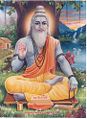
Today is the glorious Guru Purnima! A day to venerate worshipfully the vishaala-buddhi (vast-minded) Sage Veda Vyasa! A day to pay reverence prayerfully to one’s own spiritual preceptor! And all those tireless teachers from whom we learn any training lesson…On this auspicious occasion this is my humble homage to one of our late monks who made me understand the secret of Karma Yoga in a most unconventional manner! Priti Maharaj a man of simple habits was no doubt a real karma yogi whose selfless and weariless work I had seen in close quarters for more than a decade. He joined the Ramakrishna Order at its Karimganj centre (in the state of Assam) in 1951. He was an initiated disciple of Swami Virajanandaji Maharaj and had sannyasa (formal vows of monkhood) from Swami Shankaranandaji Maharaj in 1961. He passed away on 10 February 2004 at the age of 73.
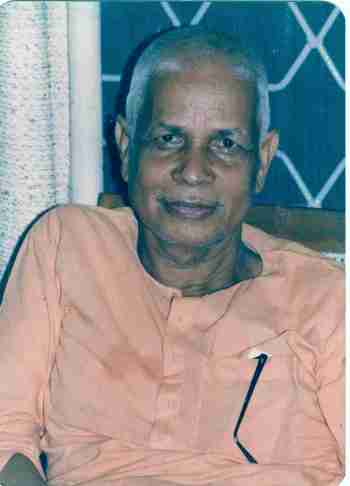
Swami Prathamanandaji
It was a crowded shrine hall. Mother Durga glowed magnificently. A tune in kedaar raaga wafted in the air, weaving a melody, working to soothe my wavering mind. Curious to know whose captivating vocal it was, I just peeped in through the window. That was the first time in 1976 at Rahara temple hall where Durga Puja was on, that I saw Revered Prathamanandaji Maharaj who to everyone was dear ‘Pritida’.
His music drew me like a magnet; because so long I have been hearing within the Mission campus only bhajans that are simple and straight. Here was a monk who elaborated a raaga in his inimitable style. The first song that captured my attention was ‘Jaya Shiva Shankara’. When his music ended I was, as if, transported to another world where I could feel the enchanting raaga taking an enticing shape.
Relief and Rehabilitation
Just before the conclusion of my Training Centre period in Belur Math, along with four other brahmacharins, I was, in 1977, deputed to Rajahmundry where a massive relief work was started by the local Ramakrishna Mission centre. First three months went into providing primary relief. The Diviseema area of Andhra Pradesh was devastated beyond recognition by the surging tidal waves. Thousands of houses were washed away. More than 20,000 people died in the sea waters that entered into coastal villages.
Pritida with the cine-celebrity N T Rama Rao at the construction site. Courtesy: Swami Aksharatmananda of Ramakrishna Mission, Rajahmundry, Andhra Pradesh, India
Our Headquarters at Belur Math urgently decided to construct 1100 new houses for the poorest of the poor in 11 villages bordering the sea coast – not a simple structure but cyclone proof shelters. A mammoth rehabilitation work had begun. Therein entered Pritida like a colossus taking the challenge head on, with whom I had the blessed opportunity to be with, day in and day out, month after month and year by year for almost a decade long since. Against insurmountable difficulties Revered Pritida struggled to make the rehabilitation work a great success. In order to get hollow bricks right at the spot, he created a huge brick manufacturing unit at Puligadda camp on the bank of the Krishna river with hundreds of local poor people getting casual employment. Seeing the hard working monk, the great cine-celebrity and later Chief Minister of Andhra Pradesh – N T Rama Rao came in with his helping hand of large donations.
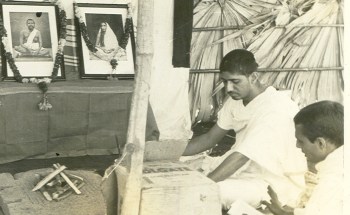
a brahmachari performing hawan for the peace of lives lost during tidal wave devastation. Courtesy: Swami Aksharatmananda of Ramakrishna Mission, Rajahmundry, Andhra Pradesh, India
Under the scorching heat of Andhra, at the coastal area, a two-hour drive from Vijayawada, he used to work tirelessly knowing not what the time was or when to eat in the Rehabilitation camp. Meals used to be taken at random – many a time standing on the veranda. Several of his monastic assistants would stare at him in utter disbelief. Available at all time to everyone, oblivious to his personal needs, there he encountered serious stomach problem, which started draining his energy. Before beginning the Rehabilitation work in a massive scale, he gave the idea to perform a hawan for the peace of those thousands of lives lost by the tidal wave devastation and he gave the blessed opportunity to me to do the shodasha upachaara puja (16 item-worship) and hawan which I gladly did on the sea sands amidst fierce winds.
Memorable Medical Work
Once the Andhra work was over, Headquarters asked Pritida to take up the responsibility of running a newly started medical centre at Itanagar in Arunachal Pradesh. He was appointed the Head of that hospital. He needed one assistant immediately to start the work there and his choice deliberately fell upon me. I did not know whether I would be able to rise to his expectations because the place was absolutely strange to me. People were indigenous tribals. The culture was unknown. The path was unchartered.
Ramakrishna Mission Hospital at Itanagar in Arunachal Pradesh – planned, executed and run by Pritida for more than two decades
Here at Itanagar under his umbrella cover, I saw before my eyes the blooming of a fresh venture with its own inherent problems. It was a treat to witness how a monk, supposedly innocent of worldly intricacies, tackled from multi various angles one by one troubles galore.
Be it laying the roads, aligning the buildings, fixing the electricals or designing the wards, recruiting and training the staff – from doctors down to sweepers -everything would come under the scrutinising scan of his sharp eyes. Here at Itanagar through his watchful eyes I came to know the tips and tricks of ‘man’ management. Pritida was massively brilliant in outwitting the manoeuvre of mischief mongers. Here at Itanagar under his protective wings I was pulled out of my own created cocoon and was exposed to the vast vagaries of people’s mood. It was Pritida who took me in his arms as it were and guided step by step so as to escape unscathed. Here at Itanagar with his able tutelage I had first hand experience in realising that mere outward personality cannot carry anybody farther; only a well balanced interior of mind and heart could sweep the feet off everyone. Revered Pritida was a shining example. He rarely paid attention to his attire. Have I not found my shirts or dhotis missing from the alna (wooden open shelf) only to spot them on his person! Such was his childlike nature that would not fail to charm anyone.
Utterly Unattached
He used to say that his brain functioned so fast that to put the ideas on to paper was almost impossible for him. Even while talking to others, the words from his mouth would flow like a torrent. I received many times his deep appreciation for my secretarial assistance in putting his thoughts in black and white. Many would think that Prityda was restless and could not stay put steadily in one place. Even supposedly enlightened persons viewed him as an enigma. That was not the case. I had seen him lying down on a cot, absolutely carefree, unmindful of any hullabaloo outside and sipping hot tea in a nonchalant manner but seriously hitting on a pleasing solution to a perplexing problem! His involvement in that Centre was total. Was he attached to the work that he created and cared for, nurtured and nourished? No. At the time of leaving that Centre, on transfer back to Belur Math, he left with a simple bag containing a pair of clothes! Thats all that he possessed!
Ramana Maharishi
Revered Pritida had enormous admirers among the monks as well as devotees. People flocked to him with their grievances possibly having no method to set right. He took delight in tackling such circumstances. Be it an inter-caste marriage, or falling in penury Revered Pritida was there with ever ready solution in his pocket, always smiling like Ramana Maharishi!
Can I really exhaust about a multifaceted personality? How much have I known about him? Somehow my mind is unable to come to the terms of his termination; rather the thoughts of his traits do create ripples of admiration and astonishment. Slowly and slowly they rise and gather in my lonely moments, whirling into bigger circles like the emergence of smooth flowing air-bubbles, looming large over the head. Prodigious Pritida cannot be forgotten.
When alive he compelled attention, more – when no more.
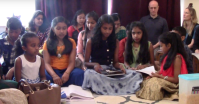
The function to commemorate the completion of One Year of the Eire Vedanta Society, Dublin held on 16 June 2019 at Nivedita House went off well, all by His grace. About 75 people and 20 children attended the function.
The children of Sanatana-Ireland did the Vedic Chanting and one bhajan. Swami Vimokshananda welcomed the gathering. Among the distinguished guests were Ms Rose Emmet, the Local Community Leader, Ms Punam Rane, the newly elected India-born Councillor, Mr Michael Sullivan, representing Dublin Inter-Faith Forum, Mr Jagan a Social Worker and Mr Dipak Inamdar of the Vedic Hindu Cultural Centre.
A devotional singing group called “Chant & Chai” did some bhajans with verve and vigour. The programme included children’s Play & Learn, Talks, given by guest speakers interspersed with bhajan singing by devotees.
Swami Purnananda gave a short Report of Activities and a future vision. The programme came to a close with a Vote of Thanks by Prof Siddhartha Sen followed by a short Arati and Lunch prasad.
Yesternight’s Purnima was indeed an adorable one for its special significance as it was on this tithi, that Lord Buddha was born as Gotama at Kapilavastu now in Nepal. We, at the Eire Vedanta Society, celebrated Buddha‘s Birthday in a solemn manner. The programme began just after 5:30 pm. An image of Lord Buddha was tastefully decorated and kept at the centre of the Altar.Swami Vimokshananda welcomed the audience. Swami Purnananda made a brief introduction about the distinguished speakers on this occasion.
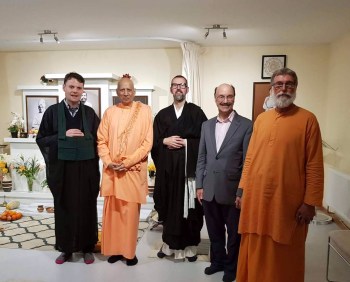
The first speaker was Prof Leo D Lefebure of Georgetown University, Washington DC, USA and a Catholic priest. He is accredited with writing several books, especially on Buddhist Scriptures like Dhammapada and how it relates to Christianity. He is Vice President of the Society for Buddhist-Christian Studies. He first read the opening verses of the Dhammapada and highlighted how enlightening they were and the similarities with certain teachings found in the Jewish and Christian Scriptures.
The second speaker was Revered Hodo Gomoku who follows Zen Buddhism. He brought out some salient points of what Lord Buddha means to the Modern World. There are several teachings such as non-violence, compassion, patience etc. But Rev Hodo considered the most important teaching of Buddha for the Modern World as ‘Mindfulness’; he quoted from the Lalitavistara Sutra, one of the prominent scriptures of Mahayana Buddhism and explained how Buddha overcame the assaults of Mara.
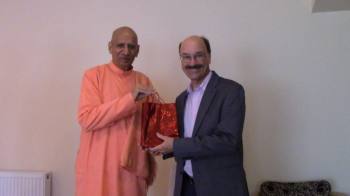
Swami Vimokshananda while appreciating the talks of the two distinguished speakers added how Swami Vivekananda had the greatest adoration to Lord Buddha and how he had darshan of Lord Buddha. Swami Purnananda gave a vote of thanks as well as presented gifts as a token of respects. This was followed by Vesper Service and partaking of prasad.
The incident how Swami Vivekananda had darshan of Lord Buddha is indeed remarkable and good to recollect what he had related to Swami Saradananda and his disciples, Sister Nivedita and Sharat Chandra Chakravarty, on 3 separate occasions. A combined account of this incident in Swamiji’s own words gathered from these 3 sources is presented here:
One day while meditating, “There flowed in my mind a current of serene bliss when I kept it still, devoid of all objects. I felt for a long time even after the end of the meditation, a sort of intoxication under its impulse.
So, I did not feel inclined to leave the seat and get up immediately. While I was sitting in that condition at the end of the meditation, from the southern wall of that room a luminous figure stepped out and stood at a little distance in front of me, filling the room with a divine effulgence.
It was the figure of a Sannyasin (monk) in ochre cloth, absolutely calm, shaven-headed, and staff and Kamandalu (a Sannyasin’s wooden water-bowl) in hand.
The man was tall and largely built. There was a wonderful radiance on his visage, yet there seemed to be no play of emotion on it. In his face was calm so deep and so established, that it seemed as if both pain and pleasure had been forgotten during an infinite time.
He gazed at me for some time and I too gazed at him in speechless wonder. I felt very much drawn towards him. He walked forward towards me with a slow step, with his eyes steadfastly fixed on me, as if he wanted to say something.
But I was seized with fear and could not keep quiet. I got up from my seat, opened the door and walked out of the room with a rapid step. The next moment I thought, ‘Why this foolish fear?’ I made bold and went back into the room to hear the monk, who, alas, was no longer there.
I waited long in vain and felt dejected, repenting that I had been stupid enough to fly away without listening to him. I have seen many monks, but never have I found such an extraordinary expression in any other face. That face has been indelibly imprinted in my heart.
It may be a hallucination, but very often it comes to my mind that I had the good fortune of seeing Lord Buddha that day.”
I am happy to reproduce, at the request of many devotees and friends, a post from a Blog maintained by Sri Kissoon Behari, a devotee from Chatsworth branch of the Ramakrishna Centre of South Africa on the occasion of Sri Hanumanjayanti. Swami Vivekananda was fascinated by the sterling qualities of Sri Hanumanji. He exhorted his disciple thus:
You have now to make the character of Mahavira (Hanuman) your ideal. See how at the command of Ramachandra he crossed the ocean. He had no care for life or death! He was a perfect master of his senses and wonderfully sagacious. You have now to build your life on this great ideal of personal service. Through that, all the other ideals will gradually manifest in life. Obedience to the guru without questioning, and strict observance of Brahmacharya – this is the secret of success. As on the one hand Hanuman represents the ideal of service, so on the other he represents lion’s courage, striking the whole world with awe. He has not the least hesitation in sacrificing his life for the good of Rama. A supreme indifference to everything except the service of Rama. Only the carrying out of Shri Rama’s behest is the one vow of his life! Such whole-hearted devotion is wanted.
February 9, 2011 — kbehari
One of the main elements of spiritual progress is the companionship of the holy and the wise. It is one of the commandments of Sri Ramakrishna (Some of the other injunctions being:repetition of God’s name and singing His glories, going into solitude now and then and thinking of God, and practising meditation.) He compared worldly people to moist wood. Even such wood when placed upon fire soon becomes dry and begins to burn. Similarly, the company of holy men or sadhus drives away the moisture of greed and lust from the hearts of the worldly, and then the fire of discrimination burns steadily in them.
And so one will easily understand how elated we were when our most Revered Swami Vimokshanandaji Maharaj accepted our invitation to visit us.
He first went to our little shrine, and uttering prayers, he worshiped with flowers. Then we led him to our lounge/dining room where some thirty friends and family were eagerly awaiting His Holiness. For some (such as Devan Shukla and Prof Usha Shukla, Devika Madari, Head of Kendra Hindi Patshala) it was a first meeting (and a most memorable one at that). Some others had met Swami Vimokshananda on earlier occasions. These included Rajish Latchman, Deeplal Buddan, Mala Rambally. These three presented a programme of Bhajans and a recital from the ‘Sundarkand’ of the Ramacharitamanasa. So enthralled was Swamiji by their rendition that he asked the artistes to continue for a little longer.
At our request, Swami Vimokshananda Ji addressed us. He presented a summary of the events of the section sung and then made a comment as only one who has a deep intuitive knowledge of scripture can. The following is a summary of the main points made.
SRI HANUMANJI FLIES TO LANKA
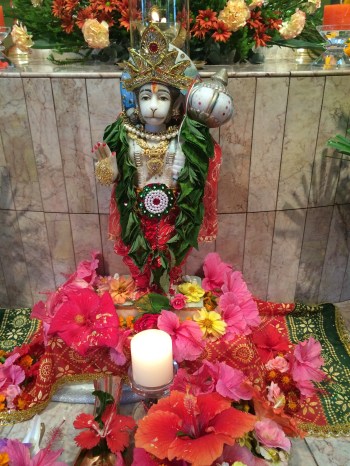
Sri Hanumanji’s cute image at Ramakrishna Centre of South Africa, Durban
Sri Hanumanji , who has just been reminded of his immense power, sets out for Lanka where Mother Sita is being held captive by the demon king Ravana. He springs up on a beautiful hill to leap across the ocean. So powerful is his taking off that the hill sinks immediately into the nether world. On the way, Sri Hanumanji refuses the offer of Mount Mainaak to rest on him. Further in his journey, he encounters Surasa who threatens to devour him. As she opens her mouth to swallow Sri Hanumanji, he enlarges his body to twice the size of her mouth. As she opens her mouth wider still, so does he increase his size. Then suddenly, assuming a very minute form, he enters her mouth and exits. Surasa reveals that she is there only to test the power of Sri Hanumanji. Receiving her blessings, he departs.
He next meets a demoness Simhika who has the power to seize a bird flying overhead just by catching hold of its shadow, dragging it down and then devouring it. Sri Hanumanji dismisses her with a single powerful blow.
The entrance of Lanka is guarded by a demoness Lankini. She detects Sri Hanumanji even though he has reduced himself to the size of a gnat. He deals her such a blow that she reels and vomits blood. She recalls that Lord Brahma had disclosed that when she would be discomfited by a blow from a monkey it would foretell the end of Ravana and the demon race.
MEANING BEHIND THE EXPLOITS
Swami V proceeded to reveal the mystery of this episode. The journey of Sri Hanumanji delineates the journey of a sadhaka in his spiritual quest.
THE LEAP UP AND THE SINKING HILL
The hill from which Sri Hanumanji leaps up and away is described as ‘beautiful’. The hill represents our attraction and attachment to the world. Ordinarily, the world holds one down by its power of gravity or pull of attraction. Spiritual life commences with a strong rejection of worldly life which weighs us down (as does a rock.)
MAINAAK’S OFFER OF REST
The temptation to relax from our spiritual activities or to turn away to another activity is always present. Such a temptation must be rejected. Mainaak’s offer represents the luxurious rest that entices the sadhaka. But Sri Hanumanji says that there is no rest for him until he has accomplished the work of Sri Ram.
OUTWIT THE JUICY DELICIOUS WORLD
The name ‘Surasa’ is a compound of ‘su’ meaning excessive and ‘rasa’ which suggests that which is pleasing to the taste. Thus, Surasa represents the world which appears pleasurable but which devours us in the end. Sri Hanumanji overcomes her with his wit and power.
THE HIDDEN ENEMY
Simhika represents jealousy. It is an invisible and most treacherous enemy of the sadhaka. The sadhaka is like the unwary bird flying high in ignorance of the threat that is lurking below (that is, in his sub-conscious mind). Once in her clutches, it is well nigh impossible to extricate himself from her, and so he perishes.
A BLOW TO PRIDE
Lanka is guarded by the keeper Lankini. (One may think of her as a security system that prevents entry.) She represents pride. Sri Hanumanji puts paid to her with such a blow that topples her and causes her to vomit blood.
The Ramayana is a masterpiece of Divine Love to Sri Ram. Throughout the verses of the Ramayana, the learned find knowledge, the singers get celestial music, the writers revel in rich poetry and the righteous, a storehouse of Dharma. In this respect the Ramayana is a repository of all sarva-mangala without parallel.
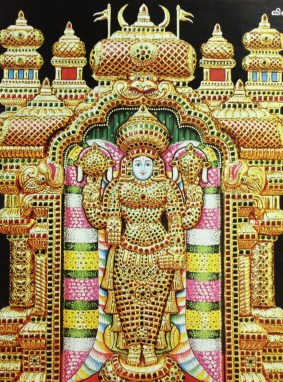
Narayana as Balaji in Tirupati, the famous Vaishnava sacred spot in South India. Courtesy: Sri Ramakrishna Vijayam, Chennai
Here, my mind is humbly reverting to Sri Hari as Sri Ram, beautifully described by Saint Tulsidas (AD 1532-1623) in his magnum opus Sri Ramcharitmanas.
Mother Kaushalya who in her past birth, as wife of Manu had unstinted devotion to Lord Hari. It was unique in that she wished that Lord Hari be born to her as her son. And she demands from the Lord that “chaahaun tumhahi samaan suta” – wish I would have a son like you!”.
Well, this must be a tall order to be complied with! So, the Lord in reply pathetically tells her “aapu sarisa khojoun kahan jaayi?” – Where shall I go to find my equal?” How poetically Tulsidas indicates to us that God is unique and therefore, cannot be xerox copied.
Take the beautiful song, “Thumaka chalata Ramachandra” where he describes so charmingly of his play with the child Rama. He was stunned at what he saw in his vision: the child form just looked exactly to child Rama and thus he wrote the song, looking at the playful baby.
“Raghuvar chavi ke saman, Raghuvara chavi bania”. One devotee from Dhanbad once wrote to me that “as he thinks of a comparison to the picture of his beautiful Raghuvira, he can’t think of anything and finally decides that his beautiful form can only be compared to his (own) form itself.”
And when Lord Hari indeed appeared now, He came with shankha, chakra, gada, padma in his four arms. That was stunning to her. Immediately Kaushalya went into raptures and started singing hymns to Him. The most funniest thing she felt was that Sri Hari, being birthless, eternal and all-pervading was in her womb all these days! This very incomprehensibility of Lord getting a birth for her sake would even shake the steady minds of munis, she wonders!
Lord Hari, the ever compassionate and merciful as baby Ram…
But she would rather have the Lord as her baby and therefore she prays to Him with both hands folded. “O Lord! Vedas say that you are beyond maya, attributes and knowledge and that the whole universe in all its manifestations resides in your body. Who would ever believe that such as YOU, resided in my womb for nine months? Please O Lord, give up this appearance and become a newborn child, because that is what will give me infinite joy.” And then the Lord, the King of the divine kingdom, smiled, became a baby and started to cry in the lap of mother. Tulsidas in the last line of this lovely piece says that whosoever sings this passage, would be liberated from this world and will never be reborn. A right anti-dote to the disease of samsara (the cycle of birth and death)!
Every devotee is precious to the Lord, and He is ever ready to help us succeed. Every spiritual home must have a copy of the Ramayana, and regular reading of this sacred Book will enable us to emulate the lives of exemplary Sri Rama, the immaculate Mother Sita, the dedicated Hanumanji and a host of bright and wonderful characters found in this gem of our scriptures.
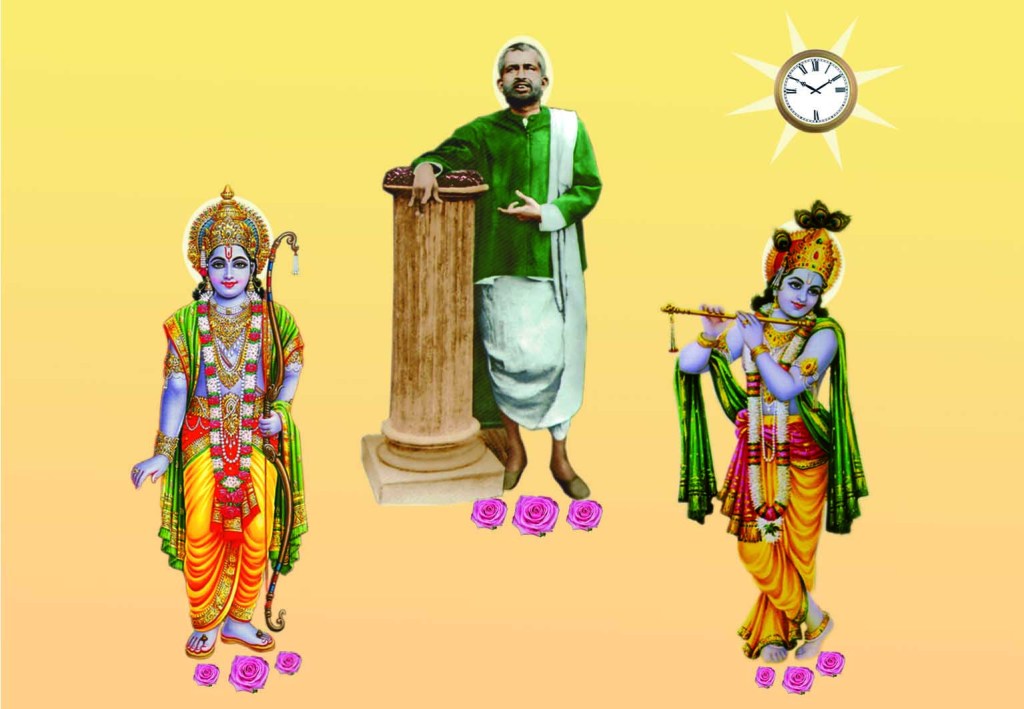
He who came as Rama and Krishna…
So, dear devotees, on this very auspicious occasion of Sri Ram Navami, let us all take a resolve to cultivate faith and love for our dear Lord Rama. Did not our Master Sri Ramakrishna assure us that “The One who became Rama and Krishna, has now come into this case (showing his body)”? May all be blessed with spiritual love and enlightenment!
In this entire journey of life – our merciful Master is with us, eager to help us when we stumble, forgive us when we make mistake, and encourage us when we falter.
Brother Swami Purnananda Ji also joins me in wishing abundance of love and healthy life to every one of you!




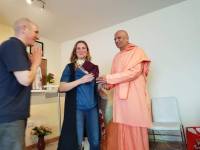
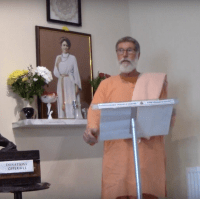
 Yesternight’s Purnima was indeed an adorable one for its special significance as it was on this tithi, that Lord Buddha was born as Gotama at Kapilavastu now in Nepal. We, at the Eire Vedanta Society, celebrated Buddha‘s Birthday in a solemn manner. The programme began just after 5:30 pm. An image of Lord Buddha was tastefully decorated and kept at the centre of the Altar.Swami Vimokshananda welcomed the audience. Swami Purnananda made a brief introduction about the distinguished speakers on this occasion.





 Vedanta in Practice