Vedanta in Practice

A Micro-Blog from Swami Vimokshananda – earlier at Durban, Singapore and Dublin – now at Yelagiri Hills, Tamil Nadu, India – "A private diary for public consumption!"

  • Spiritual seekers are of many types. Some have unquenchable thirst for knowing about God; some others love to take the name and sing God’s glory. Yet others would like to spend their time and efforts in serving the suffering; and a few would devote their life in contemplation. Whatever path one may follow, no one is exempted from doubts. We are often assailed by doubts that go on and on till they are cleared. One such doubt is about prayers. Do our prayers reach God and whether God listens to our prayers? On this auspicious holy birth tithi of Bhagawan Sri Ramakrishna it is pertinent to inquire.

    Regarding this, Sri Ramakrishna says:
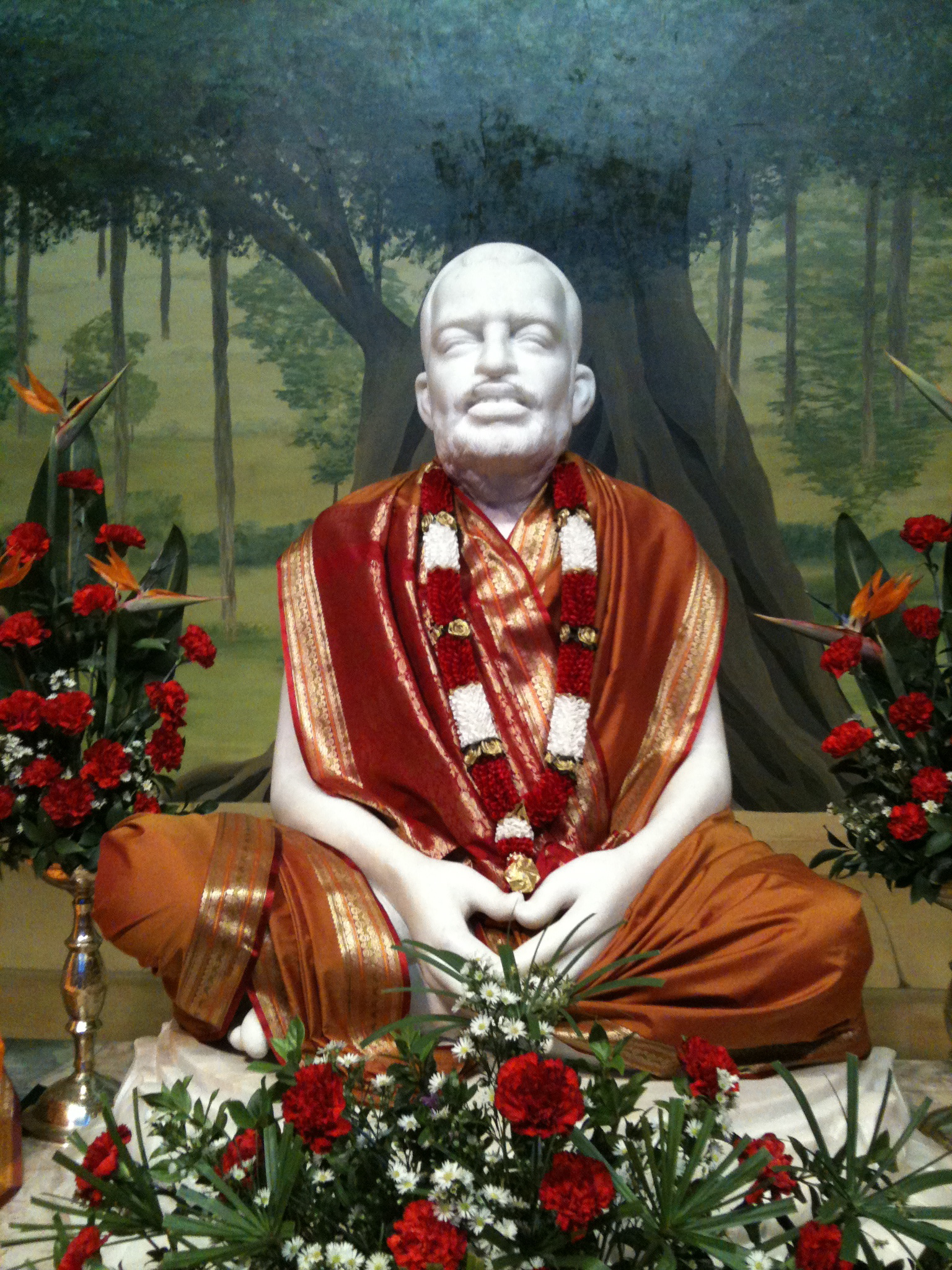
    Marble image of Sri Ramakrishna at HQ

    “If a son clamors persistently for his share of the property, his parents consult with each other and give it to him even though he is a minor. God will certainly listen to your prayers if you feel restless for Him. He has begotten us, surely we can claim our inheritance from Him. He is our own Father, our own Mother. We can force our demand on Him.”

    Here is a mind-grippping account of a devotee about how prayers are fulfilled. Once we had gone to Belur Math, the Headquarters of the Ramakrishna Math. We met the Vice-President Swami Vishuddhananda and he was talking to us. He loved us like our own father, guide and teacher. He asked us casually, “ Sri Ramakrishna has said, if you pray for three days and three nights, you will get him. Well, do you pray ? What happens to your prayer?” I was young, and I used to talk boldly. I said, “ We have prayed for so many days, yet there is no response. He has not given us his darshan”. He became very serious and said “ what do you mean?”. Do you mean to say that what he has said is not true? I was taken aback. I said “I am not saying that what he has said is untrue. But my own experience is that I have prayed for many days, but nothing has happened.”
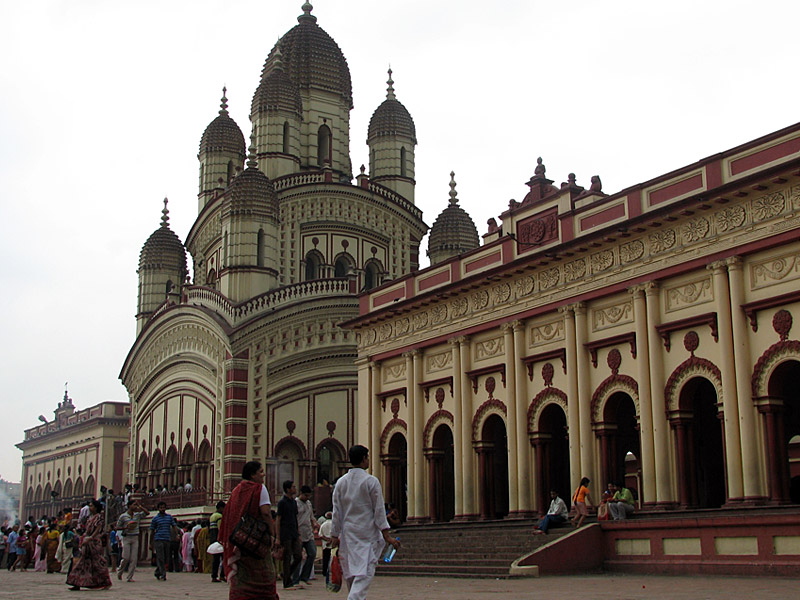
    Dakshineswar Ma Bhavatarini Kali temple

    Then he narrated an incident. A nephew of Sri Ramakrishna, named Ramlal was in Dakshineswar as the Head Priest after the Master’s passing away. Once a sadhu came from Ayodhya to Dakshineswar early in the morning. Ramalal saw this sadhu standing there covered with dust from head to foot. As soon as the man saw Ramalal, he said, “ I have come to meet the Paramahamsa. Where can I meet him?”.
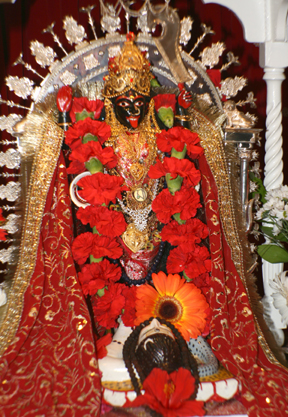
    Ma Kali Bhavatarini of Dakshineswar

    Ramalal was taken aback and said, “ Now the mangalarati is going to begin. Come inside the temple.” That man did not enter because he was full of dust and he stood faraway in the temple hall. He saw the mangalarati and then recited a beautiful stotra in praise of Mother Goddess. It was full of devotion and it seemed as though the whole temple hall was vibrating with that and the Mother was highly pleased with it.

    Ramlal took a long time cleaning the room and so on because he did not want to face the sadhu again.
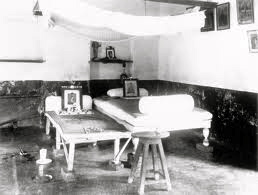
    Room of Sri Ramakrishna – as it was in those early years. Now it has been spruced up and made to look modern…

    When he came out, the sadhu was standing in the same place with the same question. “I have come to meet the Paramahamsa. Where is he?”. Ramlal brought him to the room of Sri Ramakrishna and said, ‘This is the room where he used to stay. This is the small bed where he used to take his nap in the dytime and this is the big bed where he used to sleep’. Ramlal was using the past tense, ‘used to sleep, used to take rest’, so the sadhu said, ‘Why do you talk in this manner? I want to meet him. Where is he?’. Very reluctantly Ramlal had to disclose him that Sri Ramakrishna was no longer alive, ‘Unfortunately you have come seven days late. He passed away a few days ago.’

    It was a shock to the man! He later narrated that he was a sadhu doing tapasya in Ayodhya for a very long time. And one day he had the vision of his chosen deity, his Ishtam, who told him, ‘Now go to Dakshineswar. I have come in the person of Ramakrishna Paramahamsa. Why don’t you come and meet me?’. In the beginning the penniless sadhu did not believe it. He thought that it was his imagination. Later, thrice he had the same vision. Then he decided to go. He walked all the way as he had no money. He took rest at some places asking people on the way about the direction to go to West Bengal. After three months, he arrived at Dakshineswar, believing the words he had heard in his vision. He had reached his destination, and now here was this person saying that the Paramahamsa was no longer alive.

    He was simply taken aback, ‘What is this? What do you say? It can not be!’ he exclaimed. Ramlal said, ‘I am very sorry. If you had come even fifteen days earlier you could have met him. He was not here of course. He was ill and was living in the Cossipore garden house and you could have met him there. But unfortunately, he no longer lives’.
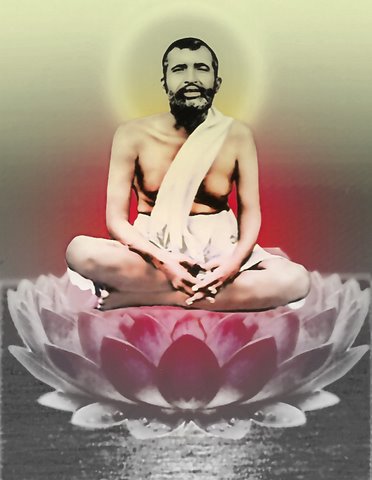
    "hridaya kamala madhye raajitam" – established in the lotus of the heart…

    The sadhu was crestfallen. He could not believe it. He just rolled on the ground moaning, ‘What is this? Why did you cheat me like this? You could have told me you were’nt going to live, that you were not going to be in the body for more than three months and asked me to come immediately. You should have told me! Why did you deceive me?’. The tremendous blow was too much for him. That continued for some time. Later, it was time for worship in the room. People were coming and the sadhu just went outside and sat on the verandah. He sat there while the day passed and the night came. The sadhu did not move. Ramlal came and tried to console him, ‘Get up and have some rest. Take some food’. The sadhu just snubbed him saying, ‘Get out! I have not come for all that!’. Ramlal was afraid of this very tall and strong sadhu. He went away and did not say anything.

    Another day and night passed. The sadhu was sitting in the same position. Sometimes he used to cry, but otherwise, he was quiet and calm. One more day passed, two days passed and third day came. Ramlal was afraid, because he was the person who spoke first with the sadhu. If he were to die there, Ramlal would be blamed. So again Ramlal went to console the sadhu and to make him get up and eat something, but he could not make him budge. The night also passed. It was hot that night. So Ramlal and others who were working in the temple slept outside on the verandah. That early next morning, before four o’clock, suddenly, Ramlal saw the sadhu, coming upto him on the verandah. He shook Ramlal and laughed shouting with great joy, ‘Did you not see him?’. At first Ramlal did not understand. He thought that may be the man had gone mad as he had not eaten for days and tired from travelling.

    Then the sadhu said, ‘Did you not hear the sound of his wooden slippers? He came! Look here! He has given me this Payasam. He came from the side of the Panchavati. I heard the sound of his wooden slippers. He came near me and put his hand behind my back and said, ‘ What are you doing? Why are you crying? Where have I gone? See, look at me’. I was simply overwhelmed and looked at him. He embraced me and told me to get up, “Come, you must have a good wash”. He took me to the steps leading to the Ganga and then said, “Put some water in you burning eyes. Let them be cool”. With such loving words, he consoled and said, “Eat, you have not eaten for the last seven days. Eat my dear!” I could not eat. Tears of joy were flowing from my eyes and I was just looking at Sri Ramakrishna. After some time I could not see him any longer, but my heart was full of joy.”
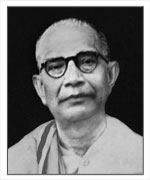
    Swami Vishuddhananda – 8th President of the Ramakrishna Math & Ramakrishna Mission

    After narrating this incident, Swami Vishuddhananda said, “Now do you believe it or not? You will say, this is just one of those stories”. He told us that even now that earthen pot in which the sadhu got the Payasam is kept at Dakshineswar and continued, “Tell me, how was his intense sorrow removed? How did he feel full of joy? Do you see how prayers are answered!’. Intense longing prayer… “I have come all the way…. and three days and three nights”. That is what the Master has promised in the Gospel of Sri Ramakrishna. So three days and three nights of one constant, longing prayer, brought Sri Ramakrishna down. He had to come. Prayer has that wonderful power to bring the Almighty down to this earth.

    Sri Ramakrishna taught the devotees how to call on the Divine Mother…. “I used to pray to Her in this way: ‘O Mother! O Blissful One! Reveal Thyself to me. Thou must!’ Again, I would say to Her: ‘O Lord of the lowly! O Lord of the universe! Surely I am not outside Thy universe. I am bereft of knowledge. I am without discipline. I have no devotion. I know nothing. Thou must be gracious and reveal Thyself to me.’

    ====================================
  • Today is the birthday of Swami Vivekananda. This is celebrated as National Youth Day in India. For the benefit of the readers who have not yet visited our Belur Math website, the following article from it, is happily reproduced here. This gives a bird’s eye-view of the Contributions made by the great Swamiji to World Culture, to India and to Hinduism.

    Image Courtesy: Dr S Adhi Narayanan, New Delhi


    Vivekananda’s contributions to World Culture

    Making an objective assessment of Swami Vivekananda’s contributions to world culture, the eminent British historian A L Basham stated that “in centuries to come, he will be remembered as one of the main moulders of the modern world…” Some of the main contributions that Swamiji made to the modern world are mentioned below.

    1. New Understanding of Religion

    One of the most significant contributions of Swami Vivekananda to the modern world is his interpretation of religion as a universal experience of transcendent Reality, common to all humanity.  Swamiji met the challenge of modern science by showing that religion is as scientific as science itself; religion is the ‘science of consciousness’.  As such, religion and science are not contradictory to each other but are complementary.

    This universal conception frees religion from the hold of superstitions, dogmatism, priestcraft and intolerance, and makes religion the highest and noblest pursuit – the pursuit of supreme Freedom, supreme Knowledge, supreme Happiness.

    2. New View of Man

    Vivekananda’s concept of ‘potential divinity of the soul’ gives a new, ennobling concept of man.  The present age is the age of humanism which holds that man should be the chief concern and centre of all activities and thinking.  Through science and technology man has attained great prosperity and power, and modern methods of communication and travel have converted human society into a ‘global village’.  But the degradation of man has also been going on apace, as witnessed by the enormous increase in broken homes, immorality, violence, crime, etc. in modern society.  Vivekananda’s concept of potential divinity of the soul prevents this degradation, divinizes human relationships, and makes life meaningful and worth living.  Swamiji has laid the foundation for ‘spiritual humanism’, which is manifesting itself through several neo-humanistic movements and the current interest in meditation, Zen etc all over the world.

    3. New Principle of Morality and Ethics

    The prevalent morality, in both individual life and social life, is mostly based on fear – fear of the police, fear of public ridicule, fear of God’s punishment, fear of Karma, and so on.  The current theories of ethics also do not explain why a person should be moral and be good to others.  Vivekananda has given a new theory of ethics and new principle of morality based on the intrinsic purity and oneness of the Atman.  We should be pure because purity is our real nature, our true divine Self or Atman.  Similarly, we should love and serve our neighbours because we are all one in the Supreme Spirit known as Paramatman or Brahman.

    4. Bridge between the East and the West

    Another great contribution of Swami Vivekananda was to build a bridge between Indian culture and Western culture.  He did it by interpreting Hindu scriptures and philosophy and the Hindu way of life and institutions to the Western people in an idiom which they could understand.  He made the Western people realize that they had to learn much from Indian spirituality for their own well-being.  He showed that, in spite of her poverty and backwardness, India had a great contribution to make to world culture.  In this way he was instrumental in ending India’s cultural isolation from the rest of the world.  He was India’s first great cultural ambassador to the West.

    On the other hand, Swamiji’s interpretation of ancient Hindu scriptures, philosophy, institutions, etc prepared the mind of Indians to accept and apply in practical life two best elements of Western culture, namely science and technology and humanism.  Swamiji has taught Indians how to master Western science and technology and at the same time develop spiritually.  Swamiji has also taught Indians how to adapt Western humanism (especially the ideas of individual freedom, social equality and justice and respect for women) to Indian ethos.

    Swamiji’s Contributions to India

    Image courtesy: Nicholas Sherbanee, USA

    In spite of her innumerable linguistic, ethnic, historical and regional diversities, India has had from time immemorial a strong sense of cultural unity.  It was, however, Swami Vivekananda who revealed the true foundations of this culture and thus clearly defined and strengthened the sense of unity as a nation.

    Swamiji gave Indians proper understanding of their country’s great spiritual heritage and thus gave them pride in their past.

    Furthermore, he pointed out to Indians the drawbacks of Western culture and the need for India’s contribution to overcome these drawbacks.  In this way Swamiji made India a nation with a global mission. Sense of unity, pride in the past, sense of mission – these were the factors which gave real strength and purpose to India’s nationalist movement.  Several eminent leaders of India’s freedom movement have acknowledged their indebtedness to Swamiji.  Free India’s first Prime Minister Jawaharlal Nehru wrote: “Rooted in the past, full of pride in India’s prestige, Vivekananda was yet modern in his approach to life’s problems, and was a kind of bridge between the past of India and her present … he came as a tonic to the depressed and demoralized Hindu mind and gave it self-reliance and some roots in the past.” Netaji Subhash Chandra Bose wrote: “Swamiji harmonized the East and the West, religion and science, past and present.  And that is why he is great.  Our countrymen have gained unprecedented self-respect, self-reliance and self-assertion from his teachings.”

    Swamiji’s most unique contribution to the creation of new India was to open the minds of Indians to their duty to the downtrodden masses.  Long before the ideas of Karl Marx were known in India, Swamiji spoke about the role of the labouring classes in the production of the country’s wealth.  Swamiji was the first religious leader in India to speak for the masses, formulate a definite philosophy of service, and organize large-scale social service.

    Swamiji’s Contributions to Hinduism

    1. Identity

    It was Swami Vivekananda who gave to Hinduism as a whole a clear-cut identity, a distinct profile.  Before Swamiji came Hinduism was a loose confederation of many different sects.  Swamiji was the first religious leader to speak about the common bases of Hinduism and the common ground of all sects.  He was the first person, as guided by his Master Sri Ramakrishna, to accept all Hindu doctrines and the views of all Hindu philosophers and sects as different aspects of one total view of Reality and way of life known as Hinduism.  Speaking about Swamiji’s role in giving Hinduism its distinct identity, Sister Nivedita wrote: “… it may be said that when he began to speak it was of ‘the religious ideas of the Hindus’, but when he ended, Hinduism had been created.”

    2. Unification

    Before Swamiji came, there was a lot of quarrel and competition among the various sects of Hinduism.  Similarly, the protagonists of different systems and schools of philosophy were claiming their views to be the only true and valid ones.  By applying Sri Ramakrishna’s doctrine of Harmony (Samanvaya) Swamiji brought about an overall unification of Hinduism on the basis of the principle of unity in diversity.  Speaking about Swamiji’s role in this field K M Pannikar, the eminent historian and diplomat, wrote: “This new Shankaracharya may well be claimed to be a unifier of Hindu ideology.”

    3. Defense

    Another important service rendered by Swamiji was to raise his voice in defense of Hinduism.  In fact, this was one of the main types of work he did in the West.  Christian missionary propaganda had given a wrong understanding of Hinduism and India in Western minds.  Swamiji had to face a lot of opposition in his attempts to defend Hinduism.

    4. Meeting the Challenges

    At the end of the 19th century, India in general, and Hinduism in particular, faced grave challenges from Western materialistic life, the ideas of Western free society, and the proselytizing activities of Christians. Vivekananda met these challenges by integrating the best elements of Western culture in Hindu culture.

    5. New Ideal of Monasticism

    A major contribution of Vivekananda to Hinduism is the rejuvenation and modernization of monasticism.  In this new monastic ideal, followed in the Ramakrishna Order, the ancient principles of renunciation and God realization are combined with service to God in man (Shiva jnane jiva seva).  Vivekananda elevated social service to the status of divine service.

    6. Refurbishing of Hindu Philosophy and Religious Doctrines

    Vivekananda did not merely interpret ancient Hindu scriptures and philosophical ideas in terms of modern thought.  He also added several illuminating original concepts based on his own transcendental experiences and vision of the future.  This, however, needs a detailed study of Hindu philosophy which cannot be attempted here.

    =======================================
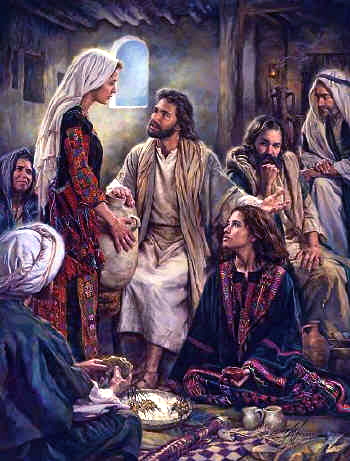
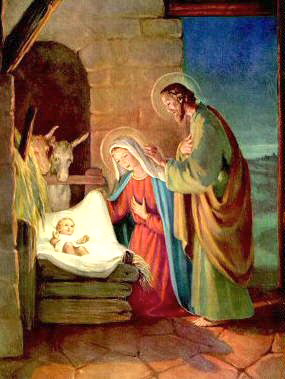
  • Merry Christmas!

    Baby Jesus bringing everlasting joy…
    One of our devotee-readers of this Blog, Sucheta Ghosh from Italy has sent the following which is a timely reminder of the divinity in different Incarnations to be contemplated upon on this auspicious occasion of Jesu Jayanti.

    As Jesus and his disciples were on their way, he came to a village where a woman named Martha opened her home to him. She had a sister called Mary, who sat at the Lord’s feet listening to what he said.

    40 But Martha was distracted by all the preparations that had to be made. She came to him and asked, “Lord, don’t you care that my sister has left me to do the work by myself? Tell her to help me!”

    “Martha, Martha,” the Lord answered, “you are worried and upset about many things, but few things are needed—or indeed only one. Mary has chosen what is better, and it will not be taken away from her.”  — Luke 10:38-42

    From The Gospel of Sri Ramakrishna

    Visit to the Brahmani’s house (Chapter 43: Tuesday, July 28, 1885)

    The Master arrived at the house of the brahmin lady who was grief-stricken on account of her daughter’s death. It was an old brick house… The brahmani had a sister; both of them were widows. Their brothers also lived in the house with their families. The brahmani had been busy all day making arrangements to receive Sri Ramakrishna…

    The brahmani came and saluted the Master. She was beside herself with joy. She did not know what to say. In a half-choked voice she said: “This joy is too much for me. Perhaps I shall die of it. Tell me, friends, how shall I be able to live? I did not feel such a thrill even when Chandi, my daughter, used to visit the house accompanied by liveried footmen, with armed guards lining both sides of the street. Oh! Now I have no trace of my grief at her death. I was afraid he would not come. Then I thought that, if that happened, I should throw into the Ganges all the things I had arranged for his reception and entertainment. I should not speak to him any more. If he visited a place, I should go there, look at him from a distance, and then come away…

    She was talking like this when her sister came up and said: “Come down, sister! How can I manage things if you stay here? Can I do it all by myself?”

    But the brahmani was overwhelmed with joy. She could not take her eyes from the Master and the devotees…

    M: “How amazing! A similar thing happened with two women at the time of Jesus. They too were sisters, and devoted to Christ. Martha and Mary.”

    MASTER (eagerly); “Tell me the story.”

    M: “Jesus Christ, like you, went to their house with His devotees. At the sight of Him one of the sisters was filled with ecstatic happiness. It reminds me of a song about Gaurānga:

    My two eyes sank in the sea of  Gora’s heavenly beauty

    And did not come back to me again;

    Down went my mind, as well, forgetting how to swim.

    “The other sister, all by herself, was arranging the food to entertain Jesus. She complained to the Master, saying: ‘Lord, please judge for Yourself-how wrong my sister is! She is sitting in Your room and I am doing all these things by myself.’ Jesus said: ‘Your sister indeed’ is blessed. She has developed the only thing needful in human life: love of God.”

    MASTER: “Well, after seeing all this, What do you feel?”

    M: “I feel that Christ, Chaitanyadeva, and yourself-all three are one and the same. It is the same Person that has become all these three.”

    MASTER: “Yes, yes! One! One! It is indeed one. Don’t you see that it is He alone who dwells here in this way.”

    As he said this, Sri Ramakrishna pointed with his finger to his own body.


    Title: 'Martha and Mary' Painter: Nathan Greene, born 1961 Year: unknown Incident shown: Martha has made her complaint, and Jesus is responding. His left hand points towards Mary, as he suggests she focus on what is really important. The disciples in this crowded little room listen intently to what he is saying. Bible reference: Luke 10:41 Information: Nathan Greene is a contemporary painter of scenes from the Bible – not an overcrowded field these days. His paintings show meticulous attention to detail – not only in brushwork and realism, but in something that the great masters of the Renaissance and Counter-Reformation considered unimportant – historical realism. The people in Greene's paintings wear Middle Eastern designs and fabrics similar to those of the biblical period; their houses and furniture are authentic to the time. Modern minds, affected by scientific realism, appreciate this attention to detail in his powerful images. Courtesy: http://www.bible-art.info/Martha_Mary.htm

    “And I tell you, ask, and it will be given to you; seek, and you will find; knock, and it will be opened to you.” [Luke 11:9 / Matthew 7:7]

    Similarities between Christ and Sri Ramakrishna

    M: “But there are many similarities between you and Jesus Christ.”

    MASTER (smiling): “What else?”

    M: “You don’t ask your devotees to fast or practise other austerities. You don’t prescribe hard and fast rules about food. Christ’s disciples did not observe the sabbath; so the Pharisees took them to task. Thereupon Jesus said: ‘They have done well to eat. As long as they are with the bridegroom they must make merry.

    MASTER: “What does that mean?”

    M: “Christ meant that as long as the disciples live with the Incarnation of God, they should only make merry. Why should they be sorrowful? But when He returns to His own abode in heaven, then will come the days of their sorrow and suffering.”

    MASTER (smiling): “Do you find anything else in me that is similar to Christ?”

    M: “Yes, sir. You say: ‘The youngsters are not yet touched by: “woman and gold”;  they will be able to assimilate instruction. It is like keeping milk in a new pot: the milk may turn sour if it is kept in a pot in which curd has been made.’ Christ also spoke like that.”

    MASTER: “What did He say?”

    M: “‘If new wine is kept in an old bottle, the bottle may crack. If an old cloth is patched with new cloth, the old cloth tears away.’

    “Further, you tell us that you and the Mother are one. Likewise, Christ said, ‘I and My Father are one.’ ”

    MASTER (smiling): “Anything else?”

    M: “You say to us, ‘God will surely listen to you if you call on Him earnestly.’ So also Christ said, ‘Knock and it shall be opened unto you.’

    ======================================

  • Gita Jayanti – What it means to us?

    The Gita as Nectarine drink

    Vaikuntha Ekadashi on 17 December 2010

    All over the globe the Hindus celebrate ‘Gita Jayanti’ on the 11th day (Ekadashi) of the bright fortnight (shukla paksha) of the month of Agrahayana (December – January). This month is also referred to as ‘Margashirsha’. Of the twelve months, Sri Krishna says in the Gita that He is Margasirsha. (X.35) It is seen that people generally attribute this day as the “Birthday of the Bhagavad Gita”. Well, can there be a birthday i.e., beginning for Divine Wisdom? As God is eternal (nitya) His knowledge is also ever present (sashwat). One cannot really say that the Song Divine has a birthday.

    Ancient Muni Veda Vyasji

    Actually, Gita Jayanti is the anniversary of the day, nearly 5000 years ago, when Bhagwan Shri Krishna spoke rather ‘sung’ to Arjuna, on the battlefield in Kurukshetra. Sanjaya, the Minister,  recited those words for the blind King Dhritarashtra. When writing Mahabharata, this Divine Song was ‘threaded into’ the great epic by ancient Maharishi Veda Vyasji for the benefit of humanity. (vyasena grathitaam puraana muninaa madhye mahaabhaaratam – First verse of Gita Dhyanam)

    But it is nowhere to be considered as an ‘interpolation’ as some misguided modern scholars opine. The internal evidence shows that there is homogeneity running all through language, diction and development of the subject ‘Brahma-vidya’ – the knowledge of Brahman, the Supreme. The entire story of Mahabharata, when condensed into philosophy becomes Gita. What the heart is to the human body, the Gita is to this Great Epic, says Swami Chidbhavanandaji in his English Translation of the Gita.

    Swami Vivekananda

    What is Bhagavad Gita? As the great ‘cyclonic monk of India’ Swami Vivekananda has once said in the West, ‘Everything goes to show that this Vedanta philosophy must be very practical; and later on, when we come to the Bhagavad-Gita…..it is the best commentary we have on the Vedanta philosophy — curiously enough the scene is laid on the battlefield, where Krishna teaches this philosophy to Arjuna; and the doctrine which stands out luminously in every page of the Gita is intense activity, but in the midst of it, eternal calmness. This is the secret of work, to attain which is the goal of the Vedanta.’

    “Bhagavad Gita” literally means Song of God or rather Song of the Spirit.  Since it is a Divine Song, the language of the original lyrics and the religion of the original singer do not have much relevance. For once, it has been ‘sung’ and written down to posterity, the song itself gets life, travelling across oceans and mountains, breaking all barriers of caste, creed and nationality.  Such is the influence of a divine song.  However, as Bhagwan Shri Krishna, Himself being the original ‘singer’, Bhagavad Gita gets the status of being the holiest and most sacred of all the songs of God. Therefore, What is its power? The lives of the lowly change, the world-disease afflicted gets healed, the morale of the depressed is uplifted. The results are as limitless as the Singer.

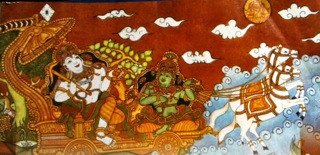
    charming painting on Brahma-Vidya (Supreme knowledge) 'sung' to Arjuna by Sri Krishna

    Mahatma Gandhi said, “When disappointment stares me in the face and all alone I see not one ray of light, I go back to the Bhagavad-Gita…I immediately begin to smile in the midst of overwhelming tragedies and my life has been full of external tragedies.  If they have left no visible, no indelible scar on me, I owe it all to the teachings of Bhagavad-Gita.”

    The Gita consists literally 18 chapters with 700 verses (shloka). It has been said that all the Upanishads are the cows, the Milker is Krishna, the cowherd boy,  Arjuna is the calf, men of purified intellect are its drinkers and milk is the supreme nectar of the Gita.

    sarvopanishado gaavo dogdha gopaala nandanah | paartho vatsah sudhir bhoktaa dugdham gitaamritam mahat || (4th verse of Gita Dhyanam)

    We have cows of varying sizes and in different colours. But the milk yielded by them is the same. Most of us do not even know how to maintain the cows. Neither are we adept in the laborious art of milking the cows. But to drink milk everyone is eligible. So also Gita is accessible for everyone, while studying the Upanishads is not for common people. However Gita is not just any milk.  This milk is nectar that flowed from the Gods. What is in it for the humanity? The magical power to heal the sick, comfort the lonely, guide the lost, uplift the fallen and bring peace to the troubled.  The milk is gentle and pure enough for a baby, and at the same time, strong enough for a soldier.

    The Gita as palm of hand

    Let us see what was the scenario when the Gita was ‘sung’. Arjuna, the third son of Kunti,  surveyed the battlefield of Kurukshetra. The armies of Pandavas and Kauravas are standing on the opposite sides. Seeing the vast army, suddenly the great warrior was overcome with despondency and he laid down his arms. He told Krishna that he would not fight. “I do not see any good in slaughtering my own people in battle. O Krishna! I desire neither victory, nor kingdom not even pleasures.” (I.31)  Thus begins the Bhagavad Gita.

    The teachings of the Gita were indeed applicable on a battlefield as in the end, we see in Mahabharata that Pandavas come out victorious. Can the Gita’s teachings be made applicable to our ‘inner battlefield’ also? Can we get a clear vision of our life, its pitfalls and its progress as a palm of hand? Through the story of Arjuna and the battle, we also derive lessons for our lives from Bhagavan Sri Krishna. The ‘real’ Kurukshetra is not to be sought somewhere outside rather ‘within’ us. Each of us is Arjuna, not knowing what is right and wrong, teared down with temptation, fallen with fear and feeling forsaken due to frustration. Our bodies are our chariots, being driven all too frequently by our senses as the horses. The mind, ego, desires, lust and greed are the evil Kauravas with whom we must do righteous battle, from whom we must not shy away in fear. If we give the reins of our lives to God (as Arjuna made Krishna his divine charioteer), we will surely be victorious.

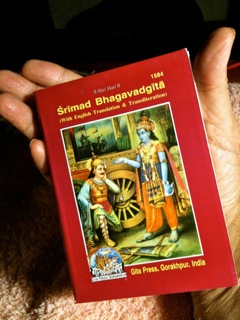
    Gita in the palm of hand…

    The Gita as a ‘palm of hand’ clearly shows us not only the destination but also in clearest terms the varying paths to reach there. One is free to select any path that suits well. Or one can even combine one with another. Throughout the Divine Song, Bhagwan Sri Krishna explains how – through devotion (bhakti), through knowledge (jnaana), and through action (karma) – one can reach the ultimate destination of union (yoga) with God. For different temperaments He lays out different paths, all the while reminding us that true, earnest  yearning and pure, surrendered love for God are the surest and simplest way to attain one with the Eternal.

    You don’t need to be a great scholar or a learned philosopher to understand the lessons of the Gita. Nor does the Gita demands decades of exacting penance to earn God’s favour. Rather, Bhagwan Sri Krishna offers infinite and eternal comfort by His words, “He, who is full of faith and zeal and is the master of the senses attains knowledge. Having attained knowledge one immediately attains supreme peace.” (IV.39)

    The Gita as the Guidepost

    Is the Gita relevant to the West today is an oft-repeated question. We can unequivocally say that yes, it is to West as it was and has been to the East. Not only for Hindus it is relevant but also for people professing any other religion. It teaches Hindus how to be better Hindus; it also teaches Muslims to be better Muslims, Christians to be better Christians, and Jews to be better Jews. For, if something is really “truth,” it must be universal. Truth is not limited to a religious framework. If it is truth, it must pertain to all.  Such is the profound truth of Bhagwan Shri Krishna’s words.

    Sun and Ganga – courtesy: matthieu-aubry

    The Bhagavad Gita is verily like Mother Ganga or the Sun; they do not discriminate.  Mother Ganga does not bring water to only Hindus’ farms.  The sun does not shine only on Christians’ gardens. Similarly, the Gita does not provide light and inspiration to only selected souls.

    Aldous Huxley said, “The Gita is one of the clearest and most comprehensive summaries of the perennial Philosophy ever to have been made.  Hence its enduring value, not only for Indians, but for all mankind.” Sometimes, it seems that the West actually needs this wisdom even more than people of the East. Why? It is often seen that the West seem to hold even more tenaciously to their agendas, their expectations and their desires. The message in much of the West is “If you work hard, you will succeed, you will become prosperous.”  So, people don’t work for the sake of being God’s hands.  They work to reap the benefits, and when the benefits don’t come or don’t come quickly enough, they are frustrated.

    It is the Karma Yoga of the Gita is the best answer to the problems engulfing the humanity in the West. People everywhere need both the message and the comfort of the Gita. With the ongoing assault of senses leaving indelible scars in the human psyche, the Gita stands as the harbinger of peace and harmony; it comes as the remover of pain; it bestows light dispelling the darkness of ignorance.

    The Gita as the Reflector

    digital painting – Courtesy : Dr S Adhinarayanan, New Delhi

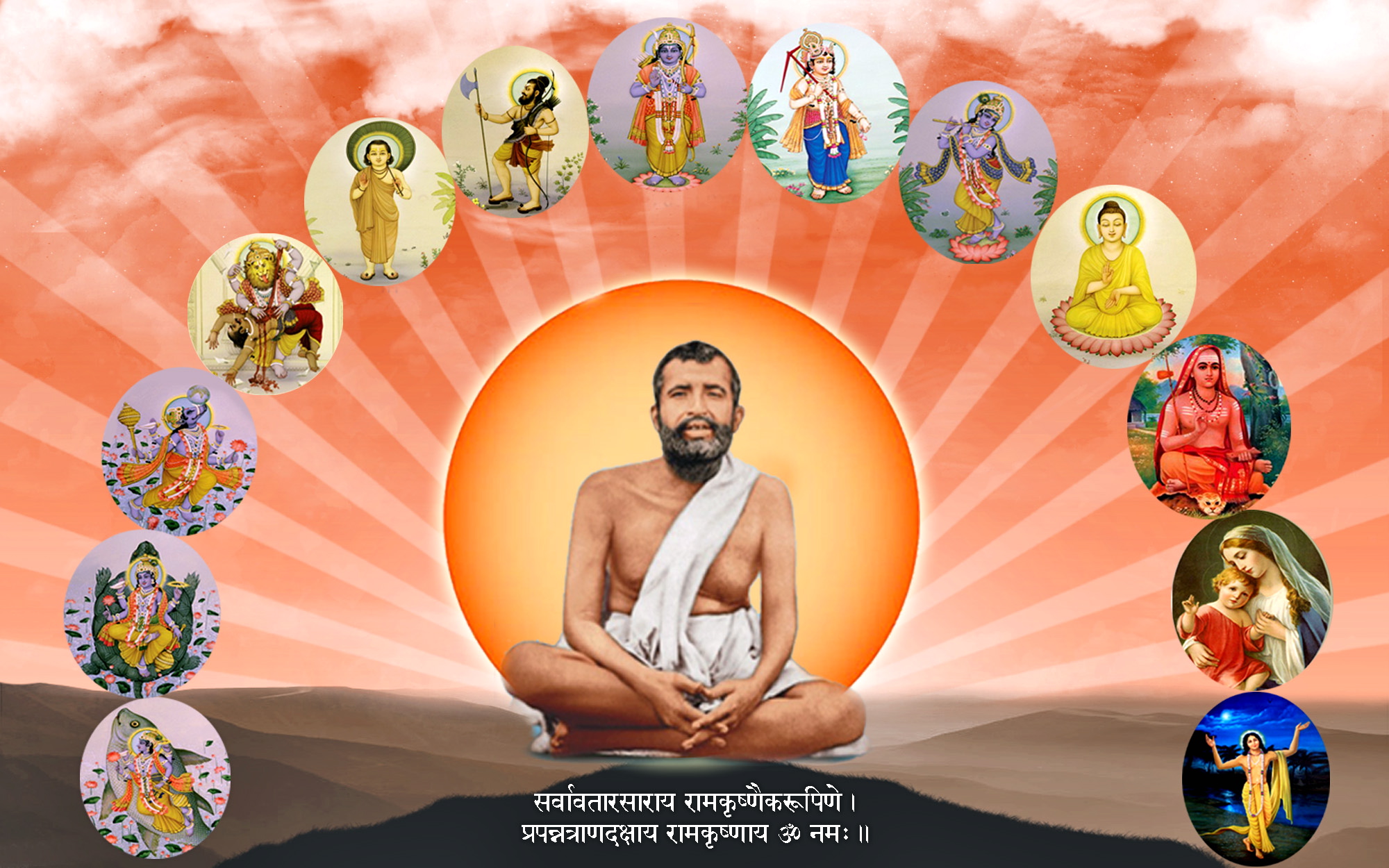
    It is remarkable that how Gita shines as the reflector for a practical spiritual life. What we see in the life of Sri Ramakrishna reiterates this point. The Paramahamsa never cared about the relative merits of religions. Neither did he entered into intricate differences of systems of philosophy. Verily he followed the footsteps of Sri Krishna. The unquenchable thirst for God and undying love for God’s name were the hallmark in Ramakrishna’s life. By his prolonged and intense spiritual practices, Sri Ramakrishna’s unique life that was transformed from an ordinary temple priest to paragon of spiritual values can best be clarified under this Gita Reflector.

    ==================================
  • 1860 Legacy – why?

    Sri Rajesh Gopie, the Playwright-Director
    Sri Rajesh Gopie, the Playwright-Director

    Morning tea-table on Tuesdays brings me regularly two visitors – Amar and Reeves, former a sports enthusiast and latter, a well-known attorney. For the past few weeks, Rajesh Gopie has also been joining us at the tea table. For those especially abroad who may not know him, let me simply tell you that he is a playwright-director. He is also well known locally as a stage, TV and a film actor. His next-door boyish looks indeed is deceptive. When he talks, his eyes spell out the emanating emotions. His recent production “The Coolie Odyssey” has been receiving rave reviews here. It presents the history of three generations of Indians in South Africa, the journey of our forefathers, the ‘indentured labourers’, ‘like no other told in this country’s theatre history’. Plays, musical melodies, cultural extravaganza, and many more media – all vie with each other in commemorating the 150th year of our ancestors’ arrival in this land. Rajesh aptly told me that all these attempts were nothing but ‘to make sense of who these forefathers were’ and simultaneously ‘to connect them to who we are today’. A very appreciable attempt indeed! And today there still are organisations that were started by the first or second generations. We at the Ramakrishna Centre were interested to know how these institutions have tried to enrich the community spiritually. The result was a Public Meeting.

    What is India?

    It is said that when our forefathers came from India in 1860, they landed at Port Natal empty-handed. We forget to note that, yes, empty-handed perhaps but not empty-hearted! When they moved into the shores of South Africa what came with them was the pristine spirituality and priceless culture of that ancient land – India.

    And then, ‘What is India?’ Let us listen to Swami Vivekananda:

    If there is any land on this earth that can lay claim to be the blessed Punya Bhumi, to be the land to which all souls on this earth must come to account for Karma, the land to which every soul that is wending its way Godward must come to attain its last home, the land where humanity has attained its highest towards gentleness, towards generosity, towards purity, towards calmness, above all, the land of introspection and of spirituality — it is India.

    What Program?

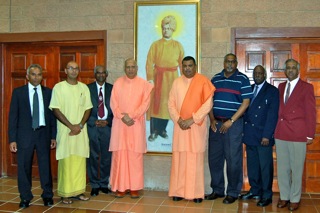
    From this land came our forefathers 150 years ago. The first ship, s.s. Truro, brought 341 immigrants. For Indians in South Africa, this day, i.e. 16 November, has great significance – not only in remembering and paying homage to those undaunted souls but also to draw lessons from them so that the future course of our life stands well-guarded. In commemoration of this historical event, our Centre organised a program, held on 13 November at Nischalananda Hall.

    from L to R: Ramesh Ishwarlall, Shivaprem, Bala Natesan, Swami Vimokshananda, Swami Saradaprabhananda, Dr JV Viranna, T Murugan, R Bindapersad

    The program included speakers from 5 organisations, with inaugural address by self and closing comments by brother Swami Saradaprabhanandaji.

    What protects whom?

    During these three and a half years of my stay in this country, I have been quietly admiring one wonderful quality of the SA Hindus, i.e. the intelligent adaptability to the ethos of this foster nation which has become the new-found Motherland.

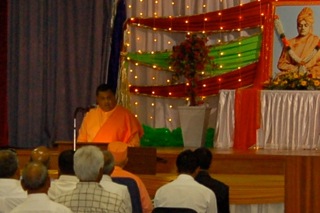
    Swami Vimokshananda inaugurating…

    While patronising this praise-worthy element of patriotism, I spoke on the need to preserve a unique religious identity –  only because the Hindus never in their history have anywhere spread their ideas either with a sword or with power or pelf. They have been all the time peace-loving and wherever they have gone, whether as immigrants or as tourists, they have, like the unseen dews of the early morning, contributed to the promotion of amity and harmony. This was largely made possible because of adopting a life-style on the basis of Dharma. I added that if dharma is maintained at all costs, that dharma alone will protect the Hindus — ‘dharmo rakshati rakshitah’.

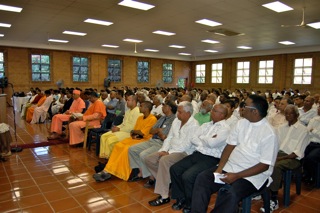
    attentive assembled audience…

    Another feature I spoke in praise of was the spirit behind the present grand achievement. Though being a minuscule minority, the presence of Indians is palpably felt in all walks of life such as Law, Medicine, Education, Engineering and the ubiquitous IT.  Marked economic advancement makes us feel proud of our progress. In this connection, I recalled the caution that Swami Vivekananda gave to his countrymen – that ‘neglect of masses’ is the foremost reason for the downfall of India. I added that concerted efforts must be co-ordinated by the Hindu community. They should disperse all possible resources in caring and sharing for the multitude living in the densely populated areas. Otherwise it would definitely be a cause for deep concern.

    What they said?

    Sri R Bindapersad of Aryan Benevolent Home Council

    I must hasten to add here that no one should come to the conclusion that no welfare work is being done by the Hindu organisations. For the last nine decades, as per the 6th/9th principles of the Arya Samaj, the Aryan Benevolent Home Council has been rendering yeomen service to the community, especially to the aged and orphans. The Council runs several permanent institutions that are indeed a model to the society, said Sri R Bindapersad, the President of the Council, who explained in detail about each of the institution’s activities.

    Sri Bala Natesan and Sri Shivaprem of Divine Life Society of SA

    Inculcating dharmic principles in individual lives was stressed by the late revered Swami Sahajanandaji Maharaj, said Sri Bala Natesan and Sri Shivaprem, co-chairmen of Divine Life Society. They enumerated such principles as brahmacharya, prayer, rights and wrongs in workplace and on the roads, spiritual readings etc. They emphasised on the meaningful relationships that should be developed and maintained between the members of the family.  It is noteworthy that the DLS has so far completed 400 social welfare projects and more than 10,000 ash-disposals have been done at Sivananda Ghat, a place used by Hindus of all denominations.

    Dr J V Viranna of Sri Sathya Sai Central Council of SA

    Dr J V Viranna, representing Sri Sathya Sai Central Council, gave a bird’s eye-view of the Value-Based Education in the Society. He said that without individual transformation, social peace cannot be achieved. He went on to describe how the intellect should be utilised in reaching the goal by comparing buddhi to a bird:  Satyam and Ritam are its wings, Shraddha its head and Yoga the Tail. All these must be combined so that the bird may soar with ease. He said that according to Sri Sathya Sai Baba advancement in technology would not bring happiness. Love is essential; that must be the undercurrent behind every activity.

    Sri T Murugan of Saiva Siddhanta Sangam of SA

    ‘Faith in oneself and faith in God is needed to get success’ is an oft-quoted saying of  Swami Vivekananda. One of the oldest Hindu organisations, Saiva Siddhanta Sangam, promoting Religion, Culture and Social Welfare, was represented by Sri T Murugan. He narrated extensively the turning point in the life of the Founder, the late Subrahmanya Guru Swamigal, who tirelessly spread the message of Faith in Lord Shiva everywhere. It was amazing to listen to Sri Murugan when he stated how Guru Swamigal, by his power of pranayama, lived one full day buried under the earth – and came out unscathed.

    Sri Ramesh Ishwarlall of Ramakrishna Centre of SA

    Hunger and thirst are the escalating factors in the sufferings of the masses, and the source of hunger is poverty. ‘Is there any cure for this worst malady?’ asked Sri Ramesh Ishwarlall, the Chairman of the Ramakrishna Centre of SA. He answered it by saying that two factors, namely, being industrious and getting educated, were the best ways to overcome this disease. He emphasised that all external service activities were to be carried out in the spirit of worship. While giving his presentation that detailed eminently all the varied activities of the Ramakrishna Centre, he advocated the policy of being ‘deeply Hindu and proudly South African’!

    What result finally?

    Swami Saradaprabhananda summarising…

    Listening to more than two and half hours of learned speeches, I was grappling with the difficulty of getting to my memory the salient points of each exponent. And right there came the help! In his inimitable way, brother Swami Saradaprabhanandaji rounded off the whole program with a brilliant summary. He pointed out that the progress of the nation presupposes the involvement of all communities. He further stressed on the need for a harmonious society that would pave the way for peaceful living. Then only will the best talent of each individual be manifested.

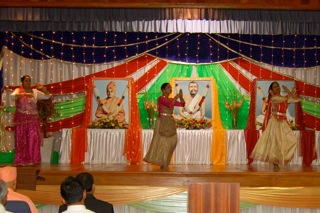
    The Ramakrishna Centre has been always promoting Hindu culture through encouraging our children imbibing traditional music, dance etc. The students of the Nateshwar Dance Academy, in their splendid performance of the dance items, caught the attention of the public. Each dance in the classical style charmed everyone.

    =========================