Vedanta in Practice

A Micro-Blog from Swami Vimokshananda – earlier at Durban, Singapore and Dublin – now at Yelagiri Hills, Tamil Nadu, India – "A private diary for public consumption!"

  • I owe an apology to all avid readers of this Blog for not placing my ‘posts’ on a regular basis. On an average two write-ups in a month was quite in order. But recently the last ‘post’ that came up on 24 March (Sri Rama navami day) was practically stranded as it was not followed up with other posts. That gave rise to mild apprehension in the minds of many devotees who wrote to me personally requesting me to continue this blog.

    Well, I had not decided to ‘discontinue’ it but due to the need for more time in my personal pursuits of scriptural study, I had to stop writing. But I can see that it produced indeed negative effect on me in that when I sat to type out my ideas, (to honour the devotees’ requests?), I had to squarely face what is called a ‘Writer’s Block’.

    However as one of our senior monks, Revered Swami Prabhanandaji Maharaj who is presently the General Secretary of our Order, well known for being a prolific writer and deep thinker, once told me that to get over the ‘block’ one has to continue writing every day without fail. Even merely copying a passage or two from any book will help in the removal of the block as thoughts would start flowing reading the ideas. I have seen him how after mangalarati and his personal sadhana in Belur Math, he would sit and write every morning. I do advise children ‘Write, write; right will you be’. I should have practiced it!

    So I place here the recent one, practically adapted from some of the info collection that I had. This was prepared under pressure of running out of time for printing of Jyoti, the quarterly magazine of our Centre, published from South Africa.

    Hindus have a large number of religious festivals. The essential purpose of holding a variety of celebrations is to make the human mind understand that Life itself a celebration. Moving from place to place in the process of doing a pilgrimage is again to make us understand that the power of God is every where.

    Lord Muruga
    Lord Muruga's lovely sanctum in Port Elizabeth, SA

    One such celebration is Thai Pusam. Thousand of devotees of Lord Muruga who is otherwise known as Skanda, Subramanya, Kartik, throng the places where He is worshipped. In the Bhagavad Gita Sri Krishna, while enumerating the God’s glory says that ‘ senaninamaham skandah’ – I am Skanda of the warrior-chiefs. (Ch X – Verse 24)

    Thai Pusam is celebrated on the day of the Pusam star in the Tamil month of Thai, which falls between January and February. Devotees in their colourful clothes come in families and express their brimming joy keeping of course to the rules of the sacred nature of the festival.

    What is Kavadi?
    The grand ritual of this festival is to carry Kavadi. What is Kavadi? It is an arch (made of wood or iron) on a wooden base. Peacock feathers and colourful flowers are used for its decoration. In it, is placed a picture of Lord Muruga. Two pots, usually filled with milk, are hung at both ends of this wooden base. The devotee carries this Kavadi on his shoulders to the temple, which is usually perched on a hill, where the milk is poured over the statue of Lord Muruga within the temple’s sanctum sanctorum. The Kavadi is carried after the observation of austerities like fasting, sleeping on the mat spread on the floor, eating only vegetarian meals etc lasting anywhere from a minimum of a week to the recommended 48 days.

    Kavadi dance
    The bearers of Kavadi dance along the route they travel to reach the temple. Those accompanying them break out in song or chant mantras. As the lead singer renders the songs, usually drawn from the kavadi chindu, a collection of songs specifically written for kavadi carrying, others in the group pick up the chorus or simply shout “Vel, Vel” at the end of each line.
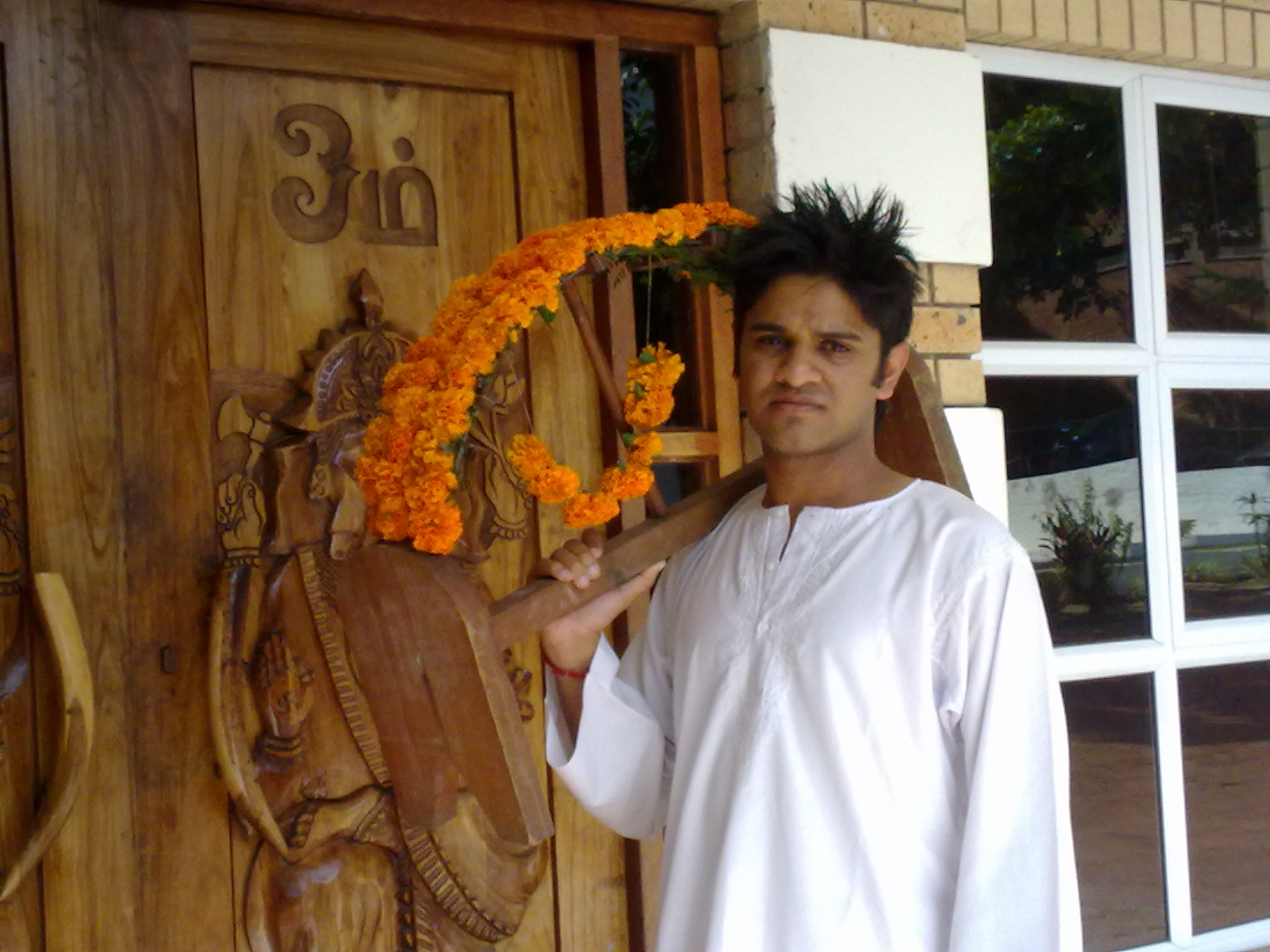
    Tinesh kavadi
    a devotee shouldering Kavadi…courtesy image : TG

    The twists and twirls done vigorously by the Kavadi dancers so as to balance the kavadi on thieir shoulders keeping to the beat of the mridangam (drums used in Carnatik music) and the melody of the nadasawaram (a conical wind instrument) is a scene of delight to the onlookers. The more experienced dancers show their artistry by shifting the kavadi over their shoulders, head and chin without using their hands. The kavadi aattam, a tandava (or masculine form of dance), produces a feeling of joy in the dancer as well as the spectators.

    What is Kavadi Chindu?
    Kavadi chindu is a generic name for a variety of Tamil folk songs. They are light compositions in Tamil, light only in the tunes, which could be sung even by children but the words potent with depth of meaning. They are popular for being simple, emotionally satisfying and spiritually appealing. The songs have stanzas but no pallavi, anupallavi and charana divisions and mostly are in praise of Lord Subramanya and are steeped in bhakti. The Kavadi Chindu relies heavily on folk music. In music concerts Kavadichindu finds a place at the tail end among the ‘tukkadas’. The ‘mudugu’ or the quick rhythmic tempo is a distinctive aspect of ‘kavadi chindu’. The songs are meant to be sung by people who carry the kavadias as an offering. This charming variety of Tamil folk song was composed and popularized by Annamalai Reddiar. He was born at Chennimalai in Tirunelvelli District of Tamil Nadu. A person of vivacious personality, he is stated to have led 
a reckless life and had spiritual transformation by developing bhakti to Lord Muruga and died in his young age of twenty-six.

    Do you want to listen to some of the compositions of Kavadi chindu? See here and listen to some lilting tunes!

    Mythology
    Thai Pusam signifies the day Lord Muruga received the Vel (spike) from His parents Siva and Parvati. According to Skanda purana, Lord Subramanya used this Vel to vanquish Tarakasur.  The demon symbolizes ego, action and its fruits and also ignorance. The weapon Vel cleaves these three limitations and frees the soul from bondage. Union with Muruga is the ultimate result.

    In South Africa

    The early Tamils who came to South Africa, despite vast improvements in their material life kept up the ancient practice of carrying Kavadi that brings them a definite social identity. The tenth day of Thai Pusam, being the last day attracts devotees to various Murugan temples. Nowadays Hindus irrespective of Language they belong to, carry Kavadis. One can see the Kavadi carriers pierce silver and gold pins through their tongues, cheeks and body. It is estimated that about 4000 kavadis are taking on that single day all over South Africa. The Seval Flag (Rooster insignia) considered holy is hoisted at the beginning of the festival. There are at least two major Kavadi festivals in a year around January and April.
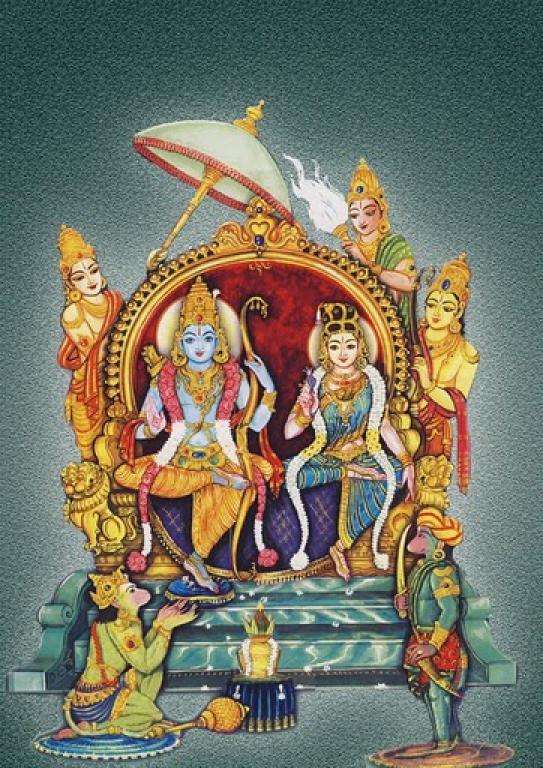
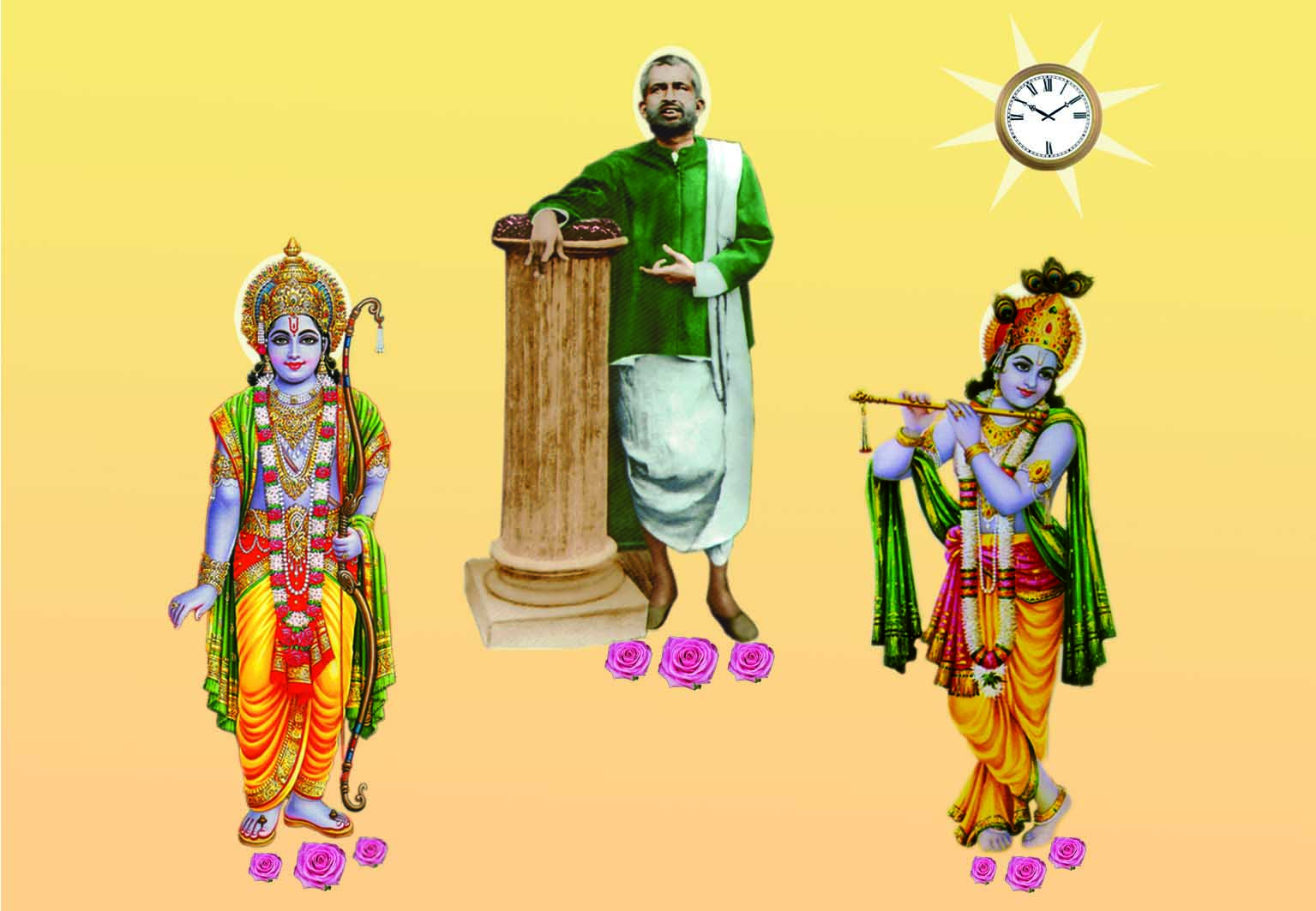
  • The above is Sri Ram durbar in a South-Indian style of painting. Cute Angad is standing opposite Sri Hanumanji. Picture appeared as the front cover image in Sri Ramakrishna Vijayam, March 2010 issue. Courtesy: Sri Ramakrishna Vijayam, The Tamil Monthly of Ramakrishna Math & Mission

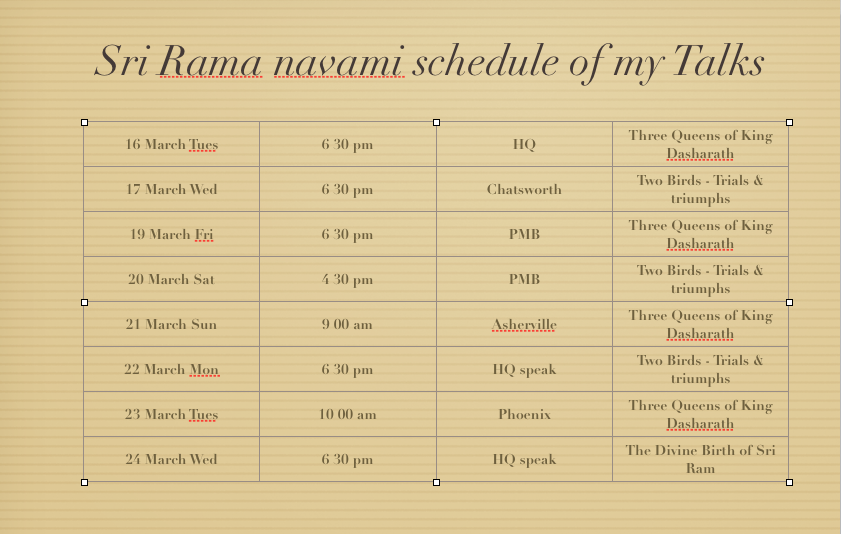
    Today is Sri Ramanavami. On this holy occasion, I convey to every one of you my hearty wishes and prayers. The last 8 days were indeed hectic. The first day was at HQ where I spoke on The Three Queens of King Dasharath. Second day was at Chatsworth sub-centre where my topic was The Two Birds – Trials and Triumphs. On Friday and Saturday at Pietermaritzburg sub-centre. On Sunday at Asherville Sri Sarada Devi Ashram. Monday at HQ. Tuesday at Phoenix sub-centre and today at HQ again on The Divine Birth of Sri Ram.

    My earlier write-up on lord Sri Rama and his sweet name is still having the highest number of views compared to other posts. When I was thinking what I should place here today, I had just glanced the Tamil Monthly magazine of our Order, Sri Ramakrishna Vijayam, brought out by Chennai Math and was thrilled to see the cover page image that gives a picture of Ram durbar as it is generally known.

    The picture depicts the coronation ceremony of Sri Rama as ascending to the throne and thus made King of Ayodhya. The attraction of this picture is the inclusion of Angad. In the above painting one can see that Hanumanji holds the footrest below the throne wherein Rama and Sita seated and Angad stands erect as a security guard with his drawn sword held in his hand as Kamban in his Tamil poem explains in his inimitable style: ariyaNai anuman thaanga angadhan udai vaaL Endha

    In North-Indian painting of the Ram Durbar, Angad is rarely included.

    The epic Ramayana whether one reads Valmiki’s invaluable original in Sanskrit or Tulasidas’ charming creation in Hindi or Kamban’s mesmerizing masterpiece in Tamil, surely abounds with the galaxy of characters. Some are major and others are minor. But each character stands for some sparkling quality and none is insignificant.

    Angad, losing his father Vaali in the hands of Sri Rama slowly raises to the occasion. Rama’s protective cover guides him to such an extent that he goes to Lanka and meets Ravana as Rama’s messenger! What a naughty boy he was in the presence of mighty Ravana!

    Tulasidas’ description of the encounter Angad had with Ravana at his assembly is undoubtedly an all absorbing account. It shows that Angad was absolutely fearless. Understandably there were some comical moments in the forceful dialogues between the unequal two, yet the whole episode signifies the wonderful physical and mental strength of Angad at that young age and his unwavering devotion to the holy feet of Lord Raghunath and thus, I feel Angad rightly deserves a place in the Ram durbar.

    =======================


  • Children like to question. And I appreciate it as an expression of their intense thirst for knowledge. I wrote this given-below dialogue in an easy, conversational style between two children and myself. This is, of course, based partly on an actual discussion with the named children, and later written for Dipika 2009. It is an annual spiritual magazine especially for children, regularly brought out by Sri Sarada Devi Ashram at Asherville in Durban. My grateful thanks go to Sister Pravrajika Ishtapranaji for according her kind consent to reproduce it here.

    After lunch, as usual, I was about to retire to my room and take my noon-day rest. Just then two fresh faced, enthusiastic, devoted boys came into my office, bursting with joy and questions. All thoughts of sleep left me when I sensed their willingness to have a conversation.

    An interesting discussion began when I asked the children to state the names of two famous incarnations of God. Rahul immediately mentioned the name of Lord Ram. His little brother Trishul remembered Lord Krishna.

    Trishul: Swamiji, why do Hindus believe that God incarnates on earth?

    Swamiji: That is a good question! God descends according to the needs of the time, to help us live happily, be peaceful and live spiritual lives. When people start misbehaving, fight with one another and adopt evil ways, then God comes to protect goodness.

    Rahul: But some of my friends ridicule us and say that we worship many Gods. Isn’t it true that there is only ONE God, Swamiji?

    Swamiji: Undoubtedly, God is ONE. Have you not heard that God is Omnipotent?

    Trishul: No! What does that mean?

    Swamiji: It means that God is all-powerful. Though there is only ONE God, yet by His divine power He can assume many forms and have many names. Therefore Hindus believe in different incarnations of God. The Sanskrit word for incarnation is Avataar.

    Rahul: So we see that God can take many names and forms because He is all-powerful!

    Swamiji: Exactly so, Rahul! You do know that there are many people on earth, though we are one as humanity, yet we have different tastes. We are born with our own varied natures. You may not like what I like. Therefore every one should have the freedom to choose the form of God that he or she likes. Each one worships the same God in the form that appeals to him or her, the most. But always remember, no matter what form of God you love and pray to, GOD IS ONE.

    Rahul: Why does God manifest Himself in human form?

    Swamiji: God wants to help us realise Him. He teaches us the righteous methods of living on His beautiful earth and how to care for all living beings. God loves all living and non-living beings on this earth, because everything has come out of Him alone.

    Trishul: Swamiji, but I find it difficult to think of God without a name and a form. Is not God with form more lovable?

    Swamiji: Rightly said, Trishul! God in his personal aspect can be loved and served too. You should be able to choose the particular name and form of God, according to your nature.

    Rahul: I love Lord Ram. He killed Ravana and brought righteousness back to Lanka. He ruled this earth from Ayodhya.

    Swamiji: Oh! that is wonderful. Can you name one great devotee of Lord Ram?

    Rahul: Yes Swamiji. Tulsidas! My father and mother read a portion from Tulsidasji’s Ramayana everyday. They say that reading the Ramayana in the morning helps them to cope with the challenges of life.

    Swamiji: Excellent! What is the title of the Ramayana that Tulsidasji wrote?

    Rahul: Sri Ramacharitamanasa.

    Swamiji: Very good, Rahul. Now boys, let me narrate an interesting story about Tulsidas, the author of this great scripture.

    Tulsidas loved Sri Ram with all his heart. In the beginning, he did not prefer any other form of God for his personal worship. One day some of his friends decided to go to Brindavan, the playground of Lord Krishna. They requested Tulsidas to accompany them. But Tulsidas was a little hesitant, because he did not want to go to any place that was not connected with Lord Ram.

    Rahul: Was he a fanatic, Swamiji?

    Saint Tulsidasji
    Saint Tulsidasji

    Swamiji: No Rahul, he was not a fanatic. But he had such deep devotion to the lotus feet of Lord Ram that his mind was not willing to accept any other form of God. When his friends insisted, he accompanied them to Brindavan. However, while entering Sri Krishna’s temple, he closed his eyes. The all-knowing Lord understood Tulsidas’ predicament. Lord Krishna looked at His beloved Radha and said, ‘Look Radha! My sincere devotee has come here. When he opens his eyes he would not like to see me in the present form. So, let us change our forms to satisfy him.’

    Trishul: Which form did they take, Swamiji?

    Swamiji: When Tulsidas made pranams (prostrations) to the Lord, he assumed that the temple deity was Sri Krishna, so he was unwilling to open his eyes. But his friends asked him to observe the magnificent murti (image) of Sri Krishna, which was decorated so well. Tulsidas opened his eyes slowly and, lo and behold! he saw the lotus feet of His beloved Sri Ram. When he raised his head in wonder he could see the bow and arrows held in Ram’s long, beautiful hands. The Lord’s eyes looked like a freshly blossomed flower. He also saw the serene face of Mother Sita. Tulsidas was stunned and overwhelmed to see Sri Ram. He now realised that Lord Krishna and Lord Ram are ONE and the SAME divine being!

    Trishul: So Swamiji, does the word ‘deity’ mean ‘God in His personal aspect’?

    Swamiji: You have understood rightly, Trishul! There are many deities and you can choose any one from the hundreds of forms, according to your taste and temperament. The one that you choose is called the ‘ishta-devata’, meaning your chosen deity. By worshipping the ishta-devata, your mind becomes one-pointed and devotion to God grows very easily and quickly. In the beginning of one’s sadhana (spiritual practices), worshipping many deities dissipates one’s energy and may not be conducive to spiritual progress. Therefore our sages have recommended that we have an ishta-devata, a chosen deity.

    Rahul: Swamiji, which deity should I choose?

    Swamiji: Choose that deity whose form you like the most!

    Trishul: Is it not true that Hanumanji also has Sri Ram as his ishta-devata?

    Swamiji: Well said.

    Srināthe jānakināthe abheda paramātmani |

    Tathāpi mama sarvasva rāmah kamala lochanah ||

    Sri Hanumanji once explained that although there was no difference between the Lord of Lakshmi (Narayana) and the Lord of Janaki (Sri Ram), yet his chosen deity was the lotus-eyed Sri Ram.

    So, Rahul and Trishul! What did you understand?

    Rahul and Trishul: Swamiji, we understood that having a chosen deity is good for devotion but at the same time, we should not be narrow-minded. We should respect all deities because the ONE God alone has become many.

    He who came as Rama and Krishna…

    Swamiji: You both attend Sunday Classes for children. Tell me, can you remember any example that our dear Master Sri Ramakrishna has quoted?

    Rahul: Yes, I remember! Master gave the example of a man digging a well. First he dug down to a depth of ten meters. He could not find any trace of water there. Then he selected another spot and dug a little deeper. He found no water there either. So he gave up that spot and dug in yet another place. Again he was unsuccessful. Disgusted at his failure to find water, he finally gave up his efforts.

    Trishul: Now, let me complete the story! So, Master said that if that man had patiently dug at one place, he would have found water. The same is the case with anyone who changes his faith continually. By having an ishta-devata one can progress and reach the goal.

    Swamiji: I really appreciate you, boys! How I wish all the children would attend our Sunday Classes!

    Today begins the nine-day Sri Rama navami celebrations in our Centre culminating in the Navami on 24 March, 2010. A special havan will be performed at the noon. Here is the schedule for my Talks:


  • A Report by Akshay Mootheeram

    Swami Shivanandaji, a direct disciple of Sri Ramakrishna, once observed: “If you want to achieve anything substantial in spiritual life, visit Belur Math, stay here and do spiritual practices. It is for this purpose alone that Swamiji dedicated his life and founded this Math.”

    The spiritual current that flows in Belur Math is carried to all its branches, affiliates, sister-centres and therefore undoubtedly visiting any of them is indeed a pilgrimage.

    A bus full of devotees from Ladysmith sub-centre decided to undertake a pilgrimage to three centres in Durban and I am glad to present a Report, penned – nay! composed in a Word Processor as the modern youth are wont to – by Akshay Mootheeram who is a youth member of the Sub-Centre there. Images courtesy: ‘Yushavia

    Aum Namo Narayanaya!
    It was Sunday the 31st of January 2010.

    captivating scenery of crimson sunrise…Image courtesy: Rishie, PMB

    At approximately 05:30, as the crimson sun raised its beautiful head only to reveal but a peak of sunlight amidst the darkness of the early morning, our bus filled with 76 devout and enthusiastic men, women and children alike, from the Ladysmith Sub-Centre set out on an prayerful pilgrimage to Durban.

    Pilgrimage to Durban?

    Yes, it was certainly a pilgrimage to Durban where we were to visit the Headquarters of the Ramakrishna Centre of South Africa in Glen Anil, the Phoenix Sub-Centre as well as the Sri Sarada Devi Ashram in Asherville.

    Although many of the devotees of Ladysmith Sub-centre had visited these Ashramas at some or other time, it was truly special to travel in unison, as a group with the same frame of mind and moreover, in the greater sense, as a family.

    Of course, belonging to an organization of this stature, one can expect only but the best in terms of service, safety and comfort, without any compromise. Therefore, a program was planned for the bus which commenced with the Opening Prayers, which was to be followed by the chanting of the Hanuman Chalisa and other kirtans. Although many of the devotees were still dreary from the early morning, everyone joined together in the melodious singing of these kirtans. The atmosphere thus created was serene and calming, soothing the minds of the devotees who were focusing on the great events that were about to unfold.

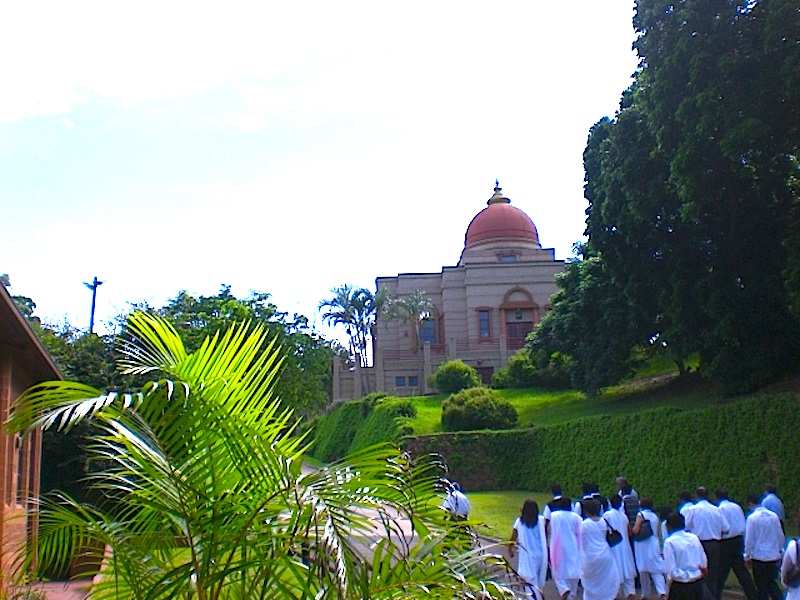
    hastening towards the holy temple…

    At approximately 08:30 we arrived at Headquarters. The sight of the majestic Ashram was overwhelming. After being warmly received by the devotees at Headquarters we proceeded to the shrine to offer our pranams to Master, Mother and Swami Vivekananda. We were then briefed in the day’s proceedings and subsequently moved to the Swami Nischalananda Hall where we were served a light, yet refreshing, breakfast. Our Revered President Maharaj, His Holiness, Sri Swami Vimokshanandaji Maharaj, addressed us, both welcoming and blessing all the Devotees. In his short address (because of his prior appointment at Chatsworth Sub-centre), he pointed out the utter usefulness of studying Ramakrishna-Vivekananda literature everyday. He added that by such studies, the ever-lasting ideas that the Holy Trio gave out for the world, would slowly sink into our mind and would be conducive for our spiritual sadhana.

    Brother Ramesh Ishwarlall, who is the Chairperson of the Centre, then took us all on a grandeur tour of the premises. For many devotees, this was their first exposure to Centre’s Ashram grounds, facilities and buildings. We then reassembled in the shrine to enjoy a blessed satsang and meet His Holiness, Sri Swami Brahmarupanandaji Maharaj who blessed us all. He is a senior monk, South Africa-born, had come from India on a visit. Sadly however, we departed at 09:10 feeling the brief stay, instead of satisfying only kindled our thirst for spending more time. We left for the Phoenix Sub-Centre to meet with His Holiness, Sri Swami Saradaprabhanandaji Maharaj.

    Swami Saradaprabhanandaji speaking to devotees…

    Once again we were most warmly received not only by the devotees, but by Swamiji Himself. We all then proceeded to the shrine where a 30-minute satsang was held. The ambience in the shrine was phenomenal and left us all speechless, including Swamiji Himself. Next we assembled in the waiting rooms of the Ramakrishna Centre of South Africa Clinic where we were addressed by Sister Veena Singaram and Advocate Kessie Naidoo, who enlightened us on the activities of the Phoenix Sub-Centre focusing on the program for Youth Development, but moreover, by Swami Saradaprabhanandaji Maharaj who really inspired us all. This was followed by a DVD presentation presented on the breath-taking advancement of the IT industry in India.

    The next event was one that everybody anxiously looked forward to…Lunch! Yes, lunch was served with the highest feeling of love and care, we all feasted on the delicious food which was thoroughly prepared by the devotees at Phoenix.

    Finally, we concluded the program with a DVD entitled ‘Mind Your Language’ which spread waves of chuckles amongst all present, creating a light-hearted and relaxing atmosphere.

    But the highlight of our Phoenix trip was the opportunity to meet with His Holiness, Sri Swami Saradaprabhanandaji Maharaj who spoke to each and every devotee individually. We then left the Ashram, with happiness and peace in our hearts, and proceeded in the early afternoon towards Asherville.

    On our arrival at the Sri Sarada Devi Ashrama, yet again without fail, the warmest of welcomes was presented to us.

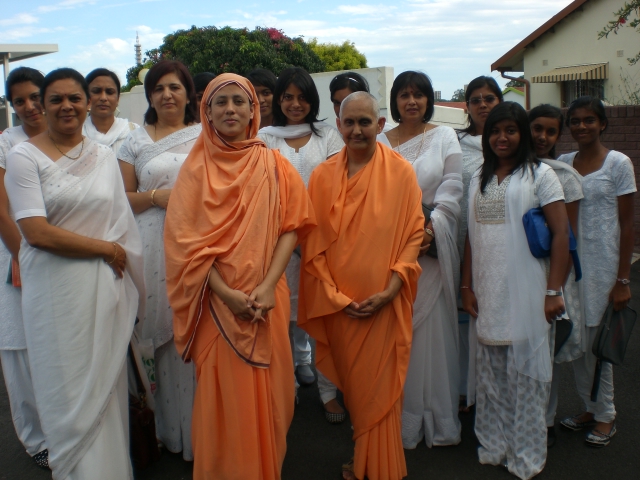
    a group of devotees with graceful matajis at SSDA

    We immediately proceeded to the shrine for a satsang which was thoroughly enjoyed by all. Promptly thereafter we were served refreshments and had the opportunity of spending a few brief moments with Her Holiness Ishtaprana Mataji and Her Holiness Divyanandaprana Mataji. As much as would have liked to stay, unfortunately the time came for us to depart.

    There could have been no better way to end our pilgrimage than at Holy Mother’s Ashram. Somehow, the day now felt totally complete and fulfilled.

    At 16:00, we boarded the bus and departed from Asherville with complete peace of mind, thanking within, one and all who made the memorable event a truly remarkable. A pilgrimage worth to ponder in a period yonder!

    Jai Sri Thakur!

    =======================

  • A Report by Avthar Sewrathan

    Many countries have their own National Youth Days. In South Africa, National Youth Day is celebrated on 16 June every year. Each country has its own reasons to celebrate it. India has its National Youth Day on 12 January which is the birthday of our illustrious leader Swami Vivekananda. Here in South Africa we, the Ramakrishna devotees, celebrate South African Youth Day on 16 June and in January, we, at HQ, have an half-day Retreat program for the youth in commemoration of Swami Vivekananada’s birth day. In continuation of the 147th birth anniversary celebrations of Swamiji, Pietermaritzburg Sub-centre had arranged a meanigful Youth meet. I am glad to present a Report, penned – nay! composed in a Word Processor as the modern youth are wont to – by Avthar Sewrathan who is a youth member of the Sub-Centre there. Images courtesy: ‘Rishie’

    The day had finally arrived!  We, the youth members were just awaiting the commemoration of the 147th Birth Anniversary of Swami Vivekananda at the Pietermaritzburg Sub-Centre, held on 5 February 2010.

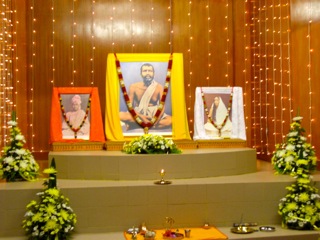
    mesmerizing shrine of Maritzburg…

    This is one of the most important functions on our Religious calendar as the philosophy of Swami Vivekananda and the ideals for which he lived and worked continue to be a great source of inspiration for the Youth. He will be ever remembered as one of the main architects of the modern world for he brought about a new understanding of Vedanta and bridged the gap between east and west. Accordingly, the youth were eagerly gathered in the shrine and great anticipation was in the air as this function was exclusively planned, co-ordinated and managed by the Youth of the Sub-Centre.

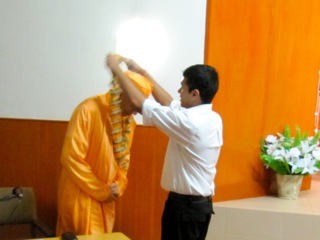
    Akshar garlanding Vimokshanandaji

    The programme commenced promptly at 19:00 hrs and the devotees were warmly greeted by sister Karistha Singh who was the Programme Director for the evening. After the initial proceedings, brother Akshar Sewrathan extended a cordial welcome to His Holiness Swami Vimokshanandaji Maharaj by garlanding him. Earlier at the entrance two sisters placed the holy tilak on his forehead in the traditional style.

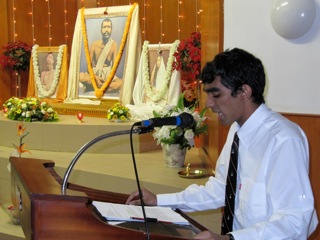
    Sonal presenting her paper…

    The first speaker for the evening was sister Sonal Sewrathan, who addressed the congregation on the topic “You are the Creator of Your Own Destiny”. Sister Sonal related the parable of a Pencil Maker, highlighting the fact that we are all created by the Maker who is God, to follow our own destiny by either beautifully designing it OR misshaping it with our thoughts, words and deeds.

    She also recounted the famous parable by Sri Ramakrishna on the wish fulfilling Kalpataru tree as of immense significance.  ‘Your mind is like the wish-fulfilling tree – whatever you think, sooner or later it is fulfilled irrespective of good or bad results.’  Finally, she challenged us to become the creators of our own destiny by following this simple inner golden rule :

    Watch your thoughts; they become your words. Watch your words; they become your actions. Watch your actions; they become your habits. Watch your habits; they become your character. Watch your character for it will become your destiny.

    Yashvir presenting his paper…

    The second speaker was brother Yashvir Rugbeer, who presented a paper entitled “The Importance of Youth in Society”. He reminded the youth of their role in society. Quoting Sri Swami Vivekananda extensively he emphasised that the sole responsibility of the youth of today rested on the present so that they can suitably mould the future, as it depended only on the efforts of their hands. He added that their values, determination and character ultimately decide the preservation of our world.

    Brother Yashvir pointed out also the fact that youth are completely entangled in the superficial world and do not realise the gravity of their actions, primarily due to their ignorance. He highlighted that the essence of true success is what ‘you make of yourself’.  ‘It is the conduct of life that you develop, it is the character that you cultivate and it is the type of person that you become.’  He advised the youth to equip themselves with the necessary skills in order to ensure a bright future as success was not measured in terms of what one obtained but in terms of what one could become, how one lived and what actions one performed.

    The youth were then treated to a soul stirring rendition of “Ham Honge Kamayab” bhajan led by sister Revathi.

    Shivaar presenting his paper

    The third speaker for the evening was brother Shivaar Partab, who delivered a paper on “Character and Human Excellence”. He narrated the story of the sculptor who indicated that beautiful figures were not created by him as he merely removed the extra pieces off the stone with his tools, relating this to Human character.  ‘Good qualities lie dormant in each one of us and it is our duty to give expression to them and let the evil ones take to their heels. We have to be examples of good values in order to achieve human excellence.’ Brother Shivaar reiterated the three important things, expressed by Swami Vivekananda, to make everyone great, every nation great, namely :

    Conviction of the power of goodness;
    Absence of jealousy and suspicion; and
    Helping those who are trying to be and to do good.

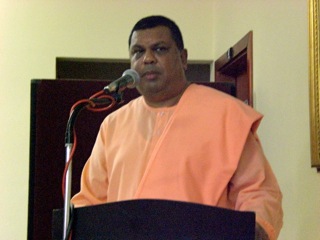
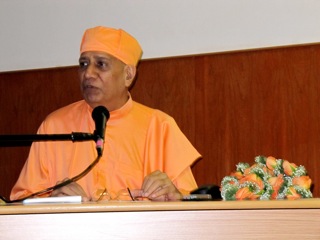
    Karishtha inviting Vimokshanandaji to present his Address…

    Finally, sister Karistha invited Sri Swami Vimokshanandaji Maharaj to address the youth. Swamiji is the embodiment of love, compassion and humility and the youth of the Centre were extremely blessed to be in his holy company. Everyone waited with bated breath in order to imbibe the sacred message that Swamiji Maharaj was about to deliver. However, true to form, Swamiji surprised us and introduced an impromptu “Question and Answer” session.

    conducting Q & A session…

    Swamiji encouraged the youth to “be bold” and put forward questions on the papers that were delivered that evening. Discussions centred around the many temptations that the youth are currently faced with, the social evils of electronic media, disciplining of the youth and overcoming injustices faced by the youth.

    Swamiji astutely handled all the questions posed by the congregation, offering sound advice based on the teaching of the holy scriptures and also as taught by the lives of the three Divinities, in terms of implementation in our daily lives.

    Sadly due to time constraints, the question and answer session had to come to an end. After the performance of arati and concluding Vedic prayers, it was my proud turn to proceed to pass the vote of thanks. Three of our youth members, sisters Kajal, Shriyanthi and Kamiksha presented a gift basket to Swamiji as a token of our appreciation.

    Happy youth group members…

    This was truly an inspiring evening. This was echoed by one of the devotees, who described the evening as “one of the best functions so far”. The youth offered their pranams to Revered Maharaj, and thereafter partook of prasad, in the form of supper.

    Thus concluded an evening of spiritual enlightenment. Everyone present can safely say that they were stimulated and entertained by the thought provoking programme. It provided the youth an opportunity to showcase their knowledge, talents and ideas and it was this that made the event a fitting tribute to the teachings of great Swami Vivekananda.

    Hari Om Tat Sat!

    ===========================