A Micro-Blog from Swami Vimokshananda – earlier at Durban, Singapore and Dublin – now at Yelagiri Hills, Tamil Nadu, India – "A private diary for public consumption!"
Paarvati devi is my Mother, father is Maheshwara – Shiva.
Relatives are the devotees of Shiva and my own country is all the three worlds.
-Sri Adisankaracharya
======================================== Dear Readers
Many thanks for the wonderful words of best wishes! And they have come just a day before and are coming during Mahashivaratri.
May He, the Bholaanaath with the divine mother Bhavaani, residing in every one’s heart, guide us at every step is my earnest prayer to Him.
Shiva means mangal. Auspiciousness. May that quality, by His infinite grace, abide in all of us in abundance!
With love and prayers Swami Vimokshananda
Many countries have their own National Youth Days. In South Africa, National Youth Day is celebrated on 16 June every year. Each country has its own reasons to celebrate it. India has its National Youth Day on 12 January which is the birthday of our illustrious leader Swami Vivekananda. Here in South Africa we, the Ramakrishna devotees, celebrate South African Youth Day on 16 June and in January, we, at HQ, have an half-day Retreat program for the youth in commemoration of Swami Vivekananada’s birth day. In continuation of the 147th birth anniversary celebrations of Swamiji, Chatsworth Sub-centre had arranged a Youth Forum meet. I am glad to present a Report, penned – nay! composed in a Word Processor as the modern youth are wont to – by Sohana Chunder who is a youth member of the Sub-Centre there. Images courtesy: ‘Jerry’
On the 31st January 2010, the Chatsworth Sub-Centre of the Ramakrishna Centre of South Africa hosted the Vivekananda Youth Forum. Swami Vivekananda has been extolled by many as a rishi, a social reformer, an educationalist and a saviour. Of special significance is the influence he had on the youth of both India and the rest of the world. This Youth Forum is based on the values that Swamiji advocated for the youth.
The panelists with the President in the Youth Forum
The Forum, on that memorable day, consisted of four participants who represented four different organizations. Each participant was required to read an extract from the teachings of Swami Vivekananda and then share their own thoughts based on the extract.
Kalayvani from Vivekananda Mission speaking on Education
The first participant was sister Kalayvani Govender of the Vivekananda Mission who chose the topic “Education”. After reading out the valuable quote of Swamiji on ‘Education’, Kalayvani proceeded to explain the tenets of civilization. She emphasized the need to adopt Swamiji’s ideas as without which the civilization may reach disastrous results. She brought out topical reference of Haiti calamity and how the organisations doing relief work were vying with each other in popularity game instead of rendering service to the suffering in all humility.
Alvna of the Sri Vishnu Temple Society, speaking on The Ends and the Means
The next one was sister Alvna Santilall of the Sri Vishnu Temple Society. She spoke on “The Ends and the Means”. While explaining how ‘ends’ must be tallying with the ‘means’, she deplored that often the means were given more importance and anything could justify the ends. She gave out four methods to fortify the concept of ends having proper means: 1- Avoid evil company, 2- Attach to right conduct, 3- Practice Will Control and 4- Cultivate virtues. She concluded that life is a school calling sacrifice with reliance on God.
Merisha of the RKC-SA – Chatsworth Sub-Centre speaking on Strength
The last participant sister Merisha Roopnarain of the Ramakrishna Centre of South Africa – Chatsworth Sub-Centre spoke on “Strength”. She analysed the character of strength as opposed to ‘weakness’. She aptly quoted Swamiji about the cause of weakness being not sticking to Truth. In order to increase ‘strength’ she advocated four methods: 1- Making good habits a regular feature, 2- Spending Time in constructive ways instead of gossiping etc., 3-Not fearing obstacles but look at them as challenges and 4- Never brooding over weakness. Sister N. Singh from the Sri Maha Ganapathi Mandhir was the next panelist, scheduled to speak on “Character” but, unfortunately due to untimely death in her family, she was unable to attend the Forum.
Swami Vimokshananda conducting Q & A session
Once all the participants delivered their presentations, it was the turn of Revered Swami Vimokshanandaji Maharaj. He shared his thoughts and feelings on the three presentations and engaged in a period of questions and answers with the audience. As usual the Q & A session was not taking off due to the apparent shyness of the participating youngsters. He made the youth understand that their inability to raise questions was not actually due to shyness but due to weakness. He further told them that how Swamiji had thundered to the youth to ‘Be Bold!’ and lo! once one question was fielded, the youth started pouring in with questions. There was of course, interesting discussions on several themes especially that are concerned with their career and shaping their future life.
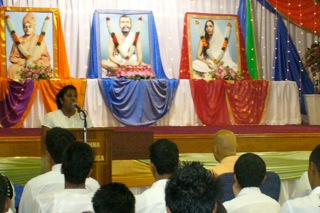
Manjusha Madam explaining what is meant by Character
Before beginning the Q & A session proper, Vimokshanandaji requested Mandusha Maharaj of the audience to come to the front and speak on the 4th topic ‘Character’. Madam Mandusha eloquently explained the salient feature of what was thought of as Character. She clearly spelt out the two means viz., keeping to Truth and surrender to God as the most important elements in developing Character. Thereafter Swami Vimokshanandaji made presentation of gifts to the panelists. The audience appreciated with loud applause madam Mandusha‘s kind gesture of sending the gift packet to the absentee panelist also who was in mourning.
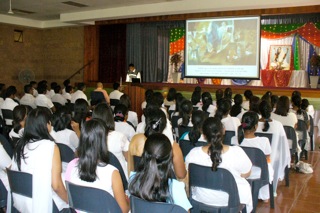
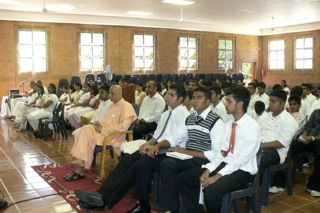
a section of audience in the Youth Forum Meet
I feel blessed to have been given an opportunity to be the Director of Ceremonies on the Youth Forum occasion. It was no doubt challenging especially during question-answer session. But there is no end to learning. After uncle KK Pillay concluded the Forum with Vedic prayers, everyone partook of a scrumptious lunch and then departed. The Forum was a memorable one and the youth left the Forum having learnt valuable lessons of Life.
For more photos of the occasion please see the slideshow below:
Many countries have their own National Youth Days. In South Africa, National Youth Day is celebrated on 16 June every year. Each country has its own reasons to celebrate it. India has its National Youth Day on 12 January which is the birthday of our illustrious leader Swami Vivekananda. Here in South Africa we, the Ramakrishna devotees, celebrate South African Youth Day on 16 June and in January, we have an half-day Retreat program for the youth in commemoration of Swami Vivekananada’s birth day. The Sunday, 24 January 2010, was chosen by the youth members of our Centre to commemorate the 147th birth anniversary of Swamiji. Despite the sweltering heat and humidity on that day, a hundred eager youth attended the specially arranged Youth Retreat. This Retreat – not definitely ‘an act of moving back’ but proceeding progressively ‘going ahead’ ! I am glad to present a Report, penned – nay! composed in a Word Processor as the modern youth are wont to – by Chetan Ramlall who is a youth member of the Centre here. Images courtesy: ‘Kamal’
The programme began at 9:00am sharp, when the youth had assembled in the main shrine hall of the Ramakrishna Temple. After the soulful rendition of bhajans and kirtans like Parama dayaal, Swamijiki jeevan gaathaa and moorta maheshwaraby the ashram’s Ramakrishna Choir, the youth were treated to another feast.
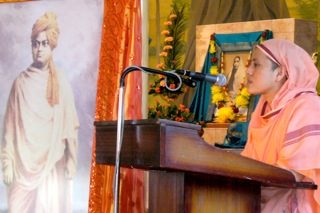
Pravrajika Divyanandaprana Mataji promoting awareness among the youth
Revered Pravrajika Divyanandaprana Mataji, a respected sannyasini (nun) of Sri Sarada Math, Dakshineshwar, near Kolkata, India, delivered a Talk. She has come to South Africa on a visit and has been staying at Sri Sarada Devi Ashram at Asherville. Notwithstanding the topic entitled – Swami Vivekananda’s Message to the Youth – undoubtedly appealing, the manner in which the learned Mataji eloquently explained Swamiji’s simple 5 step formula to success, was truly awe-inspiring. The formula as enumerated by her was to combine the Five ideas : Goal orientation, Faith in oneself, Service to others, Clean and disciplined habits and Concentration. The first session concluded with meditation and prayers.
After a short tea break, the youth reassembled in the Swami Nischalananda Hall, where they waited to a very informative Seminar.
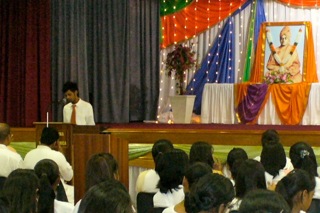
Nikhil Ramdass spoke on ‘Will power and a Disciplined Mind’ with a firm conviction
Brother Nikhil Ramdass, who matriculated last year, spoke on ‘Will power and a Disciplined Mind’ with a firm conviction. His recommendations were : identifying priorities, increasing inner vigilance, adopting time saving methods and avoiding meaningless talks.
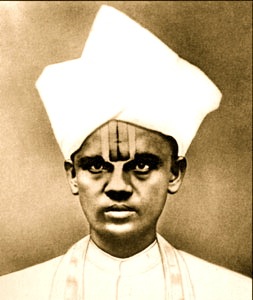
Jessica Thakurpersadh, speaking on ‘Sri Alasinga Perumal’
Sister Jessica Thakurpersadh, spoke next on ‘Sri Alasinga Perumal’, one who was referred by Swami Vivekananda as ‘My dearest disciple’. She explained in detail how Alasinga was the initial instrument for promoting Swamiji’s attending Parliament of Religions in Chicago. Fired with zeal and fortified with faith in himself and God, how Alasinga started and ran successfully an English journal that preached Vedanta as propounded by Swamiji, was the rest of her illuminating speech.
Yashmille Raghunundan speaking on ‘Swami Vivekananda’s Secret of Work’
The final speaker was brother Yashmille Raghunundan, who spoke on ‘Swami Vivekananda’s Secret of Work’. He narrated the ‘secret’ at three levels – physical, intellectual and spiritual. He also explained how this concept was closely linked to the eternal teaching of Bhagavad Gita. Yashmille’s powerful exposition was spiced with an interesting Presentation of a slide show.
If I say that the youth really learnt a lot, would definitely be an under-statement. The program then passed on to a cultural item.
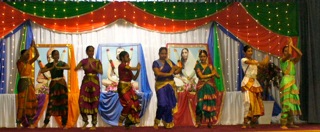
Dance is one of the most ancient of Hindu art forms, and among the most beautiful. After the Seminar, the girls of the Sri Sarada Devi Ashram performed a captivating Kathak Dance. It was truly inspiring and once again reminded us all the lasting beauty of our long standing culture.
Girls of the Sri Sarada Devi Ashram performing a captivating Kathak Dance
Thereafter, Dr H.B Parbhoo, a senior devotee and presently the General Secretary of the Centre, gave a short discourse on, ‘Lessons the Youth can learn from the 1860 settlers’. It was truly eye-opening and simply remarkable to learn about the plight of our fore-fathers when they landed here as an ‘indentured labour’, and their great struggle to survive in this foreign land of Natal, under the unsympathetic, iron-fist rule of the British. Even though they were treated like scum, they rose above the challenges and hardships, and slowly but surely, they managed to set up an infrastructure, headed by faith in God, where the Indian community would start to flourish. This Talk indeed brought out in full measure the importance of the unfailing traits that the early settlers possessed.
Audience enjoying 'Swami Bodhamayanandaji's DVD'
Following this deeply touching Talk, the youth were treated to a DVD presentation. It was part one of a four-part ‘Message to the Youth’, delivered by Sri Swami Bodhamayanandaji Maharaj, a youth monk of the Ramakrishna Order, now in Chennai Centre. Maharaj’s words were like gold, and the youth were simply hanging on to his every syllable. Maharaj addressed various issues and problems affecting the youth in modern times. Methods and techniques for overcoming these problems were alluded to. He used copious teachings of the Holy Trinity, especially that of Swami Vivekananda, as he guided the youth with his powerful voice and charged words.
After the DVD, it was time for the much awaited Question and Answer session. A panel of three, consisting of Revered Sri Swami Vimokshanandaji Maharaj, Dr. HB Parbhoo, and Mrs Rakhi Beekrum, were in the hot seat. Between them, they astutely handled all the questions posed by the youth.
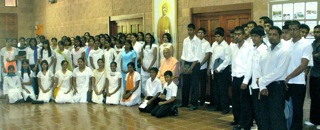
Youth happy to have a group photo
After a very rejuvenating rendition of the Centre’s Anthem, and the concluding Vedic prayers, we had come to the end of what was truly an inspiring, educational and fulfilling day. The youth offered their pranams (prostrations) to Revered Maharaj, and after partaking of prasad, in the form of lunch, they made their way home from the Retreat, feeling ‘going ahead’ in their pursuit of their chosen path…
Ramola and Sravanthi as guest writers sent me a Report on the Seminar that had the above theme as title and hosted by Sri Sarada Devi Ashram, Asherville in commemoration of Holy Mother’s 156th birth anniversary celebration at KZN University on Sunday, 13 December 2009. It was a great success with 500 delegates from even distant places attending with enthusiasm. Photos courtesy: Lushen Pillay and Jaya Ramjogi. The 1st Part was posted on1st Jan, 2010. Here is the 2nd Part!
============================================
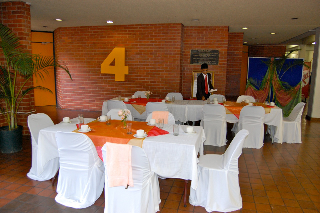
Rows of neatly laid chairs that were covered with white chair covers. The tables draped with white tablecloths and red and gold overlays
During the tea recess the delegates were lovingly ushered from the lecture room, T1, to the dining area in the ground floor foyer to partake of sumptuous refreshments. Upon entering the dining area they were welcomed with smiling faces of the members of the Sri Sarada Devi Ashram, who stood before rows of neatly laid chairs that were covered with white chair covers. The tables draped with white tablecloths and red and gold overlays were laden with delicious snacks, tea, coffee and juices, much to the delight of all. The dining area was further sanctified by the holy presence of Monks and Nuns of the Ramakrishna Order who also partook of refreshments here. The ambiance of the venue was further enhanced with the ladies of the Sri Sarada Devi Ashram in their uniform saris and the men in their red and white attire.
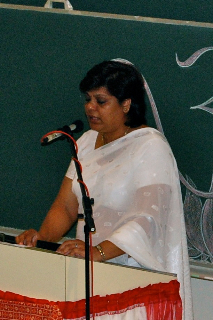
Ms Raisha Singh presenting her paper
After refreshments, the second paper was presented by Ms Raisha Singh, Campus Manager, Mnambithi FET College. In presenting her topic ‘Challenges of Parenting’, Ms Singh discussed in detail the various challenges facing parents today. Her description of the growth of a child with the simile of a young plant was apt. To grow into a healthy tree which will provide shade to many, the plant must be carefully nurtured with sufficient water, sunlight, nutrients and love. She also discussed current social concerns like rebellious children, suicide, teenage pregnancy, substance abuse and peer pressure. Methods subscribed in coping with these concerns included providing a stable environment in the home which will ensure emotional security, effective and frank communication with children, encouraging attendance at religious institutions, exposure to the finer sides of life like art and music, and lovingly disciplining children.
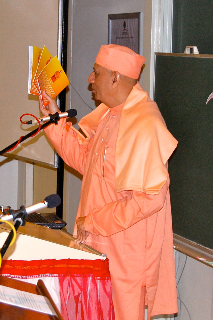
Thereafter Sri Swami Vimokshanandaji Maharaj, President, Ramakrishna Centre of SA, released a booklet on ‘Parenting – A Hindu Perspective’, containing articles by the speakers as well as many interesting ideas on parenting skills. It was freely distributed to the delegates who attended the seminar.
Swami Vimokshanandaji releasing the booklet…
While releasing the booklet Swami Vimokshanandaji drew the attention of the audience to a normally forgotten point that parenting begins with the mutual desire of the parents to have a child and not necessarily only with the birth of a baby. He highlighted the value of prayer and a religious ambience to direct the pre-natal influence of the parents on the child. He also cited from our scriptures giving the incidents of Sita in sage Valmiki’s ashram when Lava and Kusha were still unborn and saint-child Prahlad’s mother at sage Narada’s ashram. Maharaj described the need for providing sincere appreciation and love to children as incentives for their healthy growth. He also stressed the importance of religious education to strengthen character and personality.
Dr H B Parbhoo presenting his paper…
The third paper was delivered by Dr HB Parbhoo, a leading medical practitioner as well as the General Secretary of the Ramakrishna Centre of SA. He addressed the issue of ‘Cultivating Harmonious Domestic and Social Skills in the Family’ in a remarkable way. Dr Parbhoo spoke about the traditional Hindu home as being one of warmth and hospitality. Family members were united in a circle of love extending to include grandparents, in-laws and one’s community. This was contrasted with the modern family of today where nuclear families exist in isolation with individualisation of the family members and marginalisation of the elderly. Another pertinent issue he discussed was that of the difficulties that children experience in overcoming the influence of friends and following the right path. He quoted an excerpt from the life of Mahatma Gandhi, dealing with peer pressure. Dr Parbhoo stressed the importance of having appropriate role models, like Swami Vivekananda, as children by nature are hero-worshippers and would otherwise look to morally bereft celebrities to idolise. Dr Parbhoo emphasised the importance of belonging to a religious organisation as it encourages one to broaden one’s horizons and the selfish circle of one’s own immediate family interests, and reach out to others. He extensively quoted from Swami Vivekananda and concluded that the home setting needs to be a spiritual one.
Pravrajika Divyanandaprana mataji presenting her paper…
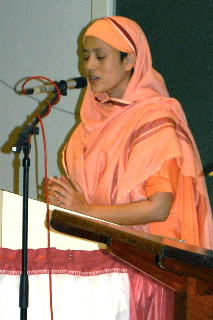
The final speaker, Pravrajika Divyanandaprana Mataji, a nun of the Sri Sarada Math, Dakshineshwar, near Kolkata, India, delivered a paper on ‘Swami Vivekananda’s ideas on Youth Development’. Analysing development according to Swamiji, the Mataji proceeded step by step to uncover the roots of human identity. Man’s identity, she declared, is rooted in his ancestry and anchored in his immediate family. She eloquently compared the parent to a bow and the child to an arrow and said it was the stability and direction of the bow that determined the direction the arrow would take. Further entering the mind of a child, Mataji showed the importance of inculcating proper cultural values and religious education in the sensitive mind of children, drawing appropriate examples from Indian history.
The Director of Ceremonies, Ms Prakashnee Gengan, extending a Vote of Thanks…
Divyanandaprana mataji also touched upon the conditioning power of love, an inspired self-image and a dynamic work culture that the growing mind requires for character development. However human personality rests on the core truth of man’s inner Being called the Atman in Hindu philosophy. Dwelling on this, Mataji explored the role of the spiritual quotient in balancing the other aspects of the personality namely Intelligent Quotient and Emotional Quotient and how ultimately the SQ was the saving factor. In essence, it was an exemplary paper that exhaustively summarised the eternal principles of Hinduism in creating an enlightened society as envisioned by Swami Vivekananda.
A question and answer session was conducted immediately after the presentation of each paper. These were efficiently and appropriately handled by the speakers. The Director of Ceremonies, Ms Prakashnee Gengan, extended a Vote of Thanks. The programme concluded with closing prayer led by Pravrajika Ishtaprana Mataji.
The Seminar helped to awaken the consciousness of the thinking community in upholding values in order to create a stable, secure and cultured social set-up. All the delegates were served lunch at the conclusion of the seminar.
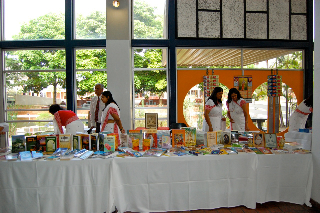
The Ashram’s ‘Vedanta Bookshop’ sold books covering a wide range of subjects including Vedanta, Ramakrishna-Vivekananda literature, scriptures like the Bhagavad Gita and Tirrukural, Meditation and Children’s books.
'Vedanta Bookshop' selling books on Hinduism….
============================================
For more photos of the Seminar please see the below slideshow.
Vodpod videos no longer available.
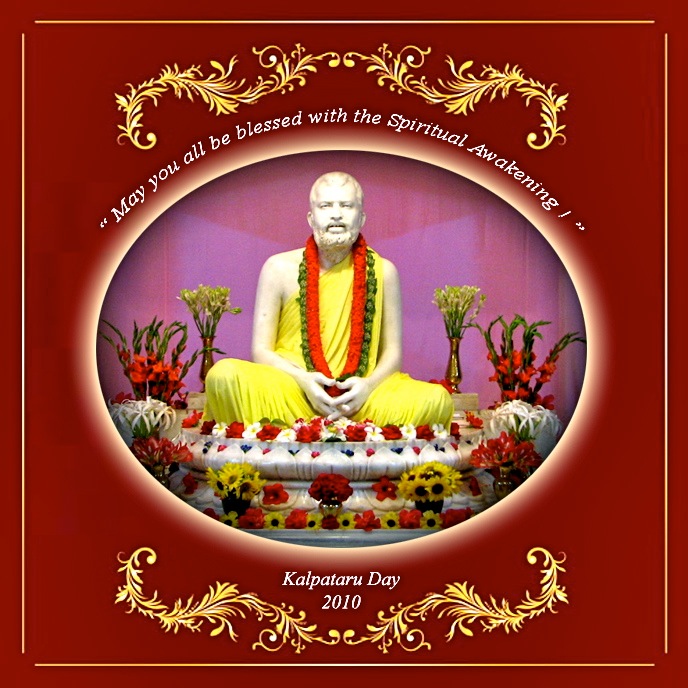
A very happy New Year to every one of you! May this Kalpataru Day bring you all blessings!
Parenting – A Hindu Perspective
Ramola and Sravanthi
Ramola and Sravanthi as guest writers sent me a Report on the Seminar that had the above theme as title and hosted by Sri Sarada Devi Ashram, Asherville in commemoration of Holy Mother’s 156th birth anniversary celebration at KZN University on Sunday, 13 December 2009. It was a great success with 500 delegates from even distant places attending with enthusiasm. Photos courtesy: Lushen Pillay and Jaya Ramjogi
Seminars were never a favourite for me as the few that I was forced to attend turned out to be fantastically tiresome! Oh! how the speakers prominently called ‘panelists’, continue to inflict pain on the disinterested listeners by holding their documents on the lectern and proceed with reading in their scholarly dry and drab tone without the much needed eye-contact! I realized that perhaps, I needed a change in my hard held opinion when I unwittingly was made to participate in a Seminar on Sunday, 13 December 2009.
A view of the audience
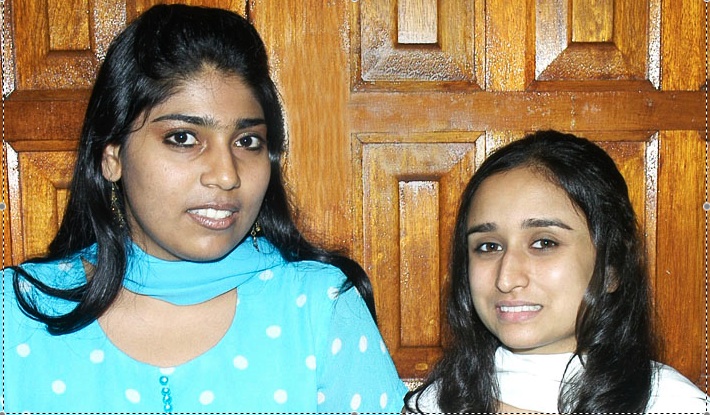
This Seminar held in order to commemorate the 156th birth anniversary of the Holy Mother Sri Sarada Devi was different; not only it provided a refreshing experience but also proved a treat to thoughtful minds. ‘Parenting – A Hindu Perspective’ was the theme entirely relevant to the modern Hindu practitioners of SA. So, dear visitors! I am happy to present here a Report, faithfully recorded by two youth members of SSDA – Ramola and Sravanthi – for the benefit of all those who could not attend the Seminar. The welcome, the decoration, the orderliness, the spic and span look, and even the drawing of OM on the background, not to mention the dining space – everything was laced with artistic patterns!
Volunteers with matajis – the guiding spirits…
My and other Swamis’ along with many of those attendees’ deep appreciation go to the devotee-volunteers who worked tirelessly as part of their Karmayoga for the success of the Seminar and the ‘Powers that be’ who ably guided them!
The year 2009 heralded the Ashram’s Silver Jubilee. 25 years of useful existence, in spite of odds and obstacles is not an ordinary occasion indeed and to celebrate the prestigious occasion four major events were conducted. The seminar was the last that ended with lasting sweet memories. Four monks and two nuns participated in the seminar. An audience of over 500 delegates from all over South Africa, including Durban, Northern Natal and Bloemfontein, attended.
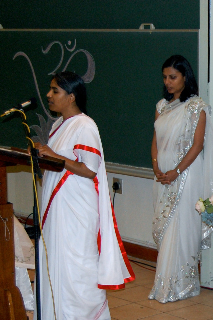
Sister Avinta saying opening prayers…
The seminar, which commenced at 9:00 a.m., was held at the University of KwaZulu Natal, Westville Campus. It was a blessing to have the holy presence of Revered Swamis Brahmarupanandaji Maharaj of Ulsoor, Bangalore; Sarvarupanandaji Maharaj of Colombo, Sri Lanka; Vimokshanandaji Maharaj and Saradaprabhanandaji Maharaj and Pravrajikas Ishtaprana Mataji and Divyanandaprana Mataji. In accordance with our Hindu tradition, Sister Avinta said the opening prayers after which Pravrajika Ishtaprana Mataji welcomed the monks of the Ramakrishna Order and every one in the august audience. She also extended a warm welcome to representatives from sister organisations and to delegates who have come from distant places. While thanking all for their presence, she expressed her trust that the delegates would benefit from the day’s discussions.
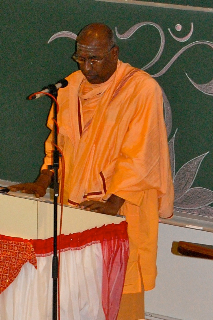
Swami Sarvarupanandaji, Head of Colombo Centre inaugurating the Seminar…
The seminar was inaugurated by the Chief Guest, Sri Swami Sarvarupanandaji Maharaj, Vice President and Head of the Ramakrishna Mission, Colombo, Sri Lanka. Revered Maharaj highlighted the importance of good parenting, emphasising the need for a moral foundation for the betterment of today’s and tomorrow’s society.
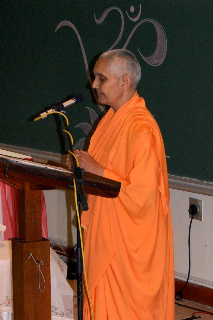
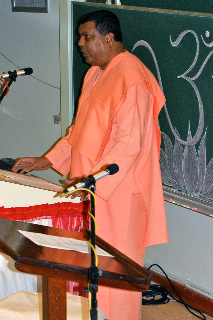
Sri Swami Saradaprabhanandaji Maharaj, Vice-President, Ramakrishna Centre of SA, delivered the first paper entitled ‘The Hindu Ideal of Parenting’. It carried the necessary knowledge required to enhance parenting skills, drawing deeply from Hinduism’s timeless heritage and culture. Maharaj analysed the family life cycle and the various stages in the child’s development, from the naming ceremony to marriage.
Swami Saradaprabhanandaji presenting his paper…
These different samskaaraas are characteristic of Hinduism and sanctify family and social obligations, facilitating spiritual evolution. Moving from one phase to another creates change, and the family must adapt to these changes. These transition periods are crucial and require understanding and skillful management, as problems occur when the family is unprepared for them. Traditional Hindu ceremonies are important to mark these transition periods and provide the moorings to make them smooth. These can be simplified or adapted to the needs of the modern age but their essence and values must be preserved, added Swami Saradaprabhanandaji.
His paper was followed by a short recess when refreshments were served.






 Vedanta in Practice