Vedanta in Practice

A Micro-Blog from Swami Vimokshananda – earlier at Durban, Singapore and Dublin – now at Yelagiri Hills, Tamil Nadu, India – "A private diary for public consumption!"

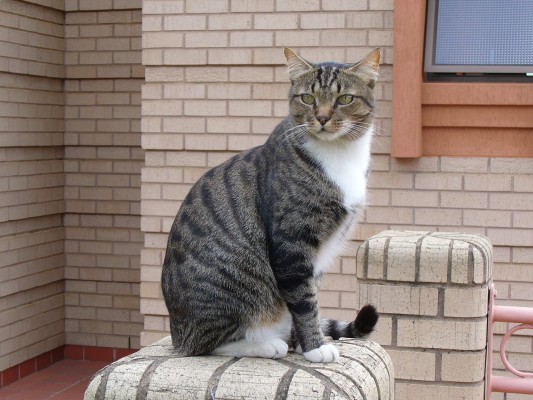
  • Ashram cat Kripa – waiting to enter into the Temple

    In 1980, a clinical research project at Brooklyn College, New York, studied heart-disease patients after their discharge from the hospital. Dr. Erika Friedmann, Ph.D., Professor of Health and Nutrition Sciences at the College, tracked each survivor, studying their medical histories, lifestyles, families, relationships – every documentable detail. Co-researcher Dr. Aaron Katcher, M.D., reported:

    “The presence of a pet was the strongest social predictor of survival…not just for lonely or depressed people, but everyone – independent of marital status and access to social support from human beings.”

    Ashram cat Satwik making 'pranam' in the Temple

    The Psychologists clearly spell out Ten Benefits in rearing a pet: While the primary benefits to animals are obvious – to place them in loving homes and keep them from being destroyed – the benefits to elderly persons are ten-fold (versus non-pet owners).

    • Pets lower blood pressure and pulse rate
    • 21% fewer visits to the doctor
    • Less depression
    • Easier to make friends (enhanced social opportunities)
    • Seniors become more active
    • Pets offer affection and unconditional love
    • Pets ease loss of a loved one
    • Pets fight loneliness
    • Seniors take better care of themselves
    • Sense of security

    You, readers may just wonder ‘What! pets and Vedanta!

    I was pleased when Skendha Singh from New Delhi, India commented that ‘pets seem to gravitate towards our places or seats of meditation’. It is so true! In our Ashram, we have now two pet cats – Kripa and Satwik. Both of them never leave the campus and are fond of being present in the Temple  during mangalarati time as well as evening arati time.

    Ashram cat Kripa 'gravitating towards Meditation seat'

    Kripa is more amiable and would not mind if any of our devotees just take him in hands and there he would cuddle quietly! And to sleep (or meditation?) he would always select one of the two monks’ aasana (seats) laid out in the Temple! He is also one of my keen students during Gita class, listening to my Talks, sitting on the chair. At meal times, he comes and takes his chair, surveying the whole neatly laid out table with an air of a ‘leader’ and immensely satisfied with just butter to give us ‘company’. Both the cats drink Ganges water from the Catbowl, kept for them inside the Temple. (Of course they have their own bowls at designated spots and regular feeds are provided.)
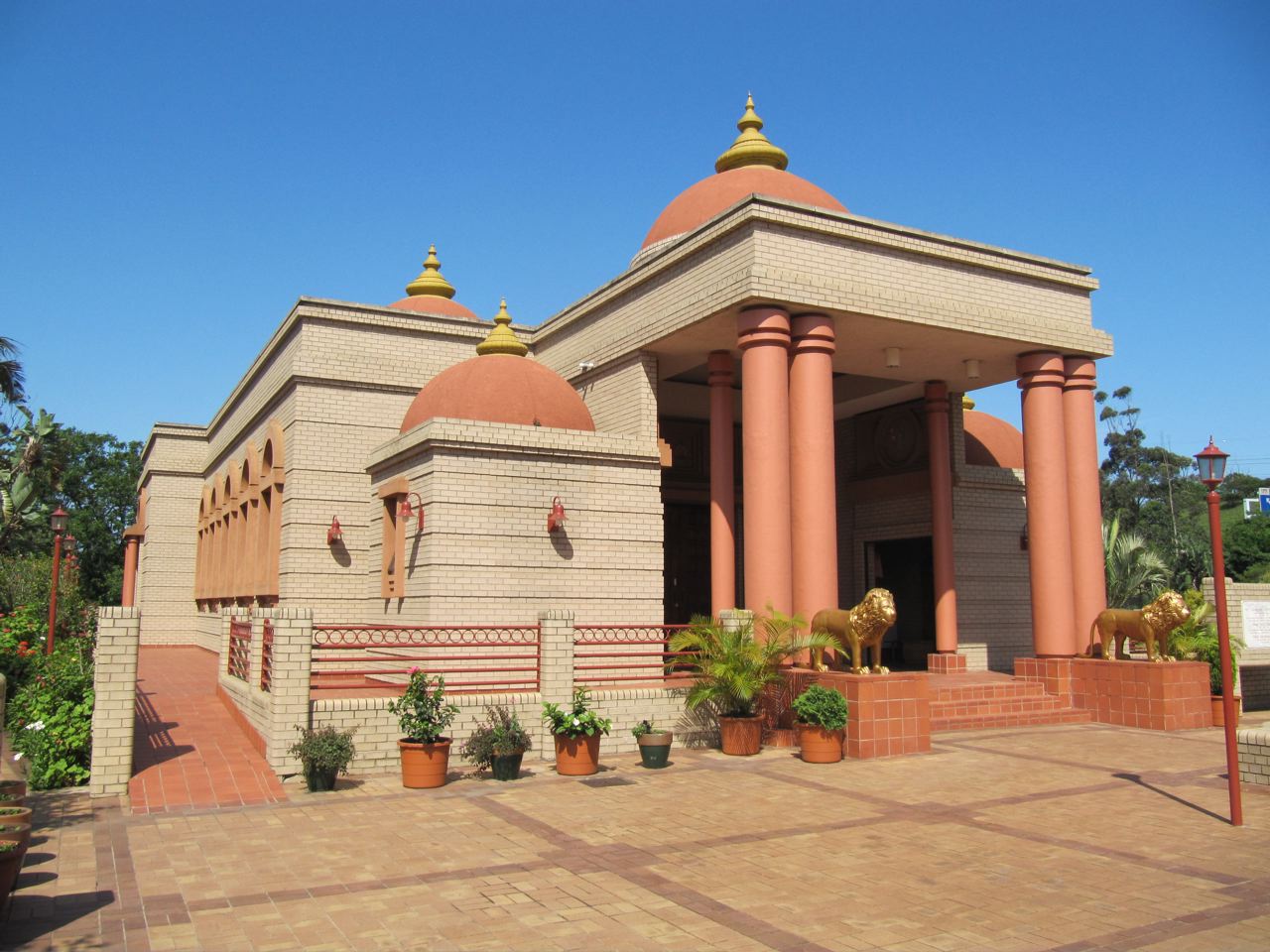
    Ashram temple – fantastic front view of two images of Lion – pets to Durga

    Yes, one of the pancha shanti mantra (the famous five peace chants) – tacchaiyn yora vrineemahe – loudly proclaim ‘shanno astu dwipade, sham chatushpade’ “May there be peace to humanity; may peace be to animals” goes back to the ancient Vedic times from when we, the Hindus have inherited the wonderful feeling to take care of not only the ‘two-legged’ but also the ‘four-legged’ ones. Our mythology is abound with creatures beloved to Gods and Goddesses. While Ganesha is fond of His mouse, His brother Murugan delights with peacock. Shiva’s favourite is bull, while Vishnu prides in eagle. Durga’s lion is well-known. Krishna had lovable calves and cows. Shiva’s servant Bhairav has dogs.

    Among the beasts and birds, dog as a pet has become the most favoured species among the men and women all over the world. Saints are not excepted. Swami Vivekananda had a dog called Bagha who had been a stray mongrel and picked up from the street as a puppy. This dog became so close to Swamiji that once Swamiji had to caution the monks in Belur Math not to harass him anytime. On the day Swamiji’s body was cremated, Bagha remained close to the funeral pyre and wouldn’t move; he was so overwhelmed by grief that he stayed there for a long time. No one could make him eat or drink on that day!

    Swami Shivananda, when he was President of the Order, had two big dogs Kelo and Bhulo. These were pedigree dogs brought from East Bengal. He would have lot of fun with them. While standing upstairs on the balcony of his room, he would sometimes play with the dogs by throwing pieces of bread in the down below courtyard as a treat. And lo! the dogs would jump and catch without fail in the mid-air! Showing his finger to the dogs, Shivanandaji would shout, “See, they are my dogs and I am Sri Ramakrishna’s dog!”

    When shall we develop that dogged attitude of dedicating our life at the Master’s feet and lay there to do His bidding? When shall we acquire the ‘pet’-sense of sharanaagati – ‘surrender’?
  • It cannot be gainsaid that going to Bloemfontein was devoid of gathering spiritual benefits either to me or to the Hindu devotees there. To me it was a learning experience in life as this was my very first visit to Free State Province in South Africa.

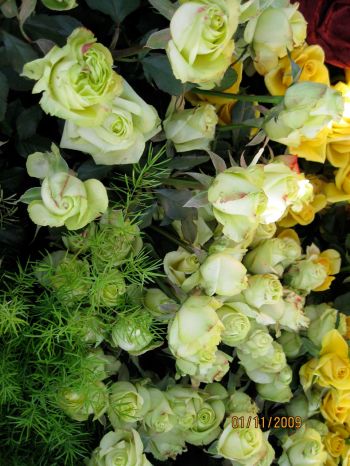
    BFN GreenRosesIMG_1291
    Roses are not Rosy but Green…! Found in the City of Roses!

    This Town is generally regarded as a Judicial Capital of SA. BFN, short for Bloemfontein is popularly and poetically known as “the city of roses”, owing to the abundance of these flowers and the annual rose festival held there. I had a good chance to see and savour the blooming roses and it was for the very first time that I was glad to glance through ‘green’ roses too.

    There are a dozen denominations of the miniscule Hindu population who, I was delighted to note, unlike in other places, love to meet at a central point under the banner ‘Bloemfontein Hindu Association’. A devotee had allotted his fully furnished Conference Hall for this purpose and it was here the inter-active sessions for two days were held.

    One devotee put it to me thus: The heart beats of the Hindus of BFN had gone upbeat in relishing simple, universal truths of Vedanta as propounded by Sri Ramakrishna. Another devotee wrote his feelings to Yash who accompanied me in this travel and made my travel utterly interesting and comfortable, thus: I want to thank you and Swami Vimokshanandaji from the very bottom of my heart for coming to us. Not one of those present is left unchanged by your presence! The place is abuzz with devotees wanting to register for the Hindu studies course and improve their spiritual life. This is living proof that association with holy company will improve one’s yearning for God, repeatedly told to us by the Master!

    BFN is, of course famous for Cheetahs – the name taken by the Rugby sportsmen who have the colour Orange. On the day I landed there, I could see plenty of BFNners – men and women alike – wearing ‘orange’ TShirts gathering with verve and vigour to witness the choice Rugby match scheduled on that day. It is something like ‘cricket fever’ in India! Seeing me in full orange dress it was amusing for many to see a ‘Cheetah supporter’ direct from India!

    BFN PetsPrettyIMG_1163
    Pretty pets pivoted to me…!

    A Short Report on my visit, duly given below, was penned by our devotee Navilla Somaru who is the Chief Prosecutor – WELKOM Cluster. With the limited resources, the arrangements made by her and husband Bishun and the care taken by this wonderful family is memorable indeed – not to forget of those pretty pets who remained pivoted to me!

    BFN NavillaIMG_1279
    Navilla Somaru


    A Report by Navilla Somaru from Bloemfontein, SA


    BLOEMFONTEIN HINDU ASSOCIATION SPECIAL PROGRAMME

    SPIRITUAL RETREAT CONDUCTED BY HIS HOLINESS SWAMI VIMOKSHANANDAJI MAHARAJ

    1. During April 2009, the Bloemfontein Hindu Association (BHA) extended an invitation to His Holiness Swami Vimokshanandaji Maharaj, President, Ramakrishna Centre of South Africa, to conduct a spiritual retreat in Bloemfontein. Pursuant thereto, the dates of 31 October (Saturday) and 1 November 2009 (Sunday) were arranged. A programme of both days’ events is attached hereto for ease of reference.

    2. Revered Swamiji arrived in Bloemfontein at approximately 13h00 on 31 October 2009.

    BFN AudienceSDC10765
    A section of serious seekers

    The programme commenced at 17h00 at our new shrine which was previously a conference room at the Taj Guest House in Bainsvlei, a smallholding just outside Bloemfontein.  We were all very surprised to have more than a hundred people in the congregation, mostly Hindus but also some members of the Christian faith, black and white alike.

    3. The programme began with the chanting of mantras at 16h45.

    BFN MeditationSDC10776
    Meditation practice

    The satsangh commenced exactly at 17h00 and included prayers to Sri Ramakrishna, singing of devotional songs, Hanuman Chalisa, Bhavani Ashthakam, Revered Maharaj’s special address, a lengthy and lively question and answer session, a guided meditation, arati and the concluding prayers.

    4. Revered Maharaj’s address was profound, to say the least. It was very well received with amazing positive input forthcoming from most members of the congregation.  Revered Maharaj’s address was eloquent, yet simple and covered very relevant and pertinent issues on spirituality and Vedanta. Revered Maharaj expounded the need for all of us  to live simply, take God’s name at every opportunity, to chant AUM every morning, elevate ourselves from religiosity to spirituality as well as to perform service to the under privileged in the immediate community and to  protect our animals.

    5. The programme concluded at 20h00 with Revered Swamiji meeting all members of the congregation and partaking of supper with those present. Many families requested personal interviews with Maharaj, which was held in the shrine and the office.  Swamiji retired at 22h30.

    6. The programme for the next day began at 10h00 and was conducted by the children of the Bloemfontein Hindu Association.

    BFN ChildrenIMG_1211
    lovely children!

    We are happy to state that the children organised the entire programme, which included prayers, devotional songs, cultural items and the vote of thanks. The tiny tots recited a poem on the glory of Diwali and an action packed version of “The love of Krishna”. The 9 to15 years old performed a garba dance in honour of the Divine Mother.

    7. Revered Swamiji brilliantly directed his address to the children by way of questions and answers enabling the children to participate actively. There was also an animated DVD presentation on the Life of Swami Vivekananda which was sent by Revered Pravrajika Ishtaprana Mataji from the Sri Sarada Devi Ashram, Durban. Everyone thoroughly enjoyed this presentation and felt inspired. We extend our sincerest gratitude to Revered Mataji, not only for the DVD but also for the assistance and encouragement received to initiate the children’s Hinduism classes which we conduct under her guidance and direction, on Sundays.

    8. Sunday’s programme concluded with lunch being served to all present. Thereafter, at the request of individuals and families, Revered Maharaj held private counselling sessions for two hours.

    9. On both days, the Sri Sarada Devi Ashram held a bookshop which stocked books on Vedanta, the Ramakrishna-Vivekananda literature, Meditation and children’s books. Mr Yash Govender arranged and managed the bookshop, which was very well supported.

    10.The Bloemfontein Hindu Association takes this opportunity of conveying our very humble, sincere and grateful thanks to Revered Maharaj for his time. We appreciate his efforts in making a journey to Bloemfontein, which is 650km from Durban, to conduct the spiritual retreat with us. The presence of Revered Maharaj meant a lot to the spiritually starved members of our fledgling association. We pray that Maharaj bestows his grace upon us by more frequent visits in future.  This will be of great benefit to the Hindu community here, as well as to the many youth we have in the community as well as at our University who are in dire need of constant spiritual education.

    Yours in the service of Sri Ramakrishna

    Navilla Somaru

    Committee Member

    Bloemfontein Hindu Association

    =====================================

  • Sri Sri Jagaddhatri
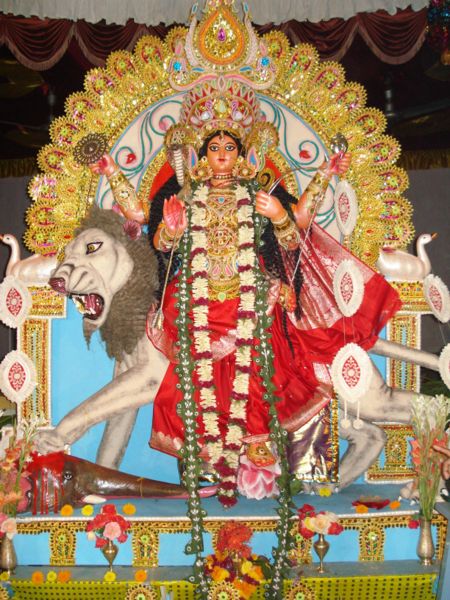
    Jagaddhatri in full regalia – clay image used for worship at Ranchi Ramakrishna Mission TB Sanatorium

    From The Gospel of Sri Ramakrishna

    (To M.) “One must accept the forms of God.  Do you know the meaning of the image of Jagaddhatri? She is the Bearer of the Universe.  Without her support and protection the universe would fall from its place and be destroyed.  The Divine Mother, Jagaddhatri, reveals Herself in the heart of one who can control the mind, which may be compared to an elephant.”

    RĀKHĀL : “The mind is a mad elephant.”

    MASTER: “Therefore the lion, the carrier of the Divine Mother, keeps it under control.”

    Today is Sri Sri Jagaddhatri Puja! I cannot escape from indulging in a little nostalgia with regard to this most important Puja of the Ranchi Sanatorium in India where I was blessed to witness for  12 long years. The enthusiasm and exuberance that expressed in different forms in staff of the hospital, devotees of the Ashram and the tribal public of the neighbouring villages and also well-wishers from distant towns are something not explainable! it was a puja fever under the spell of which we all came to our great delight.

    I remember to have written a small piece in Wikipedia in 2005 which I reproduce below:

    The formal difference between Durga and Jagaddhatri occurs in ‘Mayatantra’ and Jagaddhatri is mentioned with reference to Durga in Krishnananda’s ‘Tantrasaar’. The special puja of the Goddess on the ninth lunar day of the light fortnight in the month of Kartick has been referred in ‘Krityatattarnab’ by Srinath Acharyachudamoni of the 15th-16th century.

    As per ancient pauranik lore of the Hindu scriptures, soon after the victory over Mahishasur the Devatas became highly egoistic. They thought because of lending to Durga their instruments the mighty asuras were vanquished. To make them understand that the primordial power is alone behind every action, the Brahman appeared before the Devatas in the form of effulgent Yaksha. Bewildered by its presence one by one the Devatas approached Yaksha. First the god of wind Vayu. The Yaksha asked him what he could do. The Vayu replied that he could throw away huge trees, tumble high mountains. The Yaksha then placed a small grass and asked him to move it. The Vayu utilised all his powers but lo! he could not even displace it. So also the god of fire Agni, could not even burn it. Likewise one by one the Devatas failed. And it dawned on them that their powers are in reality not their own but derived from the supreme power who as protecting mother holds the entire creation and therefore called Jagaddhatri. Anybody who worships Jagaddhatri becomes absolutely egoless and a true servant of the world which is nothing but a manifestation of the Brahman.

    While thinking of Ma Jagaddhatri, some readers may wonder how this Puja was started in a TB Sanatorium which may seem unconnected. But I want to share a true incident that I heard from the eye-witnesses.

    It is pertinent that this memorable puja was indeed started by one in-patient of this Sanatorium in 1958. He was late Bhupati Bose from Howrah. It is said that he had a divine aadesh in dream one day for doing Devi Puja. The then Secretary Maharaj late Swami Vedantanandaji rejected his offer saying that doing Durga Puja in a hospital set up is not a joke. But Bhupati, distressed at the decision, prayed to the Mother and sought excuse for his inability to carry out Her wish. Who can eventually stop the Divine Will? He again dreamt of the Mother who said that there was one-day Puja also available! On hearing about the second dream, Vedantanandaji was ready to reconsider his decision and acceded to the patient’s request for Jagaddhatri worship. Bhupati himself prepared the image beautifully for consecutive two years. The entire staff and all the in-patients stood together in completing the one-day Puja with great devotion.

    JPUJAimmersion
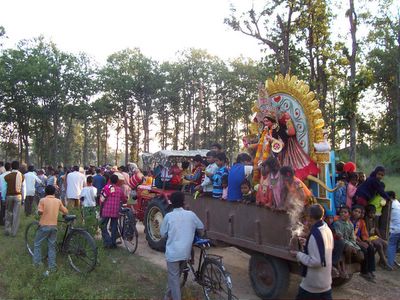
    Image of the Divine Mother taken in procession for Immersion

    Sri Lalita Sahasranama in its 173 verse speaks of Tripurasundari as Jagaddhatri .

    Vishvamata jagaddhatri vishalakshi viragini

    Pragalbha paramodara paramoda manomayi .. 173

    Vishvamata: Who is the Mother of the Universe.
    Jagaddhatri: Who is the holder of the universe.
    Vishalakshi: Who has large eyes.
    Viragini: Who is utterly passionless.
    Pragalbha: Who is surprisingly daring
    Paramodara: Who is supremely generous.
    Manomayi: Who is all mentation.

  • A picture is worth a thousand words indeed! So, who would not want to see the pictures speaking silently?

    Diwali in Durban was as fascinating as freshly laden fragrance. Its joyful feelings of care and share wafted in the air everywhere. In all the functions that I attended, hamper distribution to poor families was the main item besides bursting fire-works, social gathering and of course sumptuous meals! The hard work that devotees offered in the form of seva to Master hardly escaped my notice.

    Here below are some of the photos that can speak thousand words silently…Click the photo for a larger view!

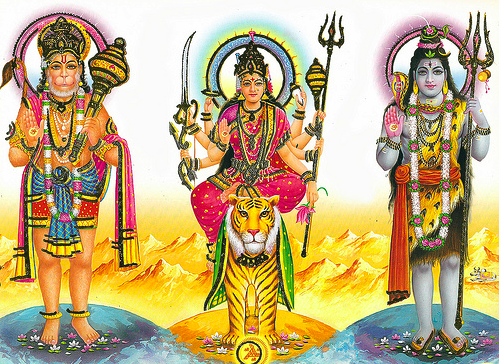
  • Today is the first night of navaratri which is holy and auspicious to all Hindus. Here in SA, the Divine Mother Goddess Durga is worshipped in Her three aspects as Mahakaali, Mahalakshmi and Mahasaraswati, three nights each during this nine-day celebration. Not only Sri Ramakrishna kept in his room several pictures of Gods and Goddesses but also advised devotees to do so. “Divine feeling is awakened through such pictures” he said. Once he went all the way to see a home of a devotee, hearing that he had a large collection of religious pictures! You can also enjoy seeing one hundred ninety-nine ennobling pictures of Hindu Goddesses, one hundred twenty-seven of which especially on Durga at this Flickr site. The Lord of Durga – Neelakantha Shiva has eleven aspects that are called Rudras. The Shiva puraana speaks about the Eleventh Rudra who incarnates as Sri Hanuman. I am thankful to Simon Ram of UK who gave permission to place a rare picture of Hanumanji with Gauri-Shankar which you can find at the bottom of this post.

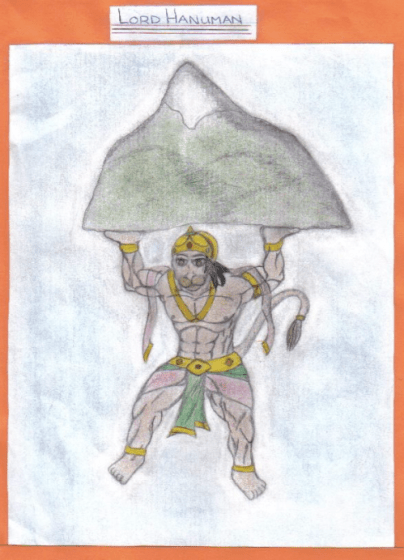
    The drawing and a write-up on Visual Art Work that is displayed in a box down below, is by one 14 year old school student who regularly attends our Sunday School for Children. Presently this boy is schooling at Ladysmith High School and in Gr.9. His name is Yashteel Raj. He attends the Ramakrishna Centre – Ladysmith branch. He also enjoys reading and learning about Hindu religion through stories like the Ramayana, etc. Recently he wrote to me an email which I reproduce here:

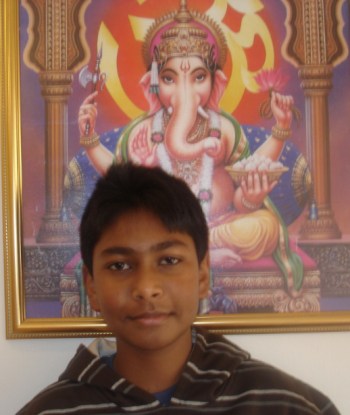
    Yashteel Raj of Ladysmith
    Yashteel Raj from Ladysmith

    Om Namo Narayanaya Swamiji

    It was very good to see you on Saturday after such a long time.

    I had to make an artwork about my culture this week and I was so inspired by your talk on Sri Hanumanji that I made a drawing of him carrying the Drona Mountain. I wanted to show you how it looks – I hope you like it.

    Mom, Dad and Chiara also send their pranams.

    Durga Durga

    Yashteel Raj

    —————————————————-

    Yes, beta Yashteel, I  am immensely pleased to see your art work. Congrats! Indeed, your devotion to Sri Hanumanji has brought Hanumanji’s grace to you and you have excelled in it. May He bestow you the three essential things which Tulsidasji, in his mystical prayer hymn, demands from Sri Hanumanji – bala, budhi, vidya!

    —————————————————–


    Inspired drawing - an Art work on Anjaneya
    Inspired drawing – an Art work on Anjaneya

    Arts & Culture:

    Visual Artwork Project

    What is Culture?

    Culture, as I understand it, is a word which describes an individual’s lifestyle. One’s culture is basically their way of life: their social and religious norms, cuisine, literature, and choice of music and art. Culture thus consists of person’s customs and traditions.

    What is your Chosen Culture and

    Why can it be defined as a Culture?

    I have chosen to make my artwork about my own “hybrid” Hindu culture as it would be personal and I already know much about it.

    My chosen culture can be described as a culture as it includes all of my social and religious norms. It consists of the food I eat (spicy) and governs, to an extent, the type of literature, art and music I come into contact with. It also consists of all of my customs and traditions.

    My religion plays a very important part in my culture, so I chose to make an artwork which is relevant to it. My artistic talent lies in drawing; hence I chose to depict an event from the epic tale, the Ramayana, in this form. Here Lord Hanuman carries the huge Drona Mountain on his shoulders, from the Himalayas to Lanka, as it contains the rare sanjeevani herb required to heal Lakshmana.

    What I found Difficult

    I faced many difficulties while creating my artwork and tried to overcome them as best I could. These problems were:

    • My colouring was uneven and looked bad, so I “smudged” or “shaded”.
    • Some garments blocked vital muscles, so I made them semi-transparent.
    • I had some trouble drawing Hanuman’s hands and feet, but I got it right in the end.
    • Lord Hanuman’s ape-like mouth was hard to blend in to the face so I experimented with sfumato.
    • It was hardest for me to give texture to Lord Hanuman and the mountain. I tried utilizing tonal value to aid me in my plight.

    What I Learnt and Enjoyed

    • I learnt how to draw another type of abdomen and six-pack, which stems from “Hercules-type” animation.
    • I discovered how to add tonal value to give texture and depth to an artwork.
    • Shading, in some cases, is more effective than colouring.
    • If you shade on differently textured surfaces, their texture will be implied on your artwork. This can be a easy way to create texture.
    • I enjoyed drawing Lord Hanuman and experimenting with different muscle-types and colours, etc.

    Conclusion

    I really liked making this artwork. Drawing is lots of fun and I really enjoyed expressing my culture in this form.

    =======================================================


    Sri Hanumanji with Sri Gauri-Shankarji - a rare picture
    Sri Hanumanji with Sri Gauri-Shankarji – a rare picture, Courtesy: Simon Ram, UK