Vedanta in Practice

A Micro-Blog from Swami Vimokshananda – earlier at Durban, Singapore and Dublin – now at Yelagiri Hills, Tamil Nadu, India – "A private diary for public consumption!"

  • IMG_2621.JPG

    Today is September 11. In 1893, on this same date Swami Vivekananda addressed the Parliament of Religions at Chicago, USA. This lecture practically catapulted him as an international figure. The last line of his famous lecture succinctly gives the gist of Hinduism: I fervently hope that the bell that tolled this morning in honour of this convention may be the death-knell of all fanaticism, of all persecutions with the sword or with the pen, and of all uncharitable feelings between persons wending their way to the same goal.

    When the Conference on Hinduism held at Ladysmith Civic Centre on Sunday 6, September, 2009 concluded amidst chanting of vedic mantras as closing prayers, when the delegates started departing in a mood of delight, all of us felt that the ideas that were discussed so forcefully would ever remain etched green in our memory-land and to say in the words of one of our Blog readers from Ladysmith “What a marvellous conference we had! Many thanks are due to the Master for making this occasion possible…There is no doubt that all who attended benefited not simply from the content, but also from the holy company.”
    My hearty thanks go to Reantha Pillay, a student-devotee, who has penned this brilliant Report – on the same day, in spite of the long distance to & fro travel – that would, I believe satisfy the curiosity of those who could not attend the Conference. I am giving below the Part II of the Report. I am also thankful to devotee Rishienandan of Pietermaritzburg subcentre for the excellent photos.

    Report – Part II

    DSC_0311Reantha Pillay

    The captivating centerpiece of many who attended  the Conference will undoubtedly be the paper delivered by Swami Saradaprabhanandaji Maharaj, Vice-President of the Ramakrishna Centre of South Africa. He spoke on Reconciling Religious Conflicts in a Family. Maharajji’s focus areas were Inter-Religious marriages and Hindu intra-marriages i.e. marriages between Hindus of different linguistic/faith backgrounds. After Maharajji’s humorous disclaimer that the paper will not bring an end to parental worry nor end the debate on this issue, Maharajji began what was to be an insightful and most interesting paper.
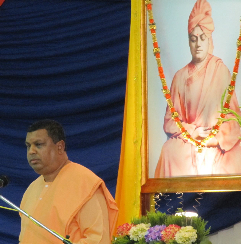
    Saradaprabhanandaji presenting his solid views
    Saradaprabhanandaji presenting his saintly views

    Maharajji established the fact that Inter-belief marriages have occurred since the Rig Veda, that is some 5000 years ago and therefore cannot be said to violate the spirit of Hindu Dharma. Post establishing the social validity of this practice, Maharajji went on to illustrate how it could be generally beset with unending problems. However, Maharajji in a positive note, pointed out that despite its inherent problematic nature, there are inter-religious marriages that  have proven successful and this was dependent entirely on the couple and their genuine love for one another and also their ability to sustain a successful marriage. Maharajji urged parents and the general  members of society to be flexible and cautioned against attempting to break a relationship founded on strong  pure love. At this junction Maharajji warned about the greatest casualty – children and the uncertainty they experience when these marriages begin to  flounder. He also addressed the Inter-sect marriages saying that they were not as problematic and marital success could be assured with little difficulty. His 6 practical tips for parties contemplating such a union are:

    • Premarital counselling
    • Beware of Conversion
    • Acquire negotiating skills to resolve conflict non violently
    • Address the issue of an Identity Crisis
    • Foster Communication Skills
    • Avoid destructive family bigotry

    Swami Saradaprabahanadaji concluded in saying that marriage is a means to attain God realisation and a vibrant Hindu marriage can attain this whilst simultaneously bringing peace to a family.
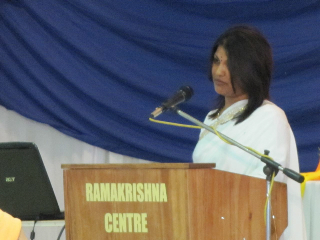
    Veena Singaram's visual impact paper
    Veena Singaram's visual impact paper

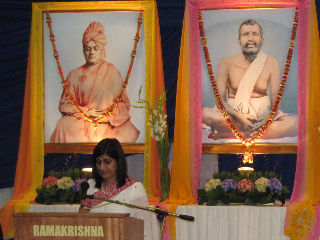
    The third paper presented was entitled Leadership qualities and Responsibilities of the Mother and was by Ms Veena Singaram, a lecturer. Ms Singaram looked briefly at the various challenges facing Hindu women, such as the need to balance the roles of a wife, mother and leader. She also briefly looked at various aspects of leadership and identified the key qualities necessary to be a leader.  Ms Singaram drew from the wealth of great Indian women such as Sri Sarada Devi, the epitome of purity and unconditional love, as well as many other historical personalities. She also looked at great men such as Gandhiji, Washington and Lincoln who honoured their mothers. Ms Singaram advised the audience that motherhood in its nature encapsulates leadership as they require similar traits.  She ended on a very practical note providing Hindu mothers with a few important gems of advice namely :

    • Parents must imbibe positive qualities
    • They must attempt to and subsequently gain an understanding of their children.
    • “Practice what they preach”
    • Educate their children on religious and cultural issues.
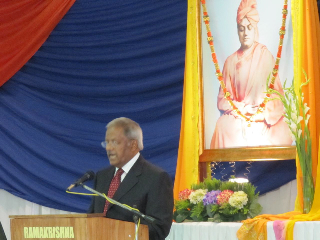
    Naidu presenting his no-nonsense paper
    Naidu presenting his no-nonsense paper

    The final paper was delivered by Senior Counsel, Advocate H Kessie Naidu, entitled Balancing Hindu values with Westernization.  Advocate Naidu drew from the inspiration of Swami Vivekananda, whose role in modernizing Hinduism and embracing western science cannot be denied. Advocate Naidu acknowledged many aspects of westernization – technology, medicine and the decreasing importance of caste system through constituent democracy. He did, however, caution the audience of the pervasive and persuasive nature of westernization and its effect on our dress, language and lifestyle. He then addressed this issue of Hindu values which lay hidden in the intricacies of our scriptures such as non-violence and the sanctity of life. Advocate Naidu attributed the rise in promiscuity and the death of our vernaculars to mindless attachment to westernization.

    He concluded by stating that awareness of the essential values of Hinduism is necessary and thereafter one is required to discern and select the positive aspects of the western world. In this he echoed Swami Vivekananda’s teaching that India should not simply imitate the west but rather absorb and assimilate some western ideals whilst retaining our glorious spiritual heritage. Advocate Naidu’s paper was entertaining and highly relevant given the times we live in.
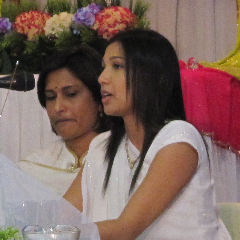
    Professionals in panel discussions
    Professionals in panel discussions – Dr Behariram and Rakhi Beekrum

    The conference was concluded with a panel discussion that generated great interest. Prompted by the astute questions posed by the members of the audience, the panel consisting of Dr Behariram (Graduated from Nelson R Mandela School of Medicine with a Masters in Family Medicine Degree. Presently manages the Crisis Centre at the Ladysmith Provincial Hospital, working exclusively with survivors of sexual assault especially children) and Rakhi Beekrum (Master of Social Science (Psychology) University of Kwazulu Natal.  Counselling Psychologist at Student Counselling Centre of the Nelson R Mandela School of Medicine and runs a private practice in Durban) handled the queries enthusiastically. Questions were fielded at the paper presenters too who did not lag behind in giving quality responses them.
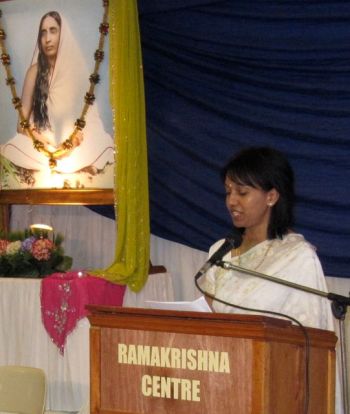
    Veni Govender, the dynamic Director of Ceremonies
    Veni Govender, the dynamic Director of Ceremonies

    I cannot conclude this Report without mentioning about the Director of Ceremonies for this Conference. She was Veni Govender, an eminent Educator of Ladysmith and also a devotee of the Ramakrishna Centre there. The spirited way she started the program, the vigorous manner she veered the responses, the creditable control that she could exercise over the floor and above all the dynamism that she displayed in directing the program cannot but be applauded.

    There can be no denying that audience delegates walked out feeling far more equipped to deal with the challenges facing Hindu families. The Conference was undoubtedly a resounding success which harbours only good for families of the future.
    IMG_2559.JPG

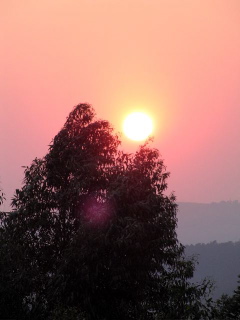
  • Delightful dawn!
    Delightful dawn!

    The delightful dawn on the 6th September while driving from Durban, drew us close to one of the historically important town in the Northern part of KwaZulu Natal province, Ladysmith where the Conference on Hinduism was scheduled. A little more than 400 delegates started arriving in batches at the venue, Civic Centre Hall from 7.30 am onwards. The Conference has generated keen interest among the professionals like educators, advocates, social workers, psychologists, doctors and in an equal measure among the common Hindu population. I had said in my previous post that I would try to place a Report on the proceedings of this august Conference. My hearty thanks go to Reantha Pillay, a student-devotee, who has penned this brilliant Report – on the same day, in spite of the long distance to & fro travel – that would, I believe satisfy the curiosity of those who could not attend the Conference. I am giving below the Part I of the Report. I am also thankful to Rishienandan of Pietermaritzburg subcentre for the excellent photos.

    Report – Part I

    Reantha Pillay

    150

    From time immemorial the family has been the foundational unit of Hindu society; however, in today’s fast paced society, the family system of old seems to face obstacles at every corner.  Divorces, domestic abuse, lack of communication and the ever changing role of women – all these factors present serious challenges to Hindu families.  It is with this in mind that the Hinduism Conference for 2009 focussed on Hindu Families – Challenges and Solutions.  The aim of the Conference was to identify the emerging problems and equip the Hindu community to deal with them.

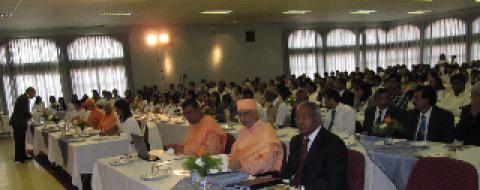
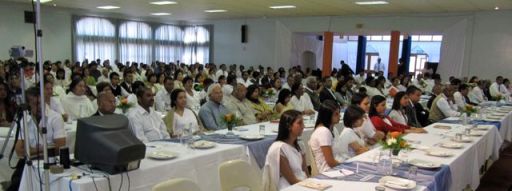
    Admirable arrangement in Civic Centre Hall
    Admirable arrangement in Civic Centre Hall

    Ladysmith Sub-centre played host to this important event held at the Civic Centre from 9 am to 1 pm on Sunday, 6 September, 2009.  The tastefully decorated venue with the centre of stage occupied by the huge portraits of the Holy Trio, the hall, equipped with data projectors and rows of tables catered for the many delegates from all over KZN and allowed a comfortable environment to listen to the esteemed panel of  speakers.  At this stage I must compliment the Ladysmith Sub Centre on a most well-organised and enjoyable, educative conference.

    Mellifluous chanting by Mataji
    Mellifluous chanting by Mataji

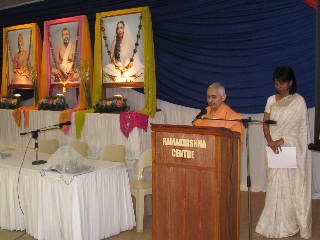
    The proceedings began with the Opening Prayer led by Pravrajika Ishtaprana Mataji, Head of the Sri Sarada Devi Ashram, Asherville. In her mellifluous voice, Mataji chanted the three most famous pranam-mantras on the Holy Trio. She was accompanied by another nun – Pravrajika Divyanandapranaji – who had recently come from India to stay and serve at Sri Sarada Devi Ashram. This was the latter’s first visit to Ladysmith. The Ladysmith Subcentre welcomed her with an offering of flower bouquet.

    Reception to the Revered new Mataji
    Reception to the Revered new Mataji

    Swami Vimokshanandaji Maharaj, President of the Ramakrishna Centre of SA, gave his inaugural address.  The address posed the ever relevant question, “Does the Hindu family system have utility in the modern era?” Maharajji brought to the attention of the audience that the traditional family system is still valid and whatever disintegration that our society experiences, needs to be addressed in order to revive old values. Maharajji then looked at some of the challenges facing the Hindu family.

    Firstly, Maharajji identified the lack of the extended family unit in modern times.  Here a humorous story about a daughter-in-law not wanting to disturb the “duties of the household” regaled the audience. On a more serious note, Maharajji looked at the wealth of knowledge, wisdom and culture that is being lost with this relinquishment of the extended family model. Secondly, Maharajji addressed the Inter-Religious and Intra-Religious divides that plague our Hindu marriages and highlighted the need to address this issue. Thirdly, Maharajji dealt with the eroding of the key concepts of Dharma and Karma in our family system. He highlighted rebirth as a means for the continuation of traditions and as service to society as well as the importance of self sacrifice for the good of the family, community, country and world at large.

    Vimokshanandaji placing his view points
    Vimokshanandaji placing his view points

    In conclusion, he stressed the important role families play in society in the furtherance of our Hindu tradition and contrasted this to the unitary family system of the West. Hindu families are based on the age-old principle, Vasudeiva Kutumbakam, the whole world is one family permeated by God. The final message was that we need to urgently address the obstacles that prevent us from achieving this ideal.

    Maharajji’s inaugural address set the scene perfectly for the four papers that were to follow. In an email conversation, a Counselling Psychologist had this to say about the Inaugural Address: …it was a pity that it was too short. Maharaj should consider presenting a paper in future. It is amazing that being in South Africa for only a few years that Maharaj has developed such insight into the lifestyles and family problems of people in South Africa. Maharaj has made some very interesting and valid points that I hope will be elaborated on in the future.

    The first speaker of the morning was Ms Aruna Chetty, an ardent and long standing devotee of the Ashram as well as a social worker.  She is presently the Director of Phoenix Child and Family Welfare Society. Ms Chetty’s topic was Creating Security and Family Stability. She began by outlining this concept of safety and security and focused first on the right ways of upbringing of the children. Ms Chetty advised the audience on four key issues.

    Ms Aruna Chetty addressing the audience
    Aruna Chetty addressing the audience

    Firstly, that there are only two ways to teach your children lasting values and they are intense love and personal example. Secondly, children require a set of routine in order to feel stable and secure. Thirdly, one’s home must create a suitable environment for the child’s development. Here she provided a few simple tips to help improve the home environment such as daily meals together and a designated place to pray. Lastly, she warned busy parents that a child’s love cannot be bought by material goods and that it is important to focus on their moral and spiritual aspects and not merely their secular education. Ms Chetty highlighted commitment, communication and correctional discipline as three key concepts required to make a family safe and secure. Ms Chetty’s paper was highly practical and afforded parents a clear guide to creating stability and security in the home.

    After the presentation of this paper the conference broke for tea.

    to be continued…

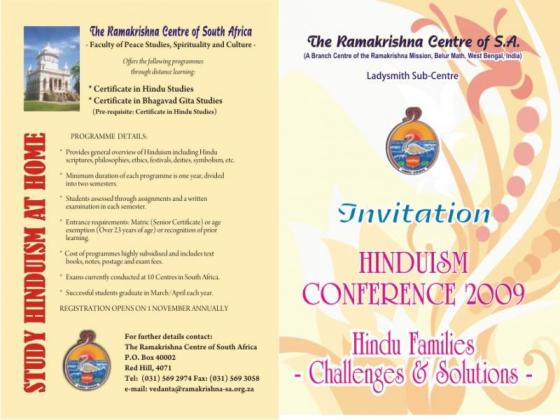
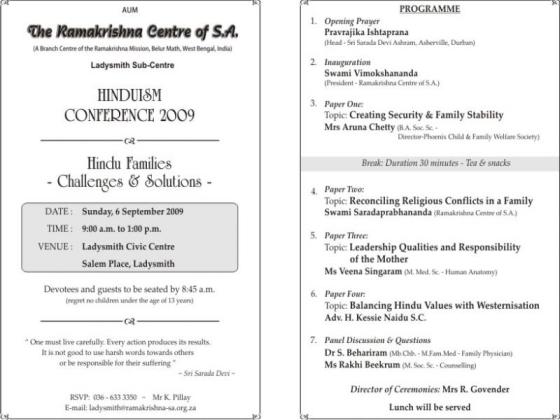
  • This year the Annual Hinduism Conference is hosted by our Ladysmith branch, scheduled on Sunday, 6th September, 2009.  The theme is Hindu Families – Challenges and Solutions. It is no doubt interesting but also topical. Dr Aruna Chetty, Director of Phoenix Child and Family Welfare Society will deliver a paper on ‘Creating Security and Family Stability’. Brother Swami Saradaprabhanandaji will speak on ‘Reconciling Religious Conflicts in a Family’. The Third paper will be presented by Veena Singaram on ‘Leadership Qualities and Responsibility of the Mother’.  Advocate H Kessie Naidu SC will present the Fourth paper on ‘Balancing Hindu Values with Westernisation’.

    Panel Discussion and Questions session will be conducted by Dr Behariram and Rakhi Beekrum. The Inaugural Address will of course by me. The Opening Prayer will be lead by Sister Pravrajika Ishtapranaji of Sri Sarada Devi Ashram, Asherville. I shall try to present a Report later on the proceedings of this prestigious Conference.

    Below here is the Invitation:

    coverpage
    Annual Hinduism Conference 2009 – cover page

    Annual Hinduism Conference 2009 - Inside Program page
    Annual Hinduism Conference 2009 – Inside Program page

  • Happy Sri Ganesh Chaturthi greetings!

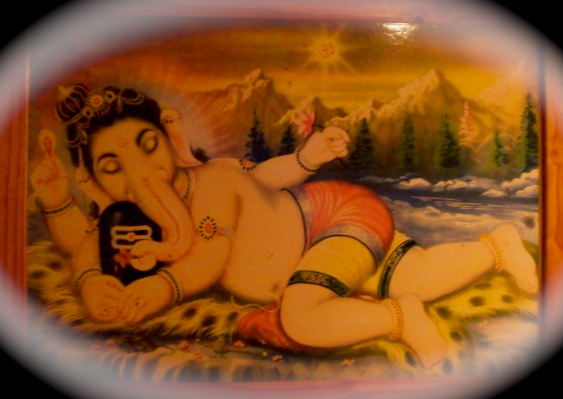
    Child Ganesha embracing Shiva-linga, Photo Courtesy: Rishi
    Divine darling Ganesha embracing Shiva-linga, Photo Courtesy: Rishi

    A Hymn to Him? Him, whom the entire Hindu world remembers before beginning anything anew; Him, whom Gauri-shankar, the parents of the universe (jagatah pitarau) praised for His wisdom ; Him, whom all the Gods, Goddesses, humans and other beings bow for removal of obstacles; today is the auspicious Sri Ganesh chaturthi.

    Last year I reminisced my childhood days during Ganesh chaturthi celebration (see here). How the wonderful Lord Ganesha, who shines like a freshly risen sun (nava-udita-arka bhaasvaram) enlightened me of a fact of life! And, alongwith, in a lighter vein, I had talked of kozhukattai, the delectable sweet dish. I must confess here that my complaint(!) was well taken as challenge by one of our devotees of Ladysmith sub-centre, who exactly reproduced kozhukattai to my great wonder and delight too, as per the recipe! Ganesha bestowed on her siddhi (success) in her earnest attempt.

    The worship of Ganesha was made an integral part of Hindu tradition by Adi Shankaracharya; It tells us about the panchaayatana puja. Five deities – GaneshaVishnu, Shiva, Shakti and Surya – are taken together for daily worship. Skanda that is Lord Murugan is also added bringing a title of great honour viz., shanmata sthapaka – “Founder of six Faiths” for Adi Shankaracharya.

    I find our Centre in SA has published a Prayer Book which is very popular among our devotees and even among other organisations too. It has excellent hymns compiled by Swami Shivapadanandaji, the second President of our Centre. Its contents are neatly classified into Prayers, Bhajans and Kirtans, Stotrams and Aratis.

    Generally hymns play a vital role in the evolution of spiritual life. As a child you start reciting it again and again along with the elders in the family and without any extra effort the whole hymn becomes byheart. The ideas of the hymn remain in the mind when you grow up. I remember vividly how I used to join the recital of hymns with my mother and other elders in the family, by the process of which several hymns became strongly embedded in memory. One such hymn was Ganesha Pancha-ratnam. The other was some captivating songs from the enchanting Thiruppugazh.

    Now let me tell you about the hymn called Ganesha pancha-ratnam – the Gems-five on Ganesha. The author of this exquisite hymn on Ganesha is our eternal Guru Adi Shankaracharya. The metre, language, and the thoughts are exceptionally elevating to our bhakti mood. This poem is composed in a metre called pancha-chaamaram, which has four quarters of sixteen syllables each, and has a scheme of short-long-short-long syllables. The dance experts say that this ‘tadhIm-tadhIm’ gait endows it with a brisk, marching gait (imagine Ganesha walking!). The learned further add that the poets of the past exactly knew how to choose metres, and sounds which conveyed the import of the poem, not just lilting lyric.

    This has been sung, creating a soul-satisfying experience, by no other than Karnatic maestro M S Subbulakshmi.

    It would be wonderful if our devotees in SA as well as in other countries who do not know this particular hymn on Ganesha, can learn it. In order to get the tune for this hymn, I give below the youtube link for Ganesha pancharatnam. While listening to the tune, one can follow the words of the hymn given hereunder. I am thankful to Chennaionline.com for the English translation of the hymn.

    Mudaa karaatha Modakam Sadaa Vimukti Saadhakam

    Kalaa dharaava tamsakam Vilaasiloka Rakshakam

    Anaaya Kaika Naayakam Vinasitebha Daityakam

    Nataasubhaasu Naashakam Namaami Tam Vinaayakam

    Meaning: I prostrate before Lord Vinaayaka who joyously holds modaka in His hand, who bestows salvation, who wears the moon as a crown in His head, who is the sole leader of those who lose themselves in the world. The leader of the leaderless who destroyed the elephant demon called Gajaasura and who quickly destroys the sins of those who bow down to Him, I worship such a Lord Ganesh.

    Nateta raati Bheekaram Navodi taarka Bhaasvaram

    Namat Suraari Nirjaram Nataadhi Kaapa Duddharam

    Suresvaram Nidheesvaram Gajesvaram Ganeshvaram

    Mahesvaram Samaashraye Paraatparam Nirantaram

    Meaning: I meditate eternally on Him, the Lord of the Ganas, who is frightening to those not devoted, who shines like the morning sun, to whom all the Gods and demons bow, who removes the great distress of His devotees and who is the best among the best.

    Samasta Loka Shankaram Nirasta Daitya Kunjaram

    Dareda rodaram Varam Vare Bhavaktra Maksharam

    Krupaa karam Kshamaakaram Mudaakaram Yasaskaram

    Manaskaram Namaskrutaam Namaskaromi Bhaasvaram

    Meaning: I bow down with my whole mind to the shining Ganapati who brings happiness to all the worlds, who destroyed the demon Gajasura, who has a big belly, beautiful elephant face, who is immortal, who gives mercy, forgiveness and happiness to those who bow to Him and who bestows fame and a well disposed mind.

    Akimchanaarti Maarjanam Chirantanokti Bhaajanam

    Puraari Poorva Nandanam Suraari Garva Charvanam

    Prapancha Naasha Bheeshanam Dhananjayaadi Bhushanam

    Kapola Daana Vaaranam Bhajaey Puraana Vaaranam

    Meaning: I worship the ancient elephant God who destroys the pains of the poor, who is the abode of Aum, who is the first son of Lord Shiva (Shiva who is the destroyer of triple cities), who destroys the pride of the enemies of the Gods, who is frightening to look at during the time of world’s destruction, who is fierce like an elephant in rut and who wears Dhananjaya and other serpents as his ornaments.

    Nitaanta kaanta Dantakaanti Mantakaanta Kaatmajam

    Achintya Rupa Mantaheena Mantaraaya Krintanam

    Hrudantarey Nirantaram Vasantameva Yoginaam

    Tameka Danta Mevatam Vichintayaami Santatam

    Meaning: I constantly reflect upon that single tusked God only, whose lustrous tusk is very beautiful, who is the son of Lord Shiva, (Shiva, the God of destruction), whose form is immortal and unknowable, who tears asunder all obstacles, and who dwells forever in the hearts of the Yogis.

    =====================================================

  • Happy Krishna Ashtami greetings!

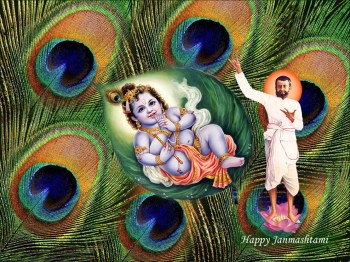
    The Yuga avataars - Sri Krishna and Ramakrishna, Courtesy: Dr S Adhinarayanan, New Delhi, India
    The Yuga avataars – Sri Krishna and Ramakrishna, Courtesy: Dr S Adhinarayanan, New Delhi, India

    Swami Vivekananda succinctly gives the central teaching of Sri Krishna when he says that “…the doctrine which stands out luminously in every page of the Gita is intense activity, but in the midst of it, eternal calmness. This is the secret of Work, to attain which is the goal of Vedanta…” On this auspicious occasion of Sri Krishna Ashtami celebration, may the Almighty be ever gracious in enabling us to practice Vedanta in our day to-day life as propounded and practiced by the Holy Trio is my fervent prayer!

    This year Lord Sri Krishna allowed me to practice that intense activity without losing my calmness. I repeat here what I wrote last year : In India, in no centre of ours, I had witnessed such an elaborate festival! The devotion of the devotees is worth noting; what a verve and vigour in singing bhajans! And faith and fervour in performing worship! And the day-long fasting and sitting in the temple for such long hours – absolutely maintaining utmost discipline – no chitchat, no gossip and all are tuned to the discourse and songs, well, I was greatly pleased and impressed with a new kind of experience that gave a boost to my devotional practices!

    And my tour program was like this:

    06 Aug – Estcourt Gayatri Temple

    07 Aug – Ladysmith Sub centre

    08 Aug – Dundee Sub centre

    09 Aug – Morn – Newcastle sub centre

    09 Aug – Even – Glencoe Hindu Temple

    10 Aug – Even – Pietermaritzburg sub centre

    10 Aug – Night – Pietermaritzburg Sri Vishnu Temple

    11 Aug – Morn – Phoenix sub centre  for the senior citizens

    11 Aug – Even – Chatsworth sub centre

    13 Aug – Asherville Sri Sarada Devi Ashram

    14 Aug – Last session of Krishna ashtami in HQ

    Happy news to our readers! This Blog started on January 23, 2008, had crossed 10 thousand hits within a span of seven months and now by the grace of Master, Mother and Swamiji has crossed 30 thousand hits ! I cannot but thank every one of you who avidly reads and sends me interesting comments.


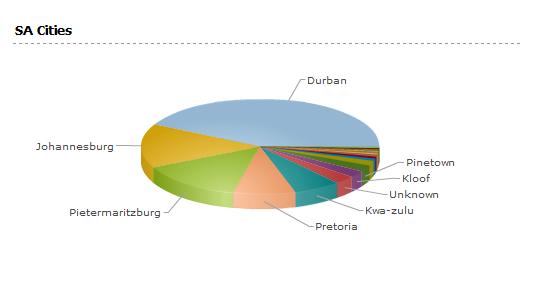
    Have a look at AMATOMU. It’s a new service created by the Mail & Guardian Online that tracks the South African blogosphere. Under the category Religion, the first 25 Popular Religion Blogs are listed (of course all South African!). And as readers of this Blog you will be pleased to know that “Vedanta in practice” has climbed up the ladder to come as 3rd by Reads!

    Another news too!

    IndiRank is a system, built to rank the blogs in the IndiBlogger network. Although every blog is manually verifiable before it’s allowed into the network, the IndiRank system is completely automated. It’s like ‘runs’ in a game of cricket – the higher the score, the higher ranking it means. Blogs are ranked on a scale of 1-100 and this blog now that is as on date, ranks 67!

    I give below the Amatomu Charts for further clarification:

    Countries_Blog


    SA_Cities_Blog