A Micro-Blog from Swami Vimokshananda – earlier at Durban, Singapore and Dublin – now at Yelagiri Hills, Tamil Nadu, India – "A private diary for public consumption!"
Many countries have their own National Youth Days. In South Africa, National Youth day is celebrated on 16 June every year. Each country has its own reasons to celebrate it. India has its National Youth Day on 12 January which is the birthday of our illustrious leader Swami Vivekananda. Here in South Africa we, the Ramakrishna devotees celebrate South African Youth Day on 16 June and in January, we have an half a day Retreat program for the youth in commemoration of Swami Vivekananada’s birth day.
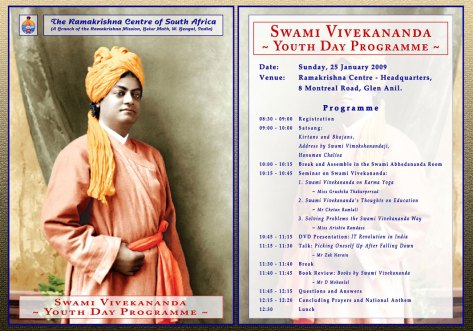
The following is the Program for the Youth Function that will be held on Sunday, 25 January, 2009.
Youth Day Program in commemoration of Swami Vivekananda's 146th birth anniversary on 17th January, 2009 as per Hindu Lunar calendar
Swami Sunirmalananda, a brother monk of our Order, graduated in Physics, Chemistry and Mathematics, came to Brazil in 2004. He gives talks, conducts courses, and presently lives in Curitiba.
He has circulated a thought-provoking essay on Sri Ramakrishna and Santa Claus on the eve of Christmas and New Year occasion. I received this through kind Dr Hiru Mukherjee of UK. A must read for all Ramakrishna devotees!
Merry X-mas! The above digital painting was sent from India by Dr S Adhinarayanan
Vedanta Retreat
Devotees of the Ramakrishna Centre found a spiritually enjoying way of the Christmas holiday by participating in the ‘Vedanta Retreat’. It was held on Thursday, 25 December 2008 (6 a.m. – 6 p.m.) at the Centre, Glen Anil.
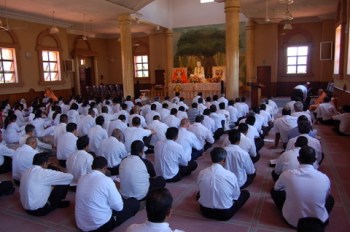
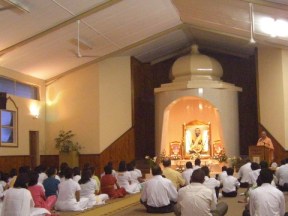
Satsang in temple hall
The program for the day started in a serene atmosphere with satsang, which included the chanting of hymns, singing of bhajans and kirtans like pranam mantras, Sri Ramakrishna Jaya Ashtakam, prakritim paramam, murta maheshvaram and bhajan on Disciples of Sri Ramakrishna, song on Lord Ganesha and bhajan on the Divine Mother, reading from the ‘Gospel of Sri Ramakrishna’ and chanting of Vedic shantimantram.
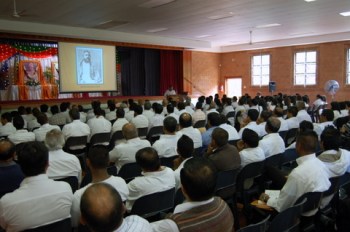
Seminar in progress
Thereafter, all the participants of the Retreat moved over to the spacious Nischalananda Hall. A seminar was conducted on the Bhagavad Gita on the following topics when each speaker presented his/her theme with a captivating slide show presentation.
1. Divine Manifestations (Chapter 10) by Miss Jyothi Bhana.
2. Moral Code for Hindus (Chapter 16) by Prof. V B Jogessar.
3. Surrendering to God – Sri Krishna’s Final Message (Chapter 18) by Mr Bhavanesh Parbhoo.
Discourse on Isha Upanishad
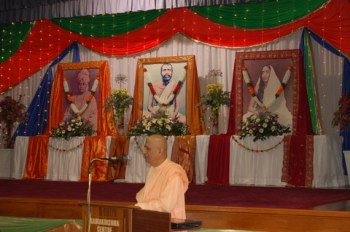
This was followed by a discourse on: “First and Second Verses of the Isha Upanisad” by Sri Swami Vimokshananda. While explaning what the first two verses imply, the Swami first focussed on the Invocation mantra “purnamadah purnamidam”. He went on then to narrate the significance of the three aspects in each verse namely, permeation of everything by God, enjoyment by renunciation, not coveting others’ wealth in the first verse and living a long life, doing work unabated, keeping the attitude of non-attachment in the second verse.
A DVD presentation thereafter on Ganges was enjoyed by all. After a short break the devotees assembled in the Temple where Sri Hanuman Chalisa was recited in chorus. Devotees enthusiastically participated in the Guided Meditation, conducted by Swami Vimokshananda . At the end of Meditation, shanti invocations were chanted.
Swati Kulkarni in concert
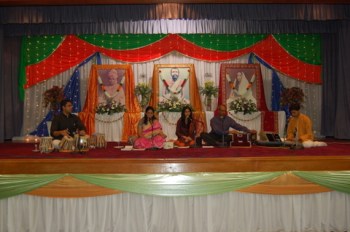
After Lunch prasad at Dining Hall a devotional concert by Mrs Swati Kulkarni (Vocalist) from India was heard attentively by the devotees. She was accompanied by two artistes namely Sam Rugbeer on Harmonium and Manesh Maharaj on Keyboard. Tabla support was provided by Ravi Rugbeer. Swati’s daughter Neha also sang and supported her mother. This was followed by a Talk: “The Holy Mother as an Example for Householders” by Pravrajika Ishtaprana of Sri Sarada Devi Ashram, Asherville. She used the slide show presentation deftly in order to bring home the simple but significant ideas of the Holy Mother, that can be practised in day to day life by anyone.
After a short break for Tea, devotees were asked to do the Likhit Japa. Question/Answer session was conducted by Dr H Parbhoo when Sri Swami Vimokshananda gave the answers.
All devotees once again assembled in the Temple Hall for the final session. It had the usual Silent Meditation, Arati, Evening Hymns, Bhajans and Concluding Prayers. Supper was served to all in the Dining Hall. This Retreat was restricted to 300 devotees.
December is the Month of the Mother! The 155th birth anniversary of Holy Mother Sri Sarada Devi is celebrated all over the world. Here in South Africa our Sub centres and Satsang groups did not lag behind. On 1st December Verulam celebrated; on 7th Glencoe; on 14th Sri Sarada Devi Ashram at Asherville; on 16th Ladysmith; on 20th HQ; on 21st Pietermaritzburg where, in all the places, I gave key-note addresses.
This week it was an inspiring trip to Ladysmith in Northern Natal during the celebration. In all the centres, the devotees were enthusiastic, keen and were interested to know more and more. Several sessions of discussions at different devotees’ places were held.
On the tithi puja day, from 6 am to 6 pm a relay japa yajna was joined by families of devotees. After hawan, in the evening, when my turn to speak came, I dwelt on the ever compassionate Mother who was so sympathetic to feed the hungry. Her grace transcended the rules and regulations and embraced the people living in dire poverty as Her own.
I was moved by that anecdote told by Swami Apurvananda in his reminiscences about Holy Mother, an extract of which I reproduce below:
Franz Dvorak (1862–1927), a painter from Prague, inspired by the teachings of Ramakrishna made several paintings of Ramakrishna and Sarada Devi
In the evening when I went to her again, I found her on the veranda of her mud hut cutting vegetables, with her legs stretched out… We chatted for some time and then she wanted to know how famine relief work was carried out. From her words it was evident that she was much distressed by the plight of the famine-stricken.
I described how we went from door to door distributing coupons among the poor, how we gathered information about their needs and miserable circumstances, how they collected rice in exchange for coupons, adding that women were also given saris sometimes. In this context, I narrated an incident which moved Mother deeply.
I described how one morning, when out on a tour of the villages where relief operations were being carried out, I discovered that none of those receiving rice from us was at home. Obviously, they had gone out to work. Those who worked were not eligible for the dole of rice. So I proceeded to investigate and found most of them sowing paddy in knee-deep slush in a paddy field outside the village.
On advancing in that direction, I noticed from a distance a woman labourer leaving the field and hiding herself behind a pile of paddy saplings. On enquiring from others, I learnt that she had delivered a baby that previous night, it was with that baby she had come to the field to work. Driven by hunger she was sowing paddy, leaving the infant wrapped in a rag in the corner of the field. If it was known that she was working in the field, she would not get rice from us. So having seen me from a distance, she was trying to hide from me.
I was much disturbed thinking of the dire distress that could compel a woman, who had given birth to a child just the night before, to come to work in the field with the newborn. It was a terrible shock. I approached the woman, and in a choked voice, just said,”Do not worry, Mother, I shall not stop your quota of rice.” This helped her muster enough courage to fold her hands and say, “Sir, I’m going through unbearable hardship. That’s why I’ve come to work.” For one days work in the field she would get two seers of paddy.
Mother shuddered with horror on hearing the story. Almost in tears, she exclaimed, “What are you saying! So fresh from childbirth she had come to work in the field! It is not right to stop the dole of rice in such circumstances. Son, you did the right thing. Master will bless you.” Then she prayed to Master, as if hurt, “Master! Can’t you see all this? Such suffering of people! How can people carry on in such miserable conditions! You have to do something for their deliverance!” Her anguished words still seem to ring in my ears. Mother was compassion personified – a fervent prayer incarnate.
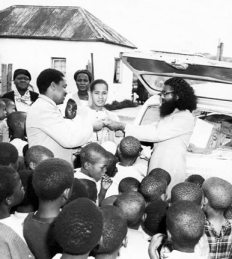
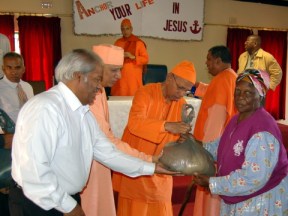
Swami Nischalananda feeding the hungry in an organised scale
Feeding the hungry has become part and parcel of our religious Order all over the world. Swami Nischalananda, the late Founder and the First President of Ramakrishna Centre of South Africa initiated a much needed Nutrition Program in 1953. This Program did play an important role in alleviating hunger and suffering, not only amongst children, but also adults in all communities. Working in the midst of impoverished communities and a wide range of organisations, the Program has been successfully able to reach the poor, destitute, unemployed, abused and disabled. The Centre and all the sub-centres and satsang groups are engaged in feeding programmes in their respective communties with remarkable precision. The Youth members of the Centre, at HQ and all its branches take pride in assisting this feeding program and perform it as Karma Yoga. The contributions from the willing donors, small or big, have made this Scheme eminently reachable to the unreached.
Hamper distribution
On a weekly basis, sandwiches, fresh fruits and vegetables are distributed in the greater Durban area. Further, cooked nutritious meals are served regularly in these areas. A monthly distribution of 2 tons of rice, 800 kg of dhall and 100 kg of salt is maintained by the Centre and supplemented with assorted vegetables and fruit, canned foods, basic grocery items, lentils etc.
Diwali Hampers
Food Hampers consisting of: rice, dhall, salt (both coarse and fine), cooking oil, canned foods, jam, dried beans, sugar and cake flour are distributed to over 1000 indigent families during Diwali. Several sub-centres and satsang groups of the Centre were provided with grocery to augment their own hampers for distribution in their respective areas. In addition to hampers, cooked meals are served to needy families.
The following are beneficiaries of the Centre’s most popular Nutrition Programme:
Abalindi Welfare Centre (incorporating the Abalindi Frail Care Centre, Orphanage and Crèche)
Kwa Mashu Ekusizaneni Children’s Home (a home that caters for orphans and children affected by the AIDS pandemic)
Verulam Day & Pakco Frail Care Centre
Dawncrest Primary School
A M Moolla Spes Nova School
Phoenix (a school for cerebral palsied children)
Phoenix Alcoholic Rehabilitation Centre – Grocery hampers and a selection of vegetables are donated to the Home on a weekly basis
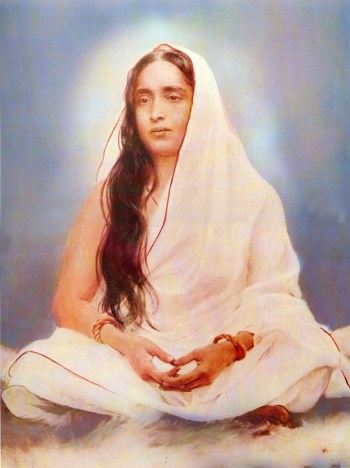
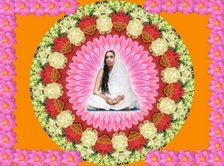
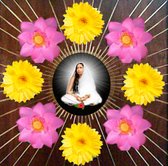
Today is Holy Mother Sri Sarada Devi’s 155th Birth Anniversary
Dr S Adhinarayanan, a devotee of Holy Mother has designed a Tribute of poster paintings in a riot of colours. Three samples are given below. But if you would like to enjoy other charming pictures that are meticulously designed digital portraits, please click here



 Vedanta in Practice