Vedanta in Practice

A Micro-Blog from Swami Vimokshananda – earlier at Durban, Singapore and Dublin – now at Yelagiri Hills, Tamil Nadu, India – "A private diary for public consumption!"

  • Today is World AIDS Day!
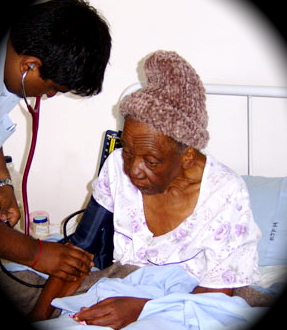
    A terminally-ill patient
    A terminally-ill patient in SA

    I was pleasantly surprised when I received the communication from the Blogcatalog requesting all bloggers to Unite in the campaign against spread of HIV/AIDS. Yes, thats a wonderful idea as today the thinking people all over the world are seized of this killer scourge problem and are trying to widely broadcast the campaign so that it reaches the most affected.

    When I was actively serving the Tuberculosis patients in Ranchi TB Sanatorium, the then Doctor Maharaj of the Sanatorium – Swami Satyeshananda – used to impress upon me on how the TB had become intimately related to the HIV infections (while unfortunately the official circles would try to underplay the statistics). I realised the inter-connexion well when I came to South Africa last year and started associating with the welfare activities here, pioneered by a monastic brother Swami Saradananda who has been relentless in conceiving and executing suitable programmes for amelioration especially of the HIV/Aids infected patients in the KwaZulu Natal province which is said to have the highest incidence in this country. 

    There are an estimated 33 million people with AIDS worldwide. It affects every country, city, and town in the world. And, the most frightening thing about it is that is going largely unchecked. In fact, that is one of the reason that worldaidscampaign.org is continuing its “leadership” theme, which it developed after learning that many leaders who promised to support AIDS were not keeping their promises. 

    What’s the position in South Africa especially of the AIDS affected children?
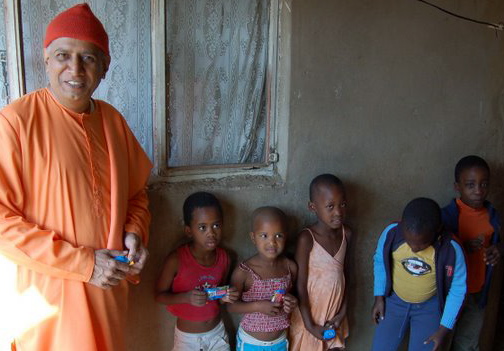
    Ekusizaneni Children's Home, in K Section, Kwa Mashu
    Ekusizaneni Children

    As per AVERT an international HIV and Aids Charity, having projects in countries where there is a particularly high rate of infection, such as sub-Saharan Africa, or where there is a rapidly increasing rate of infection such as in India, the UNAIDS estimated that there were 1.4 million South African children orphaned by AIDS in 2007, compared to 780,000 in 2003. I am quoting from AVERT:

    With many women who are HIV-positive still not receiving drugs that could prevent them passing HIV to their babies, HIV infections are alarmingly common amongst children in South Africa. According to UNAIDS, there were around 280,000 children aged below 15 living with HIV in South Africa in 2007.

    Children who are living with HIV are highly vulnerable to illness and death unless they are provided with paediatric antiretroviral treatment. Unfortunately there is still a shortage of such treatment in South Africa. The AIDS Law Project, an NGO based in Johannesburg, estimated that 50,000 children in South Africa were in need of antiretroviral drugs at the beginning of 2006, but that only around 10,000 were receiving them. UNAIDS estimates that at the end of 2005, children accounted for 8% of those receiving antiretroviral drugs in South Africa.

    As well as many children being infected with HIV in South Africa, many more are suffering from the loss of their parents and family members from AIDS. Once orphaned, these children are more likely to face poverty, poor health and a lack of access to education.

    How our Centre in South Africa stepped in…?
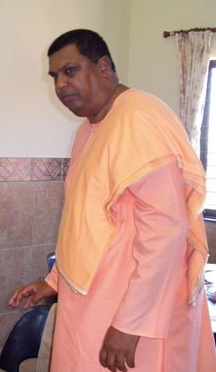
    Swami Saradananda of SA, a dynamic monk for social change
    Swami Saradananda of SA, a dynamic monk for social change

    During the 1980’s and early nineties prior to the first, free democratic elections in South Africa, violence in the Kwa Mashu area was at its peak. This resulted in many killings and deaths of parents leaving behind orphaned children. In addition, there were also many orphans due to their parents dying of HIV/Aids and children infected by HIV/Aids.

    The Ramakrishna Centre, here under the able leadership of Swami Saradananda mobilised its resources and engaged with Mrs BF Mhlongo from the Ekusizaneni Children’s Home, in K Section, Kwa Mashu to be of some assistance. At that time they had make-shift wooden cabins that were used for the children and during inclement weather posed many problems for them. The Centre immediately saw the need for good, secure and comfortable accommodation for these children and began a project to build two dormitories for boys and girls. 

    These dormitories were built and furnished with double bunk beds and handed over to the local committee in 2001, by the kind assistance of our donors and well-wishers. According to Prof Vinod Jogessar, the Chairperson of the Centre’s Health Wing Ramakrishna Clinic, “On  the opening day, 5 patients were admitted.. These patients were in wheel chairs; emaciated, frail, weak and unable to walk. Just being put into comfortable beds with clean sheets and caring nursing staff was something they had not experienced before. The joy expressed on the faces of these patients is indescribable. Some weeks later, two of these patients walked out of the hospice on discharge. Doctors of the Ramakrishna Clinic conduct weekly medical rounds and also provide fresh vegetables and other provisions on a weekly basis. Good nutrition is an important aspect in  the management of patients with AIDS. The medical doctors feel privileged to be able to serve the needy and regard service to man as  worship of God.” 

    And for the terminally-ill patients…
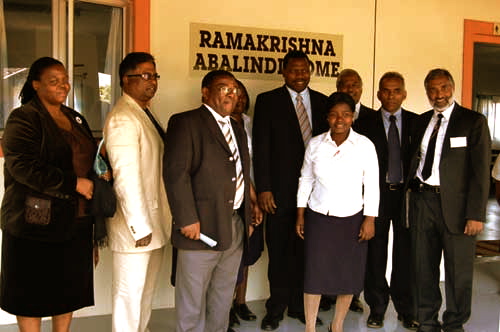
    Ms N Ngubane, Councillor Mr L Naidoo (Deputy Mayor eThekwini Municipality, KZN), Pastor B A Sibisi (Chairperson, Ramakrishna Abalindi Home), the Hon. Dr Z L Mkhize (Minister for Finance and Economic Development, KZN), Caregiver, Adv H Kessie Naidu SC, Mr P Ishwarlaal and Prof V B Jogessar
    From left: Ms N Ngubane, Councillor Mr L Naidoo (Deputy Mayor eThekwini Municipality, KZN), Pastor B A Sibisi (Chairperson, Ramakrishna Abalindi Home), the Hon. Dr Z L Mkhize (Minister for Finance and Economic Development, KZN), Caregiver, Adv H Kessie Naidu SC, Mr P Ishwarlaal (Chairperson of Ramakrishna Centre of SA) and Prof V B Jogessar (Chairperson of Ramakrishna Clinic)

    Recently the Centre took up providing indoor facility to terminally-ill patients. On 6 August 2008, the Ramakrishna Abalindi Home (Inanda) was declared open by the Hon. Dr Z L Mkhize (Minister for Finance and Economic Development, KwaZulu-Natal). This facility was built by the Ramakrishna Centre of South Africa and handed over on that day to the office-bearers of the Home. The Home, intended for terminally-ill patients, comprises three sections of 45 beds, made up of three wards (15 beds for males, 15 beds for females, 10 beds for children and 5 beds for mothers wanting to stay with their children), offices, stock rooms, ablutions facilities etc. The Home will provide a much needed facility for HIV-AIDS and cancer patients in the area.

    eThembeni Home for Terminally ill patients - Female ward
    eThembeni Home for Terminally ill patients – Female ward

    This is the second Home that the Centre has constructed for terminally-ill patients, the previous one being a 30-bed facility in Kwa Mashu. Minister Mkhize pointed out that the facility was not only a healthcare Home but also a symbol of integrated effort between Indians and Africans that promoted inter-racial, inter-religious and inter-linguistic understanding.
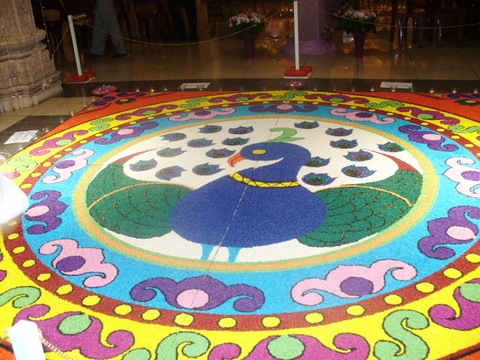
  • Diwali Rangoli at Swaminarayan Mandir at Johannesburg, prepared at 1047 woman-hours!
    Diwali Rangoli at Swaminarayan Mandir at Johannesburg, prepared at 1047 woman-hours!

    Diwali is indeed, a glorious and colourful festival that is celebrated by all Hindus internationally. How Diwali unites and brings people and families together is a matter of experience of the millions. The beautiful array of clay lamps in all Hindu households creates an atmosphere of love, warmth, sharing, and more importantly, reminds of the existence of God in all beings. Therefore during this auspicious time, we should all try and improve ourselves spiritually. At this point, three important ennobling qualities come to mind: tyaga (sacrifice), seva (service) and prema (love).

    Hearty, Happy Diwali Greetings! May this Diwali lighten up your life, may it lighten your burden and may it enlighten your path!
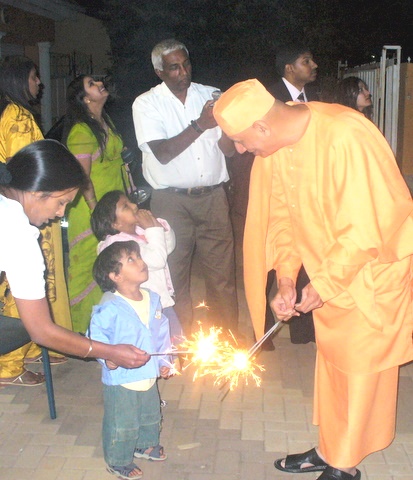
    Diwali festival with child devotees of Johannesburg
    Diwali festival with child devotees of Johannesburg

    Diwali has become an occasion for charity of all sorts. If you give love, even if you do not give much of anything else, it does not matter. And however much you may give materially, if it is not done with love, it does not mean much. So it is love that makes all giving meaningful. I would like to relate a story of how love of virtuous deeds brought blessings.

    Once upon a time the village of Nagpur in India was experiencing famine. There was such a scarcity of food that many people were starving and dying of hunger. A widow named Kamala and her little daughter, Kanama lived in this village. They were poor and had no means of earning money. The mother fell ill suddenly and she was worried about her little daughter. The little girl assured that she would be fine.

    Kanama set out to beg food for her ailing mother. She tried begging at several households with no luck. Exhausted, the little girl finally rested under a tree. In the distance she saw a lady making roti. Kanama ran to her and begged for a piece of roti. So the lady offered her one piece of bread and Kanama accepted the bread gratefully and she said, “O, mother! my mom has not eaten anything for the last week, if only I can get one more piece of bread, I will really be grateful.” The kind lady gave her another piece of bread. Kanama was returning home happily.

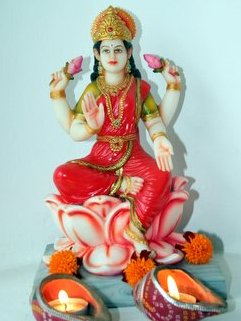
    The Ever Gracious Goddess Lakshmi - courtesy Veena Daya
    The Ever Gracious Goddess Lakshmi – courtesy Veena Daya

    On the way she saw a hungry dog looking for food. “Oh! what a pity! the dog cannot beg for food!”, so she thought and lovingly offered the dog one piece of bread. The dog ate the bread happily. When Kanama reached home, she narrated the incident to her mother. Kanama’s mother was happy to know her daughter was so compassionate. As they were about to eat the remaining piece of bread, they heard a voice at the door… “O mother! I am dying of hunger, please give me something to eat.” The virtuous Kamala said “someone is suffering from hunger, give away my share”. The compassionate little Kanama said “how can this poor beggar appease his hunger with half a piece of bread? Let me give him my share as well.” The beggar ate with great relish and said to Kanama, “May God bless you, my child.”

    When the beggar left, both the mother and daughter fainted from hunger. Then Kamala had a dream in which Goddess Lakshmi, the divine consort of Lord Vishnu appeared to her and said, “O Kamala! Even though you and your daughter were starving, both of you lovingly gave away whatever you had to the hungry dog and the famished beggar. It was I, who appeared in these forms to test you. I am very pleased with your loving concern for others. May you have enough wealth and live happily.”

    Their meritorious act brought rain to the village. The people of Nagpur were relieved of the sufferings due to the tyaga, seva and prema of the mother-daughter duo. This story shows us all, how God’s grace overflows to those who do sacrifice all in the service of others done in absolute love.  The following is taken from Prabuddha Bharata.

    Once a very poor devotee had a strong desire to go to Varanasi to have the darshan of Lord Vishwanatha. But he was too poor to do so. Swami Adbhutananda, a direct disciple of Sri Ramakrishna, was then living in Varanasi. He came to know of the devotee’s earnest longing and wrote to him to somehow collect the one-way railway fare to Varanasi and that other things could be taken care of. Thus being assured, the devotee reached Varanasi with great difficulty and had the darshan of Lord Vishwanatha and Mother Annapurna, and enjoyed the holy company of Latu Maharaj.

    Varanasi Vishwanatha in the iconic image of shivalingam
    Varanasi Vishwanatha in the iconic image of shivalingam

    But one day, at the Vishwanatha temple, he felt great mental anguish. After bathing in the Ganga and finishing his worship of Shiva with bel leaves, when he came out of the temple he saw that all the devotees were giving alms to mendicants and beggars according to their ability. He alone lacked the capacity to give in charity. He cried fie upon himself: ‘I am a poor, wretched beggar myself, deprived of this rare opportunity. On the contrary, having come to this holy place I am enjoying food and shelter provided by sadhus, and I do not have a penny to pay for it!’ He returned to his room with a heavy heart, closed the door and started shedding tears of grief. Latu Maharaj came to know everything and suggested: ‘What does it matter? You do one thing: tomorrow after bathing in the Ganga offer a handful of it to God and pray, “May all the miseries of the world be dispelled.”’ The devotee thought, ‘This is just a consolation for a helpless destitute like me. What merit can be derived from it?’ However, the next day the devotee did exactly as he was advised simply to honour the words of a great soul like Latu Maharaj. Immediately his mind became calm and serene, his heart was filled with an unspeakable bliss, and he felt blessed with divine grace. This is the result of true pilgrimage.

    The idea of complete self-sacrifice is illustrated in Mahabharata and narrated by Swami Vivekananda in his Karma Yoga lectures.

    After the battle of Kurukshetra the five Pândava brothers performed a great sacrifice and made very large gifts to the poor. All people expressed amazement at the greatness and richness of the sacrifice, and said that such a sacrifice the world had never seen before. But, after the ceremony, there came a little mongoose, half of whose body was golden, and the other half brown; and he began to roll on the floor of the sacrificial hall. He said to those around, “You are all liars; this is no sacrifice.” “What!” they exclaimed, “you say this is no sacrifice; do you not know how money and jewels were poured out to the poor and every one became rich and happy? This was the most wonderful sacrifice any man ever performed.”

    Mongoose at Ramakrishna Centre, Durban
    Mongoose at Ramakrishna Centre of SA, Durban courtesy Jody Fuchs

    But the mongoose said, “There was once a little village, and in it there dwelt a poor Brahmin with his wife, his son, and his son’s wife. They were very poor and lived on small gifts made to them for preaching and teaching. There came in that land a three years’ famine, and the poor Brahmin suffered more than ever. At last when the family had starved for days, the father brought home one morning a little barley flour, which he had been fortunate enough to obtain, and he divided it into four parts, one for each member of the family. They prepared it for their meal, and just as they were about to eat, there was a knock at the door. The father opened it, and there stood a guest.

    Now in India a guest is a sacred person; he is as a god for the time being, and must be treated as such. So the poor Brahmin said, ‘Come in, sir; you are welcome,’ He set before the guest his own portion of the food, which the guest quickly ate and said, ‘Oh, sir, you have killed me; I have been starving for ten days, and this little bit has but increased my hunger.’ Then the wife said to her husband, ‘Give him my share,’ but the husband said, ‘Not so.’ The wife however insisted, saying, ‘Here is a poor man, and it is our duty as householders to see that he is fed, and it is my duty as a wife to give him my portion, seeing that you have no more to offer him.’ Then she gave her share to the guest, which he ate, and said he was still burning with hunger. So the son said, ‘Take my portion also; it is the duty of a son to help his father to fulfil his obligations.’ The guest ate that, but remained still unsatisfied; so the son’s wife gave him her portion also. That was sufficient, and the guest departed, blessing them. That night those four people died of starvation.

    A few granules of that flour had fallen on the floor; and when I rolled my body on them, half of it became golden, as you see. Since then I have been travelling all over the world, hoping to find another sacrifice like that, but nowhere have I found one; nowhere else has the other half of my body been turned into gold. That is why I say this is no sacrifice.”

    It is my fervent prayer that each one of us be blessed with such noble and divine qualities! May the light of the lamp burn brightly in our hearts on this holy occasion of Diwali !

    असतो मा सद्गमय | तमसो मा ज्योतिर्गमय | मृत्योर् मा अमृतं गमय | ॐ शांति: शांति: शांति: || Om asato ma sat gamaya | Tamaso ma jothir gamaya | Mrityor ma amritam gamaya | Om shanti shanti shanti ||

  • Nearing Diwali means receiving greetings (and sending too!). This year by email I continue to receive greetings aplenty and I feel I would not be able to reply personally to everyone. Not that I am lazy or do not have feelings of reciprocity; I will be on a week’s tour and when I return another festival would be in the offing! So through this Blog I convey my hearty greetings to all valuable readers who have already sent and all those who plan to send. 

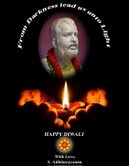
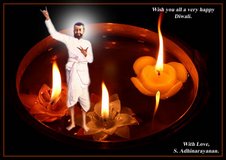
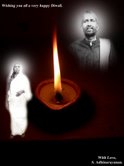
    Some greetings are just from special websites that promote free exchange of greeting cards while a few that reached me had their own stamp of the maker. Definitely the makers have exceptional artistic ability whose limit to innovation was their own imagination only. I am proud to present here six greetings from Dr Adhi Narayanan, a devotee and who has keen interest in photoshop and from another devotee Bharat Churiwala from Mumbai who is one of the moderators of the Holy Trio Group.

    May the blessings of the Holy Trio be on them is my earnest prayer!


    Bharat Churiwala from Mumbai sent me this special greetings:

  • Last Five days

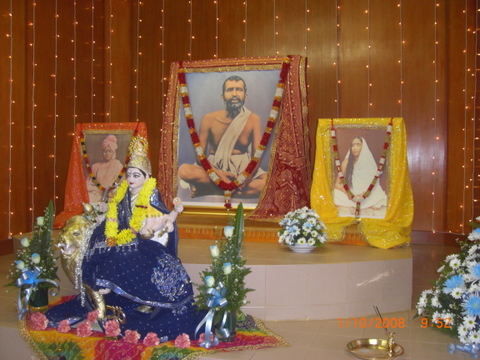
    Shrine at Pietermaritzburg Centre
    Mother Durga at Pietermaritzburg Centre Shrine

    Continued from Navaratri – I

    On Sunday, the 5th October the car drive took just one hour to Escourt. The MahaGayatri temple, there, was tastefully decorated for the sixth night of Navaratri festival. The devotees of Estcourt included devotees of other Hindu organisations as well like Divine Life Society, Satya Sai Sangh etc . With common prayers the function started that included my sixth night Talks. Here I spoke on ‘Devi and Her Splendour’. The devotees would not let me go after supper as they all sat with me in the adjoining hall where till eleven past interesting discussions took place.

    From Estcourt I reached Pietermaritzburg by midnight. How I wished the next day would go off quietly with sufficient rest! But Mother had other plans, it seemed. The almost continuous incoming telephonic or otherwise messages on the sixth October did not allow me to forget my birthday, which I badly wanted. And when the evening came, I was taken to Pietermaritzburg centre. The program on the seventh night pleasantly included, among the set pattern, extra two items of dance on the bharatanatyam style by two school girls who performed exceptionally well. Here being the seventh night of Navaratri which was inter alia the first night of worship of Mother Saraswati, I dwelt upon Mother Sarada as the embodiment and imparter of knowledge.

    Next day, by seven in the morning I was back at HQ. At Nischalananda Hall arrangements for Chandi yajna or Durga Hawan have been made in a huge scale. The chanting of entire scripture of Durga Saptashati was done followed by hawan with the mantra – ‘Aum Aim Hrim Klim Chaamundaayai Vichhe’  which was joined by all the assembled devotees. Cooked prasad was distributed thereafter. On the same eighth night, to a packed audience at the Ramakrishna Temple I spoke on the Devi Mahatmyam. Especially the meaning of ‘Aim, Hrim and Klim’ bija mantras. 

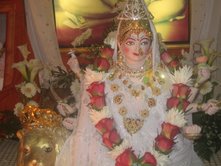
    Mother Durga at Chatsworth centre
    Mother Durga at Chatsworth centre

    On the ninth night of Navaratri, Chatsworth centre had my penultimate Talks during which I narrated the three interesting stories and their significance as contained in Sri Sri Chandi.

    The morning of the tenth day at HQ started with silent meditation and a short satsang. This was joined by all other centres in around Durban. The Durga images from Asherville, Chatsworth and Pietermaritzburg by the time arrived at the HQ and all the images were carried to sea for immersion. After a brief visarjan puja the images one by one, were immersed which was witnessed by a huge assembly of devotees. While Mother’s clay image floated on the sea waters, the devotees felt Her luminous image remained in their hearts never to leave. In his blessings to all devotees, our Most Revered President Maharaj, Swami Atmasthanandaji quotes an incident from the Life of Swami Vijnanananda, one of the Direct Disciples of Sri Ramakrishna:

     
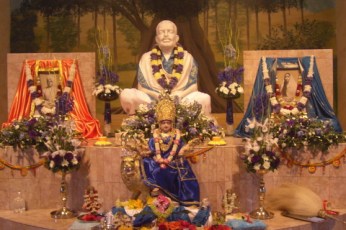
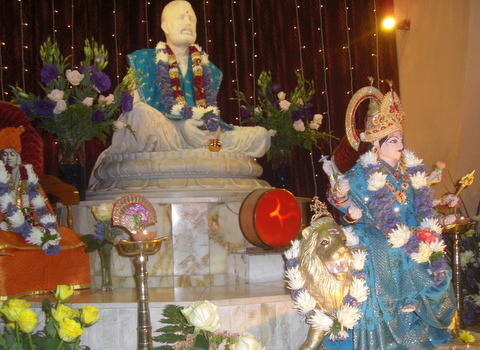
    Shrine in the Ramakrishna Temple at HQ
    Mother Durga at HQ Ramakrishna Temple

    “Revered Vijnan Maharaj is staying at the Math. Everyday, the priest starts the worship after offering pranam to him. Vijnan Maharaj asks him, ‘What is next?’  The priest describes… On the day of Navami, Maharaj asked, ‘What is there tomorrow?’ The priest replied, ‘After a brief dashopachar puja (worship with ten articles) in the morning, there will be darpan-visarjan (immersion in the mirror). And in the evening there will be immersion of the image.’ Maharaj asked again, ‘Where will you immerse the Mother?’ The priest replied, ‘Why, in the Ganges?’ Maharaj asked again, ‘In the Ganges?’ The priest replied, ‘Yes Maharaj, as is the practice every year.’ He (Swami Vijnananandaji Maharaj) said solemnly, ‘Mother is to be immersed in the heart only’. ”
    [The Life and Teachings of Swami Vijnanananda, p.32]

    And Navaratri concluded in a grand and unforgettable way on the Vijaya dashami night with my Talks centering around Devi Saraswati during the night satsang.
  • First Five days

    My Vijaya greetings to all of you! Trust by the grace of Divine Mother, the Durga Puja or Navaratri at your place, as usual, would have been a spiritually stimulating and enjoyable experience.

    Mother Durga at Asherville Sarada Devi Ashram
    Mother Durga at Asherville Sarada Devi Ashram

    Here of course, Mother made me travel (felt blessed) all the centres in Northern Natal. I left HQ on the very first evening of Navaratri for Talks at Asherville where Sri Sarada Devi Ashram is situated. The vibrant atmosphere there enlivened my Talks on Durga and Her manifold Names.

    Next day I reached Newcastle for the noon lunch. The Navaratri second night was spent there. The program there included Puja, bhajans and my Talks. ‘Mahakali – Her Aspects’ was my pet theme that I dwelt upon. After supper, the devotees of Newcastle sat with me when we had lively discussion on religious life. Next day individual appointments were granted to devotees from morning 8 to 11.

    Mother Sarada at our Newcastle Centre
    Mother Sarada at our Newcastle Centre

    My third night stay was at Dundee. The program at the Dundee shrine which is indeed so beautiful was in the set pattern including my Talks. Here I took up the subject of ‘Grace of Kali’. Next day again from morning 8 to 11 devotees of Dundee met me in groups and we had lively discussion on interesting subjects. Albeit tucked away from the mainstream land, living as if in a seclusion, the devotees of Holy Trio have undeniably kept up the spirit of love and service. The keen interest that the growing children of Dundee devotees took during discussions eminently suggested to me that they are really ‘thirsty’ for the right kind of knowledge about Hinduism.

    Mother Durga at Dundee Centre
    Mother Durga at Dundee Centre

    I reached Glencoe by noon. My thinking that I would have a quiet lunch was taken a back seat when I found that old devoted lady had invited almost all the devotees of Glencoe! The evening program was held at the only Hindu Temple wherein a big cut-out of Devi Amba was kept in front of the presiding five deities – Ganesha, Shiva, Murugan, Vishnu, Ram. Here also the usual satsang pattern was adopted that included my Talks on ‘Three Functions of Energy’.

    Mother Durga at Glencoe
    Mother Durga at Glencoe

    The children and devotees of Glencoe were always fascinating to me as their faces would instantly light up with devotion unbelievably. The post supper discussion went on and on till we realised that the time was fifteen minutes to one in the night and I rose for the rest! Next day from morning 8 to 11 the devotees and their children from Glencoe as well as Dundee assembled. The discussion continued till I got ready for departure for Ladysmith. They saw me off; and the parting was indeed so heart-rending especially when the children could not contain their tears!

    Shrine of Ladysmith Centre
    Shrine of Ladysmith Centre

    Reached Ladysmith for the lunch. Selected devotees were there who all joined me in the sumptuous lunch that was served lovingly to all of us. Post-afternoon rest, I was taken to Ladysmith Centre where a strikingly enchanting shrine is there. Here also the usual pattern of satsang was followed with my Talks juxtaposed in between the items of program on the fifth night. ‘Mother’s Protection’ was the theme I chose to deal with. About 250 devotees who attended were served with supper in the nearby Civic Hall. Next day morning I went to the Centre where the Sunday School for children was in progress. I met all the different class students from kids level to adult level. I felt satisfied in witnessing the loving efforts put up by the voluntary teachers in imparting the cherished Hindu values through study of religious books.

    Continued…