Vedanta in Practice

A Micro-Blog from Swami Vimokshananda – earlier at Durban, Singapore and Dublin – now at Yelagiri Hills, Tamil Nadu, India – "A private diary for public consumption!"

  • Guru purnima at Lenasia branch
    Guru purnima at Lenasia branch

    The fist time I had chance to go by road to Johannesburg was to attend the Guru Purnima celebration at our Lenasia branch on 2nd August, 2008. It was a memorable occasion as I was not alone. The car was ably driven by Sunil, the Chairperson of Pietermaritzburg Subcentre and accompanied by a group of devotees that included Avinash, Jaya and his two dear children Adhikar and Vidal, Anupama and Avitha.

    The travel was on a leisurely pace as I wanted to see the rural South Africa. The excellent road leading to Joburg was a treat to ride by a car. On and off whenever we would sight a spot beautiful, we would stop and enjoy the beauty of the place.
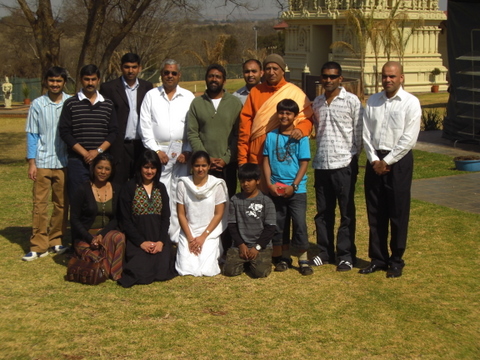
    with the visiting devotees
    with the visiting devotees

    We all stayed at Sugendrie’s place where with her husband Amith, she was wonderfully hospitable to all the guests. Despite my sore throat, the function at the branch went off well. Next day came with a great surprise as Naresh, the Chaiperson of Lenasia branch took all of us to a Temple at Erasmia, near Pretoria. This temple is situated in a beautiful spot, ‘Hennoys’ river too running around and the architecture, a typical South Indian style. It is dedicated to Lord Ayyappa. He is a popular deity in Kerala, the south-western State of India.

    Dr Kollappan of the Pretoria Bhajanai Mandram received me and other guests at the temple entrance. The inside hall space can take about 400 people and the garbha griham (sanctum santorum) was adorned by a gold plated pancha-dhatu vigraham (image of five elements) of Lord Ayyappa. The vibrations that I experienced were unmatched as from the moment that I entered the precincts, I was, as it were transported to a new world where the troubling sore throat and body ache just vanished. Dr Kollappan’s selection of song and the way he sang was inimitable. The loud chanting of “Swamiye sharanam, sharanam Ayyappa”  by all inside resonated in the hearts of all. After long many years I could listen in person to a Tamil devotional song being sung in a temple and that too in South Africa! The atmosphere was enthralling, to say the least.

    Dr Kollappan with Vimokshananda
    Dr Kollappan with Vimokshananda

    In my Talks to the assembled devotees I expressed my gratitude to Lord Ayyappa without whose Grace that I would not have had the opportunity to visit. I explained that how every Hindu from childhood is trained to adore three devatas – one grama devata – the village God, then the kula devata – the family God and finally the ishta devata – the Chosen deity – and how Lord Ayyappa was intimately familiar to me from my childhood as our pre-monastic family’s kula devata. My talks centred around Lord Ayyappa, His sports with the devotees and the famous Shabarimala in Kerala and finally how devotion to God could enable a person to cope up with the everyday new challenges of this modern era.

    Dr Kollappan while speaking about how the conceived idea of building a Temple for Lord Ayyappa came about, narrated the wonderful incidents that brought its fruition ultimately. He was visibly moved and we too, when we learnt that the White gentleman who sold his plot of land had a dream earlier that a Temple would be built there. if you can read Tamil, you can find an article that appeared in Kumudam.
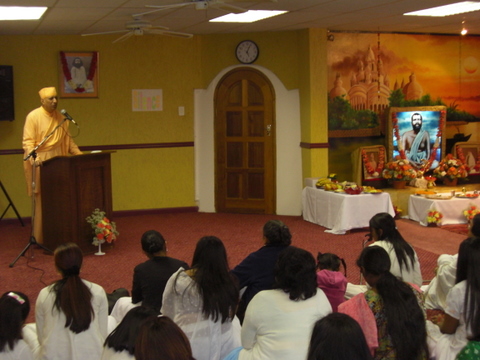
  • The following is a short report on the Hinduism Conference held at Glencoe Town Hall on Sunday 7th September, 2008. About 250 delegates from mostly Northern Natal region participated. Kumari Reantha Pillay, a student-devotee from Durban recounts here of the Conference.

    On Sunday 7 September from 9h00 to 12h00, a Conference on Hinduism was held at the Glencoe Town Hall. Mrs Shalini Bhudhu of  Sanatana Dharma Sabha delivered the inaugural address in which she discussed Hinduism and Vedanta, according to the Holy Trio.

    The first speaker was His Holiness Sri Swami Vimokshanandaji Maharaj who dealt with the topic of Devotional Practices according to the Gospel of Sri Ramakrishna.  Revered Swamiji informed the audience that in order to see God everywhere one must apply the kaajal or collyrium of bhakti (devotion) to our eyes just as Radha did.  As always, Maharaj approached the topic from a very practical point of view, listing six devotional practices that Bhagavan Sri Ramakrishna spoke about in the Gospel 
    • Shravana – that is, Hearing God’s Name
      Maharaj advised all to read holy books and seek holy company to listen to God’s name.
    • Kirtana – Sing the Glories of God
      Whether it be on a CD or through chanting and singing at satsang, we must always sing the Lord’s praises.  Revered Maharaj recounted Master’s teachings about clapping our hands to rid ourselves of negative qualities.
    • Smarana – Remembrance
      Revered Swamiji reminded us of the importance of introspection. Maharaj advised that just as a cow takes in its food only to regurgitate it and slowly munch on it, we too must slowly munch on all that we have learnt about God.
    • Padasevana – Service to all beings
      A true Bhakta sees Master (or God) in his multifarious forms.  Therefore we must serve all, animal and humans, in the spirit of worshipping God. 
    • Puja – Worship
      Ritualistic worship is necessary at the beginning of Bhakti but Maharaj advised us that rituals are not the be all and end all of devotion.  There is a higher state to be realised and that is the Lord within.
    • Bhava – Relationship with God
      Maharaj pointed out the many relationships we can share with God.  One may adopt the attitude of a beloved, have a mother and child relationship with God, think that you are the servant and God is the Master or have the attitude of a friend towards God.  These various Bhavas help one to cultivate the greatest love towards their Isthadevata (Chosen Ideal). 

    Maharaj’s discussion on spiritual practices gave us a clear guide on how to increase our devotion to God according to the path of Bhakti Yoga.   

    ————————————————-

    The second speaker, Mrs Radidevi Govender, an ardent devotee of the Ladysmith Sub-centre, spoke on the topic of Work as a Spiritual Discipline.  Mrs Govender explained the concept of Karma yoga, which is work done renouncing the fruits of the action. 

    She introduced the idea that our character was essentially our combined impressions but warned us against becoming fatalistic.  She advised that we cultivate a will power because we are responsible for who we are.  Just as there is fire in flint, so too is their knowledge in each of our human minds.  Mrs Govender informed the audience that everyone is forcibly made to act under the influence of the three gunas, and rather than allow these actions to tie us down to the world we should,  “work for works sake”. 

    Mrs Govender ended in the words of the Holy Mother, Sri Sarada Devi saying, “Everything happens by God’s will, yet man must work because God will through mans actions”

    ————————————————–

    After the second speaker the conference broke for tea. 

    On Returning, Revered Ishtaprana Mataji dealt with the topic of The Role of the Hindu Mother in Instilling Spiritual Values in the Home.  Revered Mataji warned all parents to be mindful of the samskaras (impressions) we expose our children to.  She advised mothers to chant during pregnancy, play devotional music and do positive things. Mataji recounted incidents of the change that ashram has had on young children who attended Sunday classes. 

    Mataji gave the example of bhakta Prahalad, who though a demon by birth, was in fact, a great devotee of Bhagavan Sri Vishnu. This was partly because of his kind and pious mother being taken by Sage Narada to an ashrama, where positive vibes were abundant. Mataji further gave the example of Luv and Kush who were lovingly brought up my mother Sita and Sage Valmiki in the sage’s humble ashrama.  The young boys were given love and affection but never spoilt.  Incidents from the life of Holy Mother’s niece were also recounted, thus explaining the need to allow children to perform simple chores.

    Mataji went on to explain that children were expert imitators and therefore parents must be positive role models.  Parents were reminded to read holy stories to their young ones and attend satsungs regularly.  Mataji also advised children not to argue or revolt against their parents but rather to look upon their parents as God, “Mata, Pita, Guru, Deivam. 

    The last topic of the morning was Preserving Hindu Culture for the Young Hindu away from Home, this paper was delivered by Dr H.B. Parbhoo, the General Secretary of the Ramakrishna Centre of South Africa.     

    Dr Parbhoo clearly defined the differences between culture and civilisation, stating that the former was the way of life and values, and the latter, the external manifestation of this.  He then went on to state the problems of today’s youth.  He spoke about the lack of firm judgement due to various different causes.  Dr Parbhoo advised the youth against entering places of Kali, places where gambling and drinking occur as well as slaughterhouses and brothels.  Everything gathered by our senses affect us, therefore we must be careful with the people we surround ourselves with, the food we eat and places we go to.  He reminded how Swami Gahananandaji, the past President of the Ramakrishna Order used to advise us to self analyse, pray, perform japa and meditation as well as selfless service. 

    The conference was also introduced to Swami Saradanadaji’s Golden triangle, in which the focus of our lives is school or work, home and ashrama or a place of worship.  Dr Parbhoo dealt heavily with the Taitiriya Upanishad which states that one must have a spiritual home to ground oneself.  He added some form of observable religion, association with Hindu culture and civilization, the ability to still the mind and reach out to the community would be a great help. With this vibrant message to all the delegates, the Conference came to a close.

  • ||Om hrim vighneshwaraaya namaha||

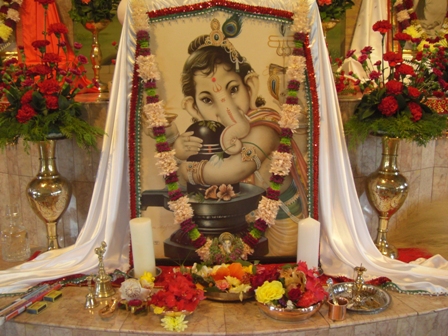
    Ganesha at the temple altar of Ramakrishna Centre of SA, Durban
    Ganesha at the temple altar of Ramakrishna Centre of South Africa, Durban

    Today we observe Sri Ganesh Chaturthi. The wonderful Bengali song, “Giri Ganesha aamaar shubhokaari” ends with this line “Suresha kumaar Ganesha aamaar | taader naa dekhile jhore noyona baari ” is being sung in the beginning of Durga Puja. “Ganesha be my auspicious. Ganesha is mine, Kartik, the son of Shiva is mine; If I dont see them, tears flow from my eyes.”

    The day started with a special puja to Sri Ganesh in our temple. Devotees, by turn perform japa of the above-quoted mantra from 6 am to 6 pm on a relay manner.  After the Puja, my mind started munching albeit nostalgically the childhood days when we would bring the image of Ganesh from the market the earlier evening. Oh! What an enthusiasm in holding Him, as Ganesh, in that small idol, appearing so cute and everyone in the family vie for each other in having Him in their hands.

    Sweet Kozhuk kattai
    Sweet Kozhuk kattai

    We, as children would eagerly await the completion of puja so that we are served with tasty modakam, in Tamil, Kozhuk kattai stuffed with purnam. There used to be two varieties one sweet and the other savoury (ellu and usili ). After leaving Madras in 1970, I have not had the taste of it as I went on moving in North and Eastern India. And now in South Africa, Tamil devotees have not even heard of this term, not to speak of its preparation!

    In Ranchi where I was stayput for long 12 years (a yuga, in local parlance), Ganesh Chaturthi was uneventful. However, I used to relish the news of the Puja getting extremely popular all over India in the last two decades and I remember how a Maharashtrian family once invited me for lunch on the Puja day and to our hearts’ content, besides the sumptuous meals, we discussed the importance of Ganesh Puja and how the veteran freedom fighter Bal Gangadhar Tilak began. 

    This happened in Ranchi. On one Ganesh chaturthi day during the noon break, I went strolling towards our school called ‘Vivekananda Vidyalaya’. The school was in recess and I found groups of pupils sitting together and enjoying their tiffin. I came near to one group of girls, studying in class IV. Among them one girl, a poor Munda Tribal, was not eating anything though the tiffin box was lying in front of her. Naturally my curiosity was aroused and I enquired her why she had not been eating while all others students were taking their tiffins. 

    She kept mum as these tribal girls do not speak out immediately. One trait I noticed with them was that to get an answer one had to repeat the question while with the non-tribals, you just ask once and you get ten answers! The tribals by nature are very timid. 

    I enquired whether somebody – one of the bullies – has eaten away her food. She nodded her head briskly to indicate that no such thing has happened. Then, what was the matter, why she was not eating, I persisted.

    She stood up shyly and said that she herself had given to one of her friends. Why, I demanded to know, stating that how in the early morning, her mother had prepared so lovingly a tiffin for her and by giving away that to someone, would it not have hurt her mother’s feelings?

    How foolish I was!

    Sri Ganesha, in all His grace, wanted to give me the wisdom. 

    The child now spoke with determination: “Maharaj, my friend had not eaten anything in the morning before coming to school. Her mother is sick and her dad went out for work. But, I did have something to eat. So, I gave her my noon lunch so that at least my friend does no go empty stomach.”

    It was hard for me to control my tears. That small girl has such a vast heart! How many of us can think of ‘others’, denying the comfort to ourselves? Did she not go out of her little ‘being’ and spread out to reach for her friend? If this is not Vedanta in practice, then what?

    May Sri Ganesha give us all the ‘feeling’ for others!

    Ethics always says, “Not I, but thou.” Its motto is, “Not self, but non-self.” The vain ideas of individualism, to which man clings when he is trying to find that Infinite Power or that Infinite Pleasure through the senses, have to be given up–say the laws of ethics. You have to put yourself last, and others before you. The senses say, “Myself first.” Ethics says, “I must hold myself last.” Thus, all codes of ethics are based upon this renunciation; destruction, not construction, of the individual on the material plane.

    Swami Vivekananda

  •  

    Swami Vimokshananda

    A big Thank you!

    Today this blog, by the grace of Holy Trio, has exceeded 10,000 hits!

    A big THANK YOU to all devotees, friends and other interested people who made this possible within seven months.

    The varied comments that the posts are eliciting from diverse people –  from school students to senior citizens – are creating a lot of interest in me to learn that the blog, a tech tool, can be also usefully employed in disseminating the ideas and ideals of our Master, Mother and Swamiji and vedanta in particular as practised by these savants.

    May the blessings of them be on all of you is my earnest prayer!