
The delightful dawn on the 6th September while driving from Durban, drew us close to one of the historically important town in the Northern part of KwaZulu Natal province, Ladysmith where the Conference on Hinduism was scheduled. A little more than 400 delegates started arriving in batches at the venue, Civic Centre Hall from 7.30 am onwards. The Conference has generated keen interest among the professionals like educators, advocates, social workers, psychologists, doctors and in an equal measure among the common Hindu population. I had said in my previous post that I would try to place a Report on the proceedings of this august Conference. My hearty thanks go to Reantha Pillay, a student-devotee, who has penned this brilliant Report – on the same day, in spite of the long distance to & fro travel – that would, I believe satisfy the curiosity of those who could not attend the Conference. I am giving below the Part I of the Report. I am also thankful to Rishienandan of Pietermaritzburg subcentre for the excellent photos.
Report – Part I
Reantha Pillay
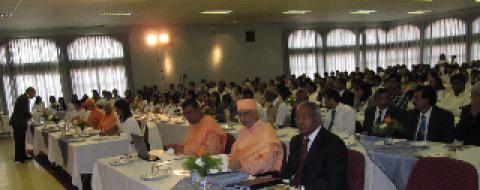
From time immemorial the family has been the foundational unit of Hindu society; however, in today’s fast paced society, the family system of old seems to face obstacles at every corner. Divorces, domestic abuse, lack of communication and the ever changing role of women – all these factors present serious challenges to Hindu families. It is with this in mind that the Hinduism Conference for 2009 focussed on Hindu Families – Challenges and Solutions. The aim of the Conference was to identify the emerging problems and equip the Hindu community to deal with them.

Ladysmith Sub-centre played host to this important event held at the Civic Centre from 9 am to 1 pm on Sunday, 6 September, 2009. The tastefully decorated venue with the centre of stage occupied by the huge portraits of the Holy Trio, the hall, equipped with data projectors and rows of tables catered for the many delegates from all over KZN and allowed a comfortable environment to listen to the esteemed panel of speakers. At this stage I must compliment the Ladysmith Sub Centre on a most well-organised and enjoyable, educative conference.
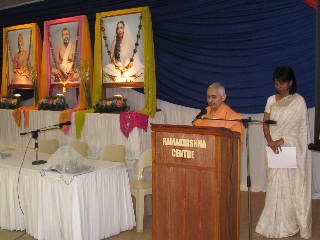
The proceedings began with the Opening Prayer led by Pravrajika Ishtaprana Mataji, Head of the Sri Sarada Devi Ashram, Asherville. In her mellifluous voice, Mataji chanted the three most famous pranam-mantras on the Holy Trio. She was accompanied by another nun – Pravrajika Divyanandapranaji – who had recently come from India to stay and serve at Sri Sarada Devi Ashram. This was the latter’s first visit to Ladysmith. The Ladysmith Subcentre welcomed her with an offering of flower bouquet.

Swami Vimokshanandaji Maharaj, President of the Ramakrishna Centre of SA, gave his inaugural address. The address posed the ever relevant question, “Does the Hindu family system have utility in the modern era?” Maharajji brought to the attention of the audience that the traditional family system is still valid and whatever disintegration that our society experiences, needs to be addressed in order to revive old values. Maharajji then looked at some of the challenges facing the Hindu family.
Firstly, Maharajji identified the lack of the extended family unit in modern times. Here a humorous story about a daughter-in-law not wanting to disturb the “duties of the household” regaled the audience. On a more serious note, Maharajji looked at the wealth of knowledge, wisdom and culture that is being lost with this relinquishment of the extended family model. Secondly, Maharajji addressed the Inter-Religious and Intra-Religious divides that plague our Hindu marriages and highlighted the need to address this issue. Thirdly, Maharajji dealt with the eroding of the key concepts of Dharma and Karma in our family system. He highlighted rebirth as a means for the continuation of traditions and as service to society as well as the importance of self sacrifice for the good of the family, community, country and world at large.

In conclusion, he stressed the important role families play in society in the furtherance of our Hindu tradition and contrasted this to the unitary family system of the West. Hindu families are based on the age-old principle, Vasudeiva Kutumbakam, the whole world is one family permeated by God. The final message was that we need to urgently address the obstacles that prevent us from achieving this ideal.
Maharajji’s inaugural address set the scene perfectly for the four papers that were to follow. In an email conversation, a Counselling Psychologist had this to say about the Inaugural Address: …it was a pity that it was too short. Maharaj should consider presenting a paper in future. It is amazing that being in South Africa for only a few years that Maharaj has developed such insight into the lifestyles and family problems of people in South Africa. Maharaj has made some very interesting and valid points that I hope will be elaborated on in the future.
The first speaker of the morning was Ms Aruna Chetty, an ardent and long standing devotee of the Ashram as well as a social worker. She is presently the Director of Phoenix Child and Family Welfare Society. Ms Chetty’s topic was Creating Security and Family Stability. She began by outlining this concept of safety and security and focused first on the right ways of upbringing of the children. Ms Chetty advised the audience on four key issues.
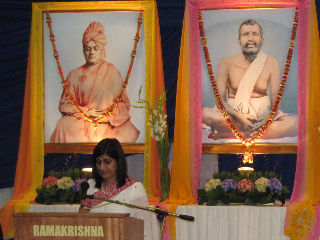
Firstly, that there are only two ways to teach your children lasting values and they are intense love and personal example. Secondly, children require a set of routine in order to feel stable and secure. Thirdly, one’s home must create a suitable environment for the child’s development. Here she provided a few simple tips to help improve the home environment such as daily meals together and a designated place to pray. Lastly, she warned busy parents that a child’s love cannot be bought by material goods and that it is important to focus on their moral and spiritual aspects and not merely their secular education. Ms Chetty highlighted commitment, communication and correctional discipline as three key concepts required to make a family safe and secure. Ms Chetty’s paper was highly practical and afforded parents a clear guide to creating stability and security in the home.
After the presentation of this paper the conference broke for tea.
to be continued…
 Vedanta in Practice
Leave a reply to Natasha and Vishal Cancel reply