Children like to question. And I appreciate it as an expression of their intense thirst for knowledge. I wrote this given-below dialogue in an easy, conversational style between two children and myself. This is, of course, based partly on an actual discussion with the named children, and later written for Dipika 2009. It is an annual spiritual magazine especially for children, regularly brought out by Sri Sarada Devi Ashram at Asherville in Durban. My grateful thanks go to Sister Pravrajika Ishtapranaji for according her kind consent to reproduce it here.

After lunch, as usual, I was about to retire to my room and take my noon-day rest. Just then two fresh faced, enthusiastic, devoted boys came into my office, bursting with joy and questions. All thoughts of sleep left me when I sensed their willingness to have a conversation.
An interesting discussion began when I asked the children to state the names of two famous incarnations of God. Rahul immediately mentioned the name of Lord Ram. His little brother Trishul remembered Lord Krishna.
Trishul: Swamiji, why do Hindus believe that God incarnates on earth?
Swamiji: That is a good question! God descends according to the needs of the time, to help us live happily, be peaceful and live spiritual lives. When people start misbehaving, fight with one another and adopt evil ways, then God comes to protect goodness.
Rahul: But some of my friends ridicule us and say that we worship many Gods. Isn’t it true that there is only ONE God, Swamiji?
Swamiji: Undoubtedly, God is ONE. Have you not heard that God is Omnipotent?
Trishul: No! What does that mean?
Swamiji: It means that God is all-powerful. Though there is only ONE God, yet by His divine power He can assume many forms and have many names. Therefore Hindus believe in different incarnations of God. The Sanskrit word for incarnation is Avataar.
Rahul: So we see that God can take many names and forms because He is all-powerful!
Swamiji: Exactly so, Rahul! You do know that there are many people on earth, though we are one as humanity, yet we have different tastes. We are born with our own varied natures. You may not like what I like. Therefore every one should have the freedom to choose the form of God that he or she likes. Each one worships the same God in the form that appeals to him or her, the most. But always remember, no matter what form of God you love and pray to, GOD IS ONE.
Rahul: Why does God manifest Himself in human form?
Swamiji: God wants to help us realise Him. He teaches us the righteous methods of living on His beautiful earth and how to care for all living beings. God loves all living and non-living beings on this earth, because everything has come out of Him alone.
Trishul: Swamiji, but I find it difficult to think of God without a name and a form. Is not God with form more lovable?
Swamiji: Rightly said, Trishul! God in his personal aspect can be loved and served too. You should be able to choose the particular name and form of God, according to your nature.
Rahul: I love Lord Ram. He killed Ravana and brought righteousness back to Lanka. He ruled this earth from Ayodhya.
Swamiji: Oh! that is wonderful. Can you name one great devotee of Lord Ram?
Rahul: Yes Swamiji. Tulsidas! My father and mother read a portion from Tulsidasji’s Ramayana everyday. They say that reading the Ramayana in the morning helps them to cope with the challenges of life.
Swamiji: Excellent! What is the title of the Ramayana that Tulsidasji wrote?
Rahul: Sri Ramacharitamanasa.
Swamiji: Very good, Rahul. Now boys, let me narrate an interesting story about Tulsidas, the author of this great scripture.
Tulsidas loved Sri Ram with all his heart. In the beginning, he did not prefer any other form of God for his personal worship. One day some of his friends decided to go to Brindavan, the playground of Lord Krishna. They requested Tulsidas to accompany them. But Tulsidas was a little hesitant, because he did not want to go to any place that was not connected with Lord Ram.
Rahul: Was he a fanatic, Swamiji?

Swamiji: No Rahul, he was not a fanatic. But he had such deep devotion to the lotus feet of Lord Ram that his mind was not willing to accept any other form of God. When his friends insisted, he accompanied them to Brindavan. However, while entering Sri Krishna’s temple, he closed his eyes. The all-knowing Lord understood Tulsidas’ predicament. Lord Krishna looked at His beloved Radha and said, ‘Look Radha! My sincere devotee has come here. When he opens his eyes he would not like to see me in the present form. So, let us change our forms to satisfy him.’
Trishul: Which form did they take, Swamiji?
Swamiji: When Tulsidas made pranams (prostrations) to the Lord, he assumed that the temple deity was Sri Krishna, so he was unwilling to open his eyes. But his friends asked him to observe the magnificent murti (image) of Sri Krishna, which was decorated so well. Tulsidas opened his eyes slowly and, lo and behold! he saw the lotus feet of His beloved Sri Ram. When he raised his head in wonder he could see the bow and arrows held in Ram’s long, beautiful hands. The Lord’s eyes looked like a freshly blossomed flower. He also saw the serene face of Mother Sita. Tulsidas was stunned and overwhelmed to see Sri Ram. He now realised that Lord Krishna and Lord Ram are ONE and the SAME divine being!
Trishul: So Swamiji, does the word ‘deity’ mean ‘God in His personal aspect’?
Swamiji: You have understood rightly, Trishul! There are many deities and you can choose any one from the hundreds of forms, according to your taste and temperament. The one that you choose is called the ‘ishta-devata’, meaning your chosen deity. By worshipping the ishta-devata, your mind becomes one-pointed and devotion to God grows very easily and quickly. In the beginning of one’s sadhana (spiritual practices), worshipping many deities dissipates one’s energy and may not be conducive to spiritual progress. Therefore our sages have recommended that we have an ishta-devata, a chosen deity.
Rahul: Swamiji, which deity should I choose?
Swamiji: Choose that deity whose form you like the most!
Trishul: Is it not true that Hanumanji also has Sri Ram as his ishta-devata?
Swamiji: Well said.
Srināthe jānakināthe abheda paramātmani |
Tathāpi mama sarvasva rāmah kamala lochanah ||
Sri Hanumanji once explained that although there was no difference between the Lord of Lakshmi (Narayana) and the Lord of Janaki (Sri Ram), yet his chosen deity was the lotus-eyed Sri Ram.
So, Rahul and Trishul! What did you understand?
Rahul and Trishul: Swamiji, we understood that having a chosen deity is good for devotion but at the same time, we should not be narrow-minded. We should respect all deities because the ONE God alone has become many.
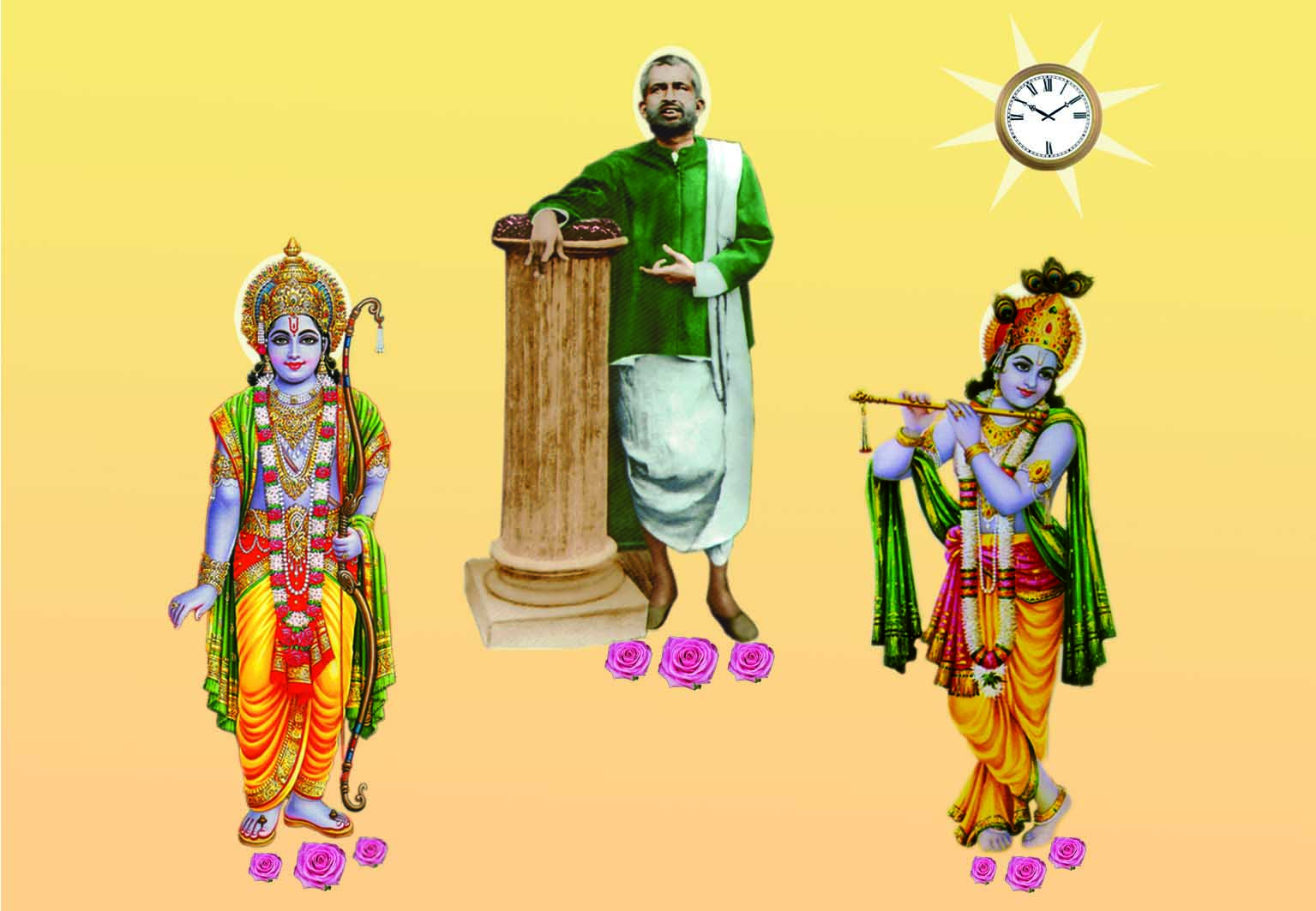
Swamiji: You both attend Sunday Classes for children. Tell me, can you remember any example that our dear Master Sri Ramakrishna has quoted?
Rahul: Yes, I remember! Master gave the example of a man digging a well. First he dug down to a depth of ten meters. He could not find any trace of water there. Then he selected another spot and dug a little deeper. He found no water there either. So he gave up that spot and dug in yet another place. Again he was unsuccessful. Disgusted at his failure to find water, he finally gave up his efforts.
Trishul: Now, let me complete the story! So, Master said that if that man had patiently dug at one place, he would have found water. The same is the case with anyone who changes his faith continually. By having an ishta-devata one can progress and reach the goal.
Swamiji: I really appreciate you, boys! How I wish all the children would attend our Sunday Classes!
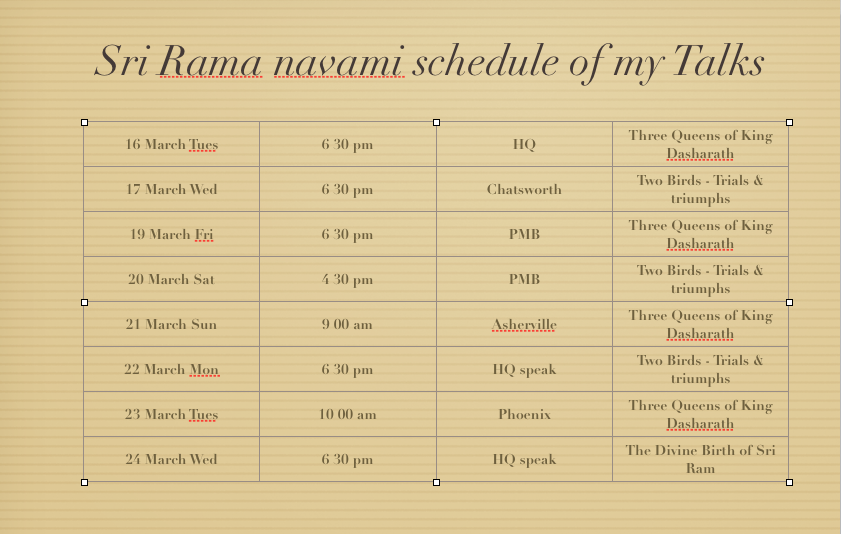
Today begins the nine-day Sri Rama navami celebrations in our Centre culminating in the Navami on 24 March, 2010. A special havan will be performed at the noon. Here is the schedule for my Talks:
 Vedanta in Practice
Leave a reply to SV Cancel reply