Hanuman – Make Him your Ideal
I a
m happy to reproduce, at the request of many devotees and friends, a post from a Blog maintained by Sri Kissoon Behari, a devotee from Chatsworth branch of the Ramakrishna Centre of South Africa on the occasion of Sri Hanuman jayanti. Swami Vivekananda was fascinated by the sterling qualities of Sri Hanumanji. He exhorted his disciple thus:
You have now to make the character of Mahavira (Hanuman) your ideal. See how at the command of Ramachandra he crossed the ocean. He had no care for life or death! He was a perfect master of his senses and wonderfully sagacious. You have now to build your life on this great ideal of personal service. Through that, all the other ideals will gradually manifest in life. Obedience to the guru without questioning, and strict observance of Brahmacharya – this is the secret of success. As on the one hand Hanuman represents the ideal of service, so on the other he represents lion’s courage, striking the whole world with awe. He has not the least hesitation in sacrificing his life for the good of Rama. A supreme indifference to everything except the service of Rama. Only the carrying out of Shri Rama’s behest is the one vow of his life! Such whole-hearted devotion is wanted.
February 9, 2011 — kbehari
One of the main elements of spiritual progress is the companionship of the holy and the wise. It is one of the commandments of Sri Ramakrishna (Some of the other injunctions being:repetition of God’s name and singing His glories, going into solitude now and then and thinking of God, and practising meditation.) He compared worldly people to moist wood. Even such wood when placed upon fire soon becomes dry and begins to burn. Similarly, the company of holy men or sadhus drives away the moisture of greed and lust from the hearts of the worldly, and then the fire of discrimination burns steadily in them.
And so one will easily understand how elated we were when our most Revered Swami Vimokshanandaji Maharaj accepted our invitation to visit us.
 He first went to our little shrine, and uttering prayers, he worshiped with flowers. Then we led him to our lounge/dining room where some thirty friends and family were eagerly awaiting His Holiness. For some (such as Devan Shukla and Prof Usha Shukla, Devika Madari, Head of Kendra Hindi Patshala) it was a first meeting (and a most memorable one at that). Some others had met Swami Vimokshananda on earlier occasions. These included Rajish Latchman, Deeplal Buddan, Mala Rambally. These three presented a programme of Bhajans and a recital from the ‘Sundarkand’ of the Ramacharitamanasa. So enthralled was Swamiji by their rendition that he asked the artistes to continue for a little longer.
At our request, Swami Vimokshananda Ji addressed us. He presented a summary of the events of the section sung and then made a comment as only one who has a deep intuitive knowledge of scripture can. The following is a summary of the main points made.
SRI HANUMANJI FLIES TO LANKA
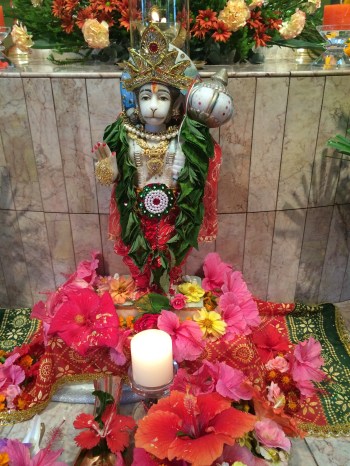
Sri Hanumanji , who has just been reminded of his immense power, sets out for Lanka where Mother Sita is being held captive by the demon king Ravana. He springs up on a beautiful hill to leap across the ocean. So powerful is his taking off that the hill sinks immediately into the nether world. On the way, Sri Hanumanji refuses the offer of Mount Mainaak to rest on him. Further in his journey, he encounters Surasa who threatens to devour him. As she opens her mouth to swallow Sri Hanumanji, he enlarges his body to twice the size of her mouth. As she opens her mouth wider still, so does he increase his size. Then suddenly, assuming a very minute form, he enters her mouth and exits. Surasa reveals that she is there only to test the power of Sri Hanumanji. Receiving her blessings, he departs.
He next meets a demoness Simhika who has the power to seize a bird flying overhead just by catching hold of its shadow, dragging it down and then devouring it. Sri Hanumanji dismisses her with a single powerful blow.
The entrance of Lanka is guarded by a demoness Lankini. She detects Sri Hanumanji even though he has reduced himself to the size of a gnat. He deals her such a blow that she reels and vomits blood. She recalls that Lord Brahma had disclosed that when she would be discomfited by a blow from a monkey it would foretell the end of Ravana and the demon race.
MEANING BEHIND THE EXPLOITS
Swami V proceeded to reveal the mystery of this episode. The journey of Sri Hanumanji delineates the journey of a sadhaka in his spiritual quest.
THE LEAP UP AND THE SINKING HILL
The hill from which Sri Hanumanji leaps up and away is described as ‘beautiful’. The hill represents our attraction and attachment to the world. Ordinarily, the world holds one down by its power of gravity or pull of attraction. Spiritual life commences with a strong rejection of worldly life which weighs us down (as does a rock.)
MAINAAK’S OFFER OF REST
The temptation to relax from our spiritual activities or to turn away to another activity is always present. Such a temptation must be rejected. Mainaak’s offer represents the luxurious rest that entices the sadhaka. But Sri Hanumanji says that there is no rest for him until he has accomplished the work of Sri Ram.
OUTWIT THE JUICY DELICIOUS WORLD
The name ‘Surasa’ is a compound of ‘su’ meaning excessive and ‘rasa’ which suggests that which is pleasing to the taste. Thus, Surasa represents the world which appears pleasurable but which devours us in the end. Sri Hanumanji overcomes her with his wit and power.
THE HIDDEN ENEMY
Simhika represents jealousy. It is an invisible and most treacherous enemy of the sadhaka. The sadhaka is like the unwary bird flying high in ignorance of the threat that is lurking below (that is, in his sub-conscious mind). Once in her clutches, it is well nigh impossible to extricate himself from her, and so he perishes.
A BLOW TO PRIDE
Lanka is guarded by the keeper Lankini. (One may think of her as a security system that prevents entry.) She represents pride. Sri Hanumanji puts paid to her with such a blow that topples her and causes her to vomit blood.
 Vedanta in Practice
Leave a reply to Debanjan Roy Cancel reply