A Micro-Blog from Swami Vimokshananda – earlier at Durban, Singapore and Dublin – now at Yelagiri Hills, Tamil Nadu, India – "A private diary for public consumption!"
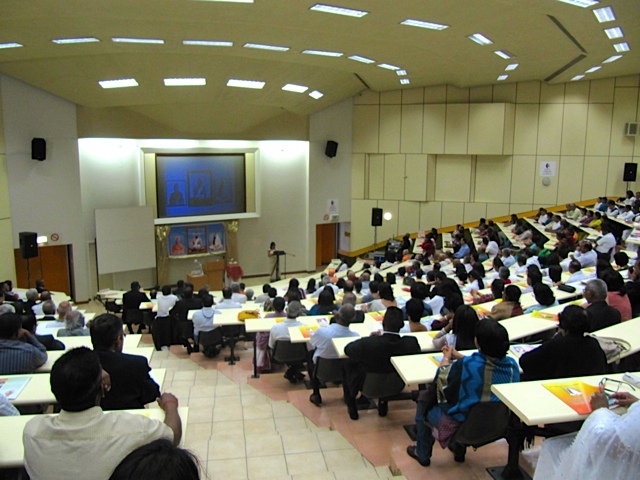
Conducting a Conference is beset with certain inherent risks. Scheduling it especially on a Sunday morning when weather is absolutely right for lazying around, you do not know how many would turn up. And if the Conference is on religious matters that does not contain even a single ‘cultural item’ its much worse. Ruminating with some sort of anxiety on these lines, I reached the Westville Campus of UKZN on Sunday, the 30th September 2012 fifteen minutes before the Conference began. What I saw was something unimaginable. The Hall was packed to its capacity!
This Conference entitled “Hinduism – The Way Forward” was convened by Sri Sarada Devi Ashram (SSDA) of Durban. On arrival, I could clearly discern the devotion of the members of the SSDA and how they were working in unison. At various points of the campus, the volunteers were guiding delegates to the parking lots and venue. Reaching nearer to the venue, I could also observe how the lady devotees of the Ashram warmly welcomed every one. They duly directed the speakers and guests to T-Block where, after registration, each delegate was given a Conference pack and led into the lecture theatre.
a portion of attentive audience…
Well, I was thoroughly pleased to get a detailed Report from Ms Shiksha Ramkissoon who is a devotee of SSDA. Professionally she is a Physio-therapist attached to a hospital. Her Report is lucid, presenting a vivid picture of what happened at the Conference. I do hope our reader-devotees enjoy this Report. Images courtesy: Lushen Pillay.
A Report by Shiksha Ramkissoon
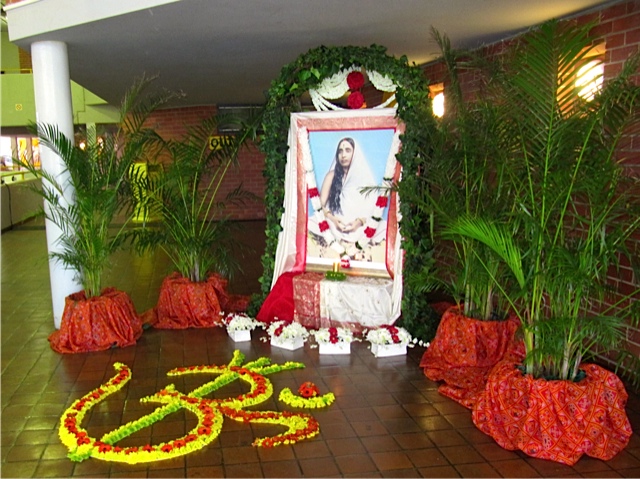
The clear skies and the Durban warmth presented a perfect backdrop for a Sunday morning of discussion on some of Hinduism’s sacred texts. The foyer outside T1, the venue of the Conference, was converted into a small shrine with a beautiful garlanded picture of Holy Mother Sri Sarada Devi surrounded by plants, bouquets and an artfully created ‘Aum’ symbol made with flowers. It was complemented by a slide show of spiritual quotations on a digital screen above the entrance.
Pranavaswaroopini Ma – Mother (the embodiment of AUM) at the Entrance…
The backdrop at the podium in the hall, was adorned with a stunning banner of an image of the Holy Trio highlighted by a beautiful gold drape around it. By 9 30 am the room was filled with over 700 guests. His Holiness Revered Swami Brahmarupanandaji Maharaj, a senior monk of the Ramakrishna Order based in Ulsoor, Bangalore, India, graced the Conference with his presence. Also present, were His Holiness Revered Swami Vimokshanandaji Maharaj and His Holiness Revered Swami Saradaprabhanandaji Maharaj.
The Chairperson of SSDA, Ms Prakashnee Gengan taking control of the floor
The program director was an attorney Ms Prakashnee Gengan, the Chairperson of SSDA. Sister Avinta Badrinath led the congregation in prayer, before Her Holiness Pravrajika Ishtaprana Mataji lovingly welcomed every delegate including the Revered Swamijis, members of sister organizations and those who had travelled from far and wide to attend the Conference. Ms Gengan elaborated on the theme of the Conference and the topics which were to be presented. They were based on two popular scriptures, viz., the ancient and eternal Ramayana and the modern day Gospel of Sri Ramakrishna.
The first speaker was Swami Saradaprabhanandaji Maharaj, Vice-President of the Ramakrishna Centre of S.A. whose topic “Crime in the Ramayana – Challenges and Solutions” was discussed in a detailed and scholarly manner. Citing specific incidents in the Ramayana from the perspective of criminology, Swamiji’s talk provided a new perspective on the cause, prevention and management of crime and demonstrated that the scriptures provide the answers not only to our spiritual lives but also to the challenges that we face in our daily lives.
Swamiji began by tracing the cause of crime by quoting from the Bhagavad Gita in which Arjuna asks Lord Krishna what impels a man to commit sin, as if by force. The Lord replies that it is desire and anger, born of rajas, which are the root causes of this behavior. Swamiji then highlighted the various characters of the Ramayana who committed various crimes, starting from Ratnakar, to others such as Ahalya, Surpanaka, Ravana. These examples enforced the point that unbridled desire indeed is the source of crime.
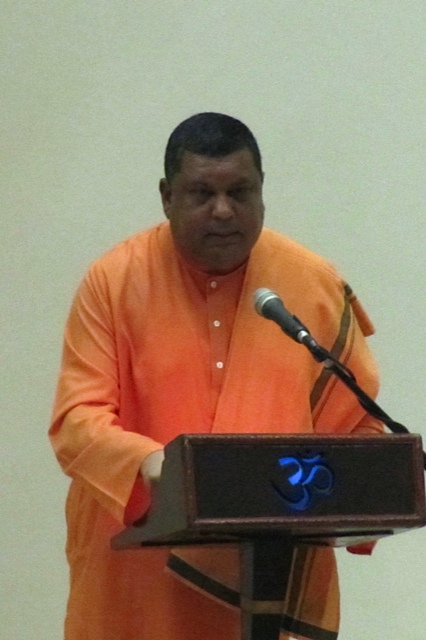
Swami Saradaprabhananda presenting a scholarly Paper…
Swamiji explained that criminal desires are to be managed before they are expressed. For this, the tool of self-control is essential. He identified personalities such as Lord Rama, Mother Sita, sevakHanuman, Queen Mandodari and others who displayed a great degree of self-control. He added that this should be adopted by Hindus as a means to prevent crime. Characters who displayed poor self-control were Vali, Ravana, Kumbhakarna, Indrajit.
He gave examples of different kinds of graded system of punishment that was meted out in the Ramayana. He identified three dimensions of combating crime, viz., individual goodness, a single individual becoming proactively good on his own and an individual working in a team, a pressure group or organization. All have to be done within the parameters of the law.
Valmiki constructed a complex crime scene in which Sita, who was untrained in self-defence, was abducted by Ravana who used disguise to deceive Her. Sita is initially portrayed as a victim of crime, but Valmiki showed that righteousness eventually prevails and Sita emerges as a survivor of crime. The Ramayana thus has many episodes of crime but eventually proves that criminals are never victorious.
The congregation then adjourned for a refreshment break. The second session saw the remaining three papers being delivered.
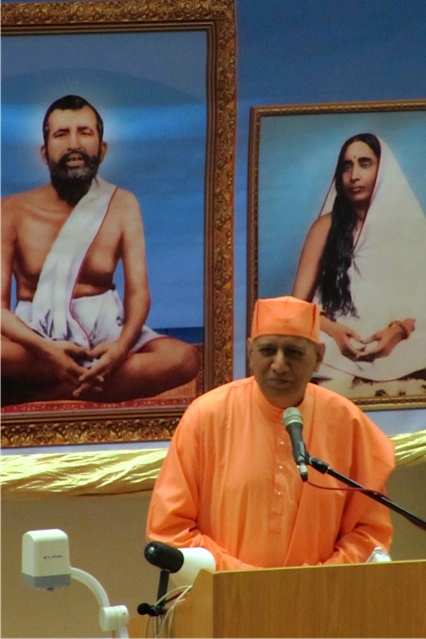
The first speaker in this session was Swami Vimokshanandaji Maharaj, President of the Ramakrishna Centre of S.A. who presented his Talks, undoubtedly the highlight of the Conference, on ‘Prayer in Daily Life – According to the Gospel of Sri Ramakrishna’. Maharaj expanded on all points by using examples from daily life, effectively bringing in humour, which left the audience roaring with laughter whilst simultaneously further imprinting the message and concepts into their minds.
Swami Vimokshananda delivering a speech interspersed with humour…
Maharaj explained that prayer is a powerful tool found in all religions. In Hinduism, the importance of prayer was forgotten over the years, while other spiritual practices, like self-enquiry, yoga etc., were developed to a great extent. With the advent of Sri Ramakrishna, ‘prayer’, as a fundamental spiritual tool, was highlighted again.
Maharaj defined prayer as the simple act of talking to God. Prayer, as it is usually done, (Maharaj called this the preliminary stage, or a petitionary prayer) begins by asking God for something. There are people who criticise this type of prayer as being materialistic or unnecessary, as God is Omniscient and hence knows our inner desires. Maharaj explained that this type of prayer should not be condemned as, without this, millions of people would not think of God at all. Moreover, the acquisition of material possessions, artha, and fulfilment of desires, kama, (done within the framework of dharma) are legitimate goals of life. Since God is our very own, there is nothing wrong in asking of Him what we want.
Maharaj pointed out that, when praying, we should discriminate between a prayer for a particular need and a prayer for a want. Not all prayers are answered since God will provide what is needed and not necessarily what we want as that which is wanted, is not always good for us or we may not be capable of taking care of it. The manner in which we pray is also important. Since God is our own, our conversation with Him (or Her) should be in our own mother tongue (or the language that we understand), with tears in our eyes and sincerity of heart. Since God is Omniscient and Omnipresent, there is no specific time or place that is set for prayer.
Even though prayer is considered a lower form of spiritual practice, Maharaj emphasised that it is a fundamental practice as it opens our hearts, brings balance to our spiritual life and helps us overcome any difficulties/complications that may arise from other spiritual practices.
As we progress in our spiritual life through the means of prayer, the nature of the prayer itself changes. As our hearts grow, asking for ourselves expands to asking for others – be it wife, children, family, neighbours, country, etc. Finally, as we realise that God provides all our needs, it changes from asking for things to a pure love for God when we continuously think of/communicate with God, just want to be with God and surrender completely to God.
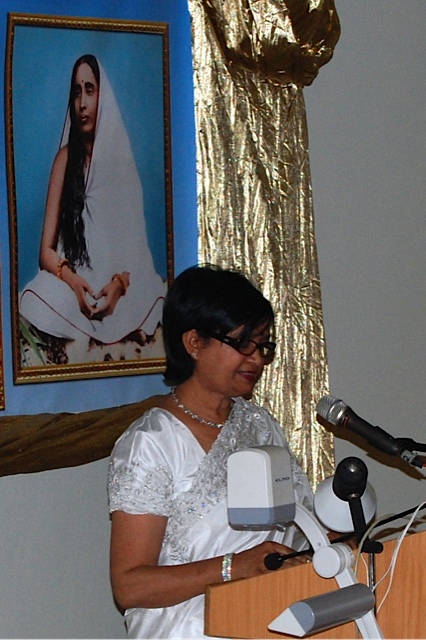
Dr Nirmala Balkaran of Ladysmith presenting her charming Paper…
The next paper was presented by Dr Nirmala Balkaran. Her talk entitled “Nurturing children and youth – the Ramayana Way” was accompanied by a PowerPoint presentation which had charming pictures of little children, including a stunning cover picture of baby Rama. The core of the speech was the examples of the parenting of King Dasharatha and Mother Sita, the education and nurturing their children received and how these ideals can be implemented in modern society in response to challenges that are faced by parents and teachers today.
She discussed in detail how the sons of King Dasharatha, from a young age, were given a well-balanced secular, vocational, artistic and spiritual education by their father, Guru and other teachers assigned by their father, both directly and indirectly through exposure. The importance of stimulating the child by the reading of religious texts from the foetal stage to adolescence was highlighted.
Dr Balkaran described Mother Sita as a single parent who, even under difficult circumstances, ensured that her children Luv and Kush received a balanced, well-rounded education that catered to their physical, intellectual, moral and spiritual development under the tutelage of sage Valmiki.
In contrast, the current school system merely provides a secular education which is a stepping stone to tertiary institutions that endow one with the necessary skills to earn a livelihood. As important as that is, it is not sufficient for the development of the entire personality of a human being, for as Swami Vivekananda says, education should be “man-making, life giving and character-building”. Hence there is a need for parents to involve their children with organisations that provide programs which offer moral and spiritual education and promote a holistic and balanced development which includes the growth of character and morality.
Pravrajika Ishtaprana mataji presenting her illuminating Paper…
The final paper entitled “Illuminating Parables on Spirituality from the Gospel of Sri Ramakrishna” was presented by Pravrajika Ishtaprana Mataji. Mataji chose certain tales from the Gospel as told by the Master. These contained deep spiritual truths and guidelines for spiritual life. Mataji’s simple description of the stories and the animated pictures on the PowerPoint presentation made it easy for the audience to relate to the parables.
Mataji described the Gospel of Sri Ramakrishna as a “scripture which clearly points the way forward”. The popular stories provided insight on topics such as the nature of God, both form and formless; the grace of the Guru; renunciation; causes of conflicts between practitioners of different religions/sects; obstacles in spiritual life; and spiritual practices including concentration of mind. She encouraged all to take the Gospel and read a little daily to imbibe some of the lessons from them.
Sister Avinta closing the Conference with her mellifluous shanti paath
After each talk, there was a short question and answer segment, which drew brilliant answers from the panel of speakers to the various interesting questions from the audience. There were also some abiding comments and observations from the audience. At the end of the Conference, the speakers were presented with tokens of appreciation by devotees of SSDA. Sister Avinta brought the Conference to a close with her mellifluous shanti paath recital before all proceeded to the foyer where a sumptuous lunch was served.
The general consensus of those present was that the Conference was a ‘major success’ and ‘well organised’. It was indeed a morning well spent! The credit singularly must go to Holy Mother Sri Sarada Devi whose infinite grace seemed to be over flowing that day!
I have the honour to receive host of mails from devotees of different parts of the world enquiring how Sri Krishna Janmashtami celebrations were conducted by our Centre in South Africa. Thanks for their well-meant curiosity. I do take delight in expressing in detail an account on the Sri Krishnashtami celebrations here at our headquarters in Durban. There were Satsangs every evening from the first day to the last ashtami day i.e . for all eight days! Satsang here has a definite pattern.
Themes for Talks
First four days I had vocal rest, as, a week back I had a bad laryngitis. On fifth day morning I addressed Senior Citizens at our Phoenix sub-centre. The point of my address was that the idols or pictures are not to be viewed as mere stones or paper but as a manifestation of the One, supreme Divinity. In the evening I reached Verulam where in the Gopallaala temple I met devotees and spoke on Sri Krishna’s mercy. On the sixth day I had to travel to Stanger, a one-hour distance in the severe cold. There also the Gracious God was the theme. On the seventh day at our HQ Sri Ramakrishna Temple hall, I spoke on Sri Krishna and the Black Cobra. It was the story of poisonous Kaliya and how Sri Krishna tamed it and the spiritual import of this charming story.
On the eighth day, which was the last auspicious ashtami evening, my theme for the discussion was the Divine birth of the Unborn. We had two sessions. In the first session the theory of Incarnation was dealt with. And in the second session the secret of the Unborn Supreme God appearing as baby Krishna to Devaki and Vasudeva was explained.
Brother Saradaprabhananda this year went to Chatsworth branch and gave discourses there for all eight days on the significance of the Fourth chapter of the Bhagavad Gita. The first six evening Satsangs at HQ were addressed by our Youth members. I was witness to their speeches. On hearing them speak with confidence, I joined others in the audience in appreciating them for the research they had done on different themes and how they, in simple form, placed the ideas before the public.
Satsang Style
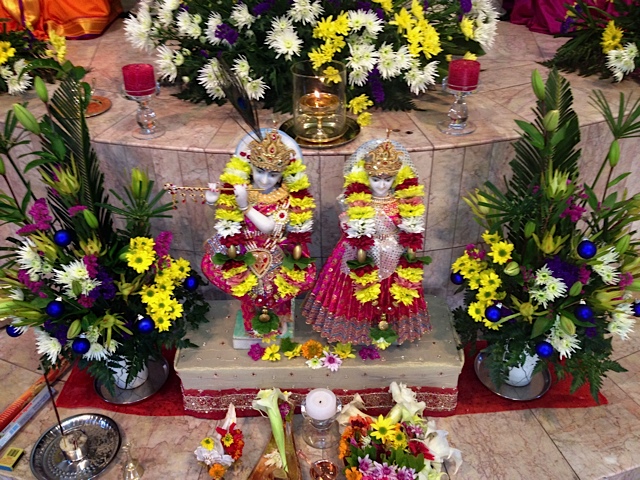
Every evening of the Krishnashtami celebration, Satsang attracted a large number of devotees. There were lot of bhajans and kirtans till the end of the program. Selected passages from Srimad Bhagavad Gita were sung to the traditional tunes every evening satsang. The temple was beautifully decorated. The yugal murti Sri Radha-Krishna bedecked with finery and ornaments dazzled every one. At the stroke of midnight 12, the baby Krishna in a beautiful cradle was brought out to the audience. Finally with arati to Sri Radha-Krishna and offering of flower and rocking the cradle by every assembled devotee the solemn program came to an end with distribution of prasad.
Image courtesy: Madhumita, Kolkata
In tune
The devotion of the devotees is worth noting; what a verve and vigour in singing bhajans! And faith and fervour in performing worship! And the day-long fasting and sitting in the temple for such long hours – absolutely maintaining utmost discipline – no chitchat, no gossip and all are tuned to the discourse and songs.
Religion forms the building blocks of any individual’s life. In the rapidly changing society which is being bombarded with Westernization and technological advancement many of us face the dilemma of deferring from our routes and are faced with the predicament of losing sight of our ultimate goal of life: God Realization. With this in mind the Annual Hinduism Conference attempts to revive our faith and re instill the crucial values of Hinduism and our Religion.
the Hall tastefully decorated with audience
Dundee Sub-centre played the role of hosts to the last year’s Annual Hinduism Conference which proceeded from 9 am till 1 pm on Sunday, 3 September, 2011 at the Dundee Moth hall. Upon entering, the welcoming pictures of the Holy Trio provided for the central attraction and together with a colour co-ordinated tasteful deco, provided a hearty environment for the devotees as well as the esteemed panel of speakers.
I am happy to present here a Report written specially for this Blog by one of our Dundee Sub-centre’s youth members. Ms Deveshnie Govender is presently studying for Bachelor of Accounting Science at Johannesburg in the University of Witwatersrand.
Inaugural address
The proceedings began with Prayer to the Holy Trio. Inauguration of the function was done by Ms R D Bedassi who is the chairperson of the Talana Museum Board of Trustees as well as the Treasurer of the Aryan Benevolent Home in Glencoe as well as the 1860 Legacy Foundation. She is also a member of the Child Welfare of South Africa, Glencoe branch. She is a reputed for her involvement in different community welfare projects.
Being a senior educator in the Northern KZN region Ms Bedassi pointed out the richness of our cultural heritage and emphasised that the greatest threat that we face today is the challenge of an identity crisis. She discussed the law of Karma, pointing out that good Karma is created through living a dharmic life. She discussed 9 Hindu values which lead to the attainment of moksha.
Satyam: Truth. All should lead a life of honesty and compassion.
Astheyam: We should guard against greed and selfishness.
Daya: We should practise compassion and sympathy, and be kind and merciful.
Shanti: Patience, forgiveness and tolerance should be the hallmark in our life.
Arjavam: We should practise simplicity and straightforwardness.
Madhuryam: Sweetness and disposition should be of prime importance to us.
Dama: We should practice self-control and not act upon impulse.
Dana: Give, teach, purify and protect.
Akalmasham: We should attempt to live a life that is free of sin. This will lead to a positive action resulting in a positive reaction.
She concluded that we should attempt to prevent bad deeds and be non-judgmental. It was with this inspiring inauguration that the function was officially begun.
Key-note address
The first address which could also be classified as the Key-note address was by our Revered Swami Vimokshanandaji Maharaj, the President of the Ramakrishna Centre of SA.
He pointed out that many of our Hindu youth are not able to give clear answers when questioned by youths from other religions about our scriptures. It is because Hinduism has many scriptures. Hinduism has delved into every facet of spiritual life and human experience, there is, therefore a great treasure-house of spiritual literature, any one of them passing off as an important Hindu scripture. Generally, the Upanishads are regarded as the umbrella under which they all fall. However, the Vedas also are pivotal. Any sect, new or old, wanting to be regarded as a Hindu sect must be able to justify its principles and teachings on the basis of the teachings of the Upanishads or the Vedas.
Upon analysis, we find that some of the ideas have been lost. However, the Bhagavad Gita is regarded as the very quintessence of Upanishads and Vedas. We find that every saint has brought the Bhagavad Gita into their teachings, thus showing the universality of the Bhagavad Gita. It speaks to all humanity for which Hinduism stands.
Sri Ramakrishna said that the gist of the Gita can be found in the repetition of the
word “gita” ten times, which then becomes tagi, meaning ‘renunciation’. Master
emphasized that more than just reading scriptures, putting the teachings into practice was more essential! Maharaj said that practising five ideas with faith, sincerity and dedication was far more superior than learning off the scriptures by rote.
He further added that we were blessed to have the Gospel of Sri Ramakrishna as our modern scripture, and doubly blessed that it is available in English. Master is the personification of the Vedas and hence all the scriptures are within him.
Maharaj’s paper was extremely enlightening and uplifting. Maharaj quenched the spiritual thirst among us and managed to pacify the scriptural turmoil within our minds. It was on this high note that the conference broke for Tea and snacks.
Panelist’s presentation on Parenting
The second speaker was Dr HB Parbhoo who is a long standing member of the Ramakrishna Centre. He is also the General Secretary of the Ramakrishna Centre of South Africa. Dr Parbhoo is also a specialist physician in Durban.
His paper “Parenting – A Hindu Perspective”, aimed to resolve the dilemma numerous parents face. He dealt with the theme of protection versus pleasure, guided growth with Self Responsibility. He discussed how the past values (hard work, sacrifice, good habits and education) which were treasured and admired are now being neglected in search for enjoyment and entertainment. He emphasized the fundamental importance of creating a loving, proper environment for children, an environment where children have the opportunity to explore and express themselves. The theme of protection versus pleasure was also discussed whereby the child has to realize their growth is their own responsibility. “My Life”.
If parents do not guide and provide a pertinent role model for their children, they seek for it in the media, and so adopt bad habits. He gave a guideline to parents: provide love in the first five years, then discipline for the next 10 years, when the child reaches 16; the parent should attempt to become their friend. Through performing and completing one task at a time, being ever-vigilant, we will develop mind control and will power. He said that we should not blame others for our faults, that we should mind our own business, make ourselves perfect and others will become perfect in our eyes.
Dr Parbhoo’s paper was higly relevant and intriguing for both parents as well as children.
Panelist’s presentation on Harmony of Four Yogas
The third speaker was Ms Indrani Basdeo who is the Secretary of the Etete Satsung group. She is a long standing member of the Ramakrishna Centre. She occupies the career of a legal manager in a financial company.
Ms Basdeo attempted to enlighten us upon the 4 yogas. As humans we are all in an endless search for real peace and happiness. Through the grace of our divine Lord, Swami Vivekananda gave us the nectar of Vedanta; however this gift remained unopened. Yoga is the union of the individual soul with the almighty Lord. In the attainment of this one goal there are various different paths according to our temperaments.
These 4 yogas are: Bhakti Yoga, Jnana Yoga, Karma Yoga and Raja Yoga.
Bhakti yoga – Emotional Path, the relationship between the devotee and God.
Jnana Yoga– Intellectual Path, the reading and studying of the scriptures. This involves intellectual discrimination. The necessity for us to discriminate from the real and the unreal leading to spiritual realization, the expansion of our intellect. It was here that Ms Basdeo used a funny story of a camper and doctor for better understanding. They both went camping, when the camper told the doctor to look up and tell him what he saw, the doctor provided a list of stars and planets! When the doctor asked the camper what he saw, he simply replied “our tent has been stolen!”
Karma Yoga– working- This involves selfless service in the spirit of worship. The essence of Karma Yoga is selfless service. “Numerous individuals think, if I help what will happen to me, however a great individual does it for no gain”. It is considered as a spiritual action. The secret of action is purity and serenity of mind.
Raja Yoga – Spiritual Path- This includes the meditation and prayer aspect. By concentrating our mind, it becomes much more powerful thus providing us with a better quality of life. She also used a story to illustrate this and linked it to handling turbulence in our lives such as traffic jams.
It was here that Ms Basdeo posed the question of “How do we train our mind? “ She provided the answer of constant practice and dispassion. Swami Vivekananda says that the 4 yogas are capable of taking us to supreme infinite knowledge and bliss. Many question which is the best to practice? The best is a combination of all four as this results in maximum usage and maximum benefits that will lead us into reaching our goal more rapidly. The Harmony of the 4 Yogas are best given in the Bhagavad Gita. In conclusion she provided us with an intriguing element called “sandwich sadhana”!
First slice: Dedicate everything to God in the morning. Filling: Work performed. Other slice: In the night dedicate all your actions to God.
We should attempt to open Swami Vivekananda’s unopened gift thus pursuing peace and happiness. It was a well prepared and presented paper. The stories and parables used definitely made for easier memory.
Panelist’s presentation on Relevance of Rabindranath Tagore
The last paper of the Conference was delivered by Ms Raisha Singh, a member of the Newcastle Sub-centre who also acts as the course co-ordinator of the Faculty of Peace Studies, Spirituality and Culture run by the Ramakrishna Centre. Professionally she occupies the post of the Ladysmith Campus Manager.
She addressed on the Kaviguru Rabindranath Tagore‘s message of wisdom and its relevance in today’s society. The following 6 ideas were highlighted:
Peace and Harmony
The Unity of Man
Liberation and emancipation of woman
Divinity within us
Rural Reconstruction:
Inner Turmoil
Ms Raisha Singh highlighted how we are touched by the meaningful enormous literature penned by Rabindranath Tagore, creating a new art of living. He translated the essence of creative impulses into social context. His writing and the wisdom of it surpasses time and space. She emphasized the importance of interpreting Indian philosophy and religion and expanding our horizon of love. In conclusion, Ms R Singh elaborated on Rabindranath Tagore to such an extent that he is well known as an extremely great personality that made him win a Nobel Prize for Literature. The relevance of the thoughts of Rabindranath Tagore is especially appropriate in the 150 years celebration of arrival of Indian indentured labourers.
Audience Response
The Conference was concluded with a panel discussion led by our Revered Maharaj. It was here that Maharaj in his inimitable way, summarized the main concepts of the three speakers. He deeply appreciated the time given by the delegates by attending the Conference and listening to the learned panelists. But that was not enough, he added. Maharaj exhorted the audience to ‘implement the ideas’ that have sunk into their minds so that the lives of elders become an example to the youth and children.
Prompted by Maharaj, youth were asked to provide their opinions or observations. Nibha Ramkelawan, a student devotee, provided an exceptional response highlighting the relevance and importance of our organization and the proper moral grounding it provides. She elaborated that in a Christian pre-dominant schools, the youth often faced with various challenges and it was through learning from Conferences, literature and guidance and through the grace of our Master, the Hindu youth overcome these. To other topical questions fielded at the paper presenters, I should confess, that the learned panelists definitely did not lag behind in giving quality responses to them.
In conclusion
This report will not be complete without the mentioning of the Director of Ceremonies, Ms Ashnee Jaggath an eminent educator of Danhauser secondary and devotee of the Dundee Sub-centre. The spirited way she started the programme, vigorous manner she steered the responses and professional control she exercised over the floor and the exceptional dynamism she displayed in directing the programme cannot but be applauded.
And kudos to the Dundee Sub-centre Chairperson Mr Shaiel Chunder and all the members of its Committee for making everyone feel absolutely comfortable.
Through the grace of our divine Master, it was evident that the audience and delegates left the Conference feeling enriched and motivated to deal with challenges and far more knowledgable on certain aspects of Hinduism. The Conference was undoubtedly an incomparable success and definitely an annual event we await with bated breath!






 Vedanta in Practice