A Micro-Blog from Swami Vimokshananda – earlier at Durban, Singapore and Dublin – now at Yelagiri Hills, Tamil Nadu, India – "A private diary for public consumption!"
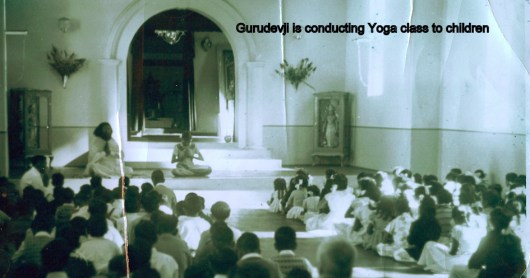
The great ‘Gurudev’ Swami Nischalanandaji Maharaj was born in Newcastle. At his birthplace, the Children’s Cultural festival of the Northern Natal was celebrating its Golden Jubilee this year. It was not an accident; neither was it planned. But it had come in due course bringing forth how much ‘Gurudev’ loved the children and how much more he was interested in instilling the spiritual values among them. Some of the old devotees still remember how Gurudev used to stand on hours together in training the children in performance of cultural items. He used to personally conduct Yoga Camps especially for children training them in correct postures through practice of yogasanas.
I was pleased to attend the Northern Natal Children’s Cultural Festival held at Newcastle Richview hall. Branches from Estcourt, Ladysmith, Newcastle, Glencoe and Dundee participated. The enthusiasm of the children was infectious, each one vying with one another, making efforts in excelling in whatever he/she did. The Festival was an occasion to bring out the best in the child. There were scintillating sketches, soul-filling songs, sterling speeches and delighting dances interspersed with inspiring quotes from the Holy Trio. While I gave the Key-note Address, brother Swami Saradaprabahanandaji gave the Concluding Address. Overall the time from 9 am to 4 pm was well spent in the company of the children. In spite of the inclement weather of speedy winds, the officials did a splendid job in organising the Festival at the venue.
Abiding spiritual values are taught to the children who attend our Sunday School classes. The parents have reported to me that they are immensely benefitted as they could see emergence of the wonderfully shaping of their children’s personality. In my previous post I gave a brief intro about the Sunday School classes and three slideshows on the Certificates Award function.
To see all the photos of the Festival, just click on the below link that will take you to the picasa web album. There click ‘slideshow’, then relax and watch!
Children’s Education Programme organised by the Ramakrishna Centre of South Africa through its 14 branches conducts what is called ‘Sunday Schools’ which hold Hinduism for Children Classes.
From 4 – 9 years : level 0 which is applicable to students studying in Grades RR, R, 1, 2 and 3. Their activities include colouring, mantra recitals, singing and story telling.
All the Texts have life-giving morals, values and lessons that are learnt and related with current situations of everyday life. Children are encouraged to practice what they learn. Their Study also includes the learning of mantras and Gita verses along with English meanings.
These Classes are aimed at character building, personality development, and to imbibe morals and values for a modern generation and to equip our youth to face Life’s challenges on the basis of Hinduism. The unique aspect of these classes is the spread of Hinduism in its broadest sense as exemplified and expounded by Sri Ramakrishna, Holy Mother Sri Sarada Devi and Swami Vivekananda. This year 400 children participated in these classes all over the country and gave examinations.
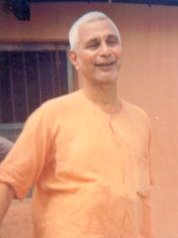
The day of 7th may reminds me of the departure from this world, a devout venerable monk of our Order, Swami Umeshanandaji Maharaj. During my 12 year-stay at the Ranchi Sanatorium centre, I had the privilege of having his wonderful company for a little more than 11 years. Holy men come in different hues and Umeshanandaji was unique in his own way.
Smiling always, bringing cheers to every heavy-hearted soul, Swami Umeshanandaji dedicated his life for the service of TB patients since 1962. He was popularly called Durga Maharaj. He was born in a place near Mangalore of Karnataka State on 20th February 1923.
He left Indian Army service and joined the Ramakrishna Mission, Belur Math. He was given mantra diksha by the sixth President of the Ramakrishna Order, Srimat Swami Virajanandaji Maharaj. Later in 1959 he was initiated into Sannyasa by the seventh President Srimat Swami Shankaranandaji Maharaj.
It is said that Swami Shaswatanandaji Maharaj, the then Assistant Secretary of Belur Math told Durga Maharaj in 1962 “to go to Ranchi and serve the poor tribals and suffering TB patients and die there in harness”. During his long forty-four years of extraordinary service, Durga Maharaj never went outside. He was fully engrossed in the patient matters like admission of patients, preparation of patient files, making ready discharge certificates etc. He knew every patient by his name and address.
Straight forward and simple, Durga Maharaj was indeed highly popular among the local Adivasi (tribal) public. No one would forget to meet this smiling Swami and make pranams to him. His admirers are now spread all over the country who would feel blessed to take his name in the very morning.
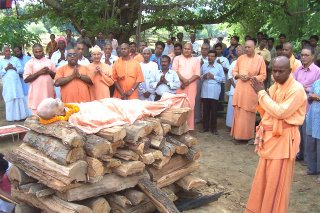
The mortal coil of Swami Umeshanandaji Maharaj readied on the pyre
He was 84 when he breathed his last, after suffering from Alzheimer’s Disease with old age ailments for a few months. Swami Satyeshananda, the ‘doctor maharaj’ informed me of the final end and we, all the monks, devotees, staff and others immediately rushed to his room. His mortal coil was consigned to flames the next day at 9 in the morning. The final rites were performed at “Panchavati” within the Sanatorium campus. On this solemn occasion, Sannyasins and Brahmacharins of Morabadi Ashrama and Sanatorium, Swamijis of Tupudana Advait Swarup Ashram, devotees from Ranchi and local adivasi admirers along with employees of the Sanatorium were present in good number.
As per our monastic tradition, on the 13th day of death, a ‘special worship’ of Sri Ramakrishna is done in the temple and a ‘saadhu bhandaaraa’ would form a special feature. And on that day i.e., Friday, 19th May, prasad feeding to all in-patients, employees and devotees was arranged at Sanatorium Ashrama premises in honour of the departed soul. A Smritisabha (memorial meeting) was also conducted preceding the Bhandara. That Sadhus from Bihar and Jharkhand branch centres of Ramakrishna Mission and also of the other outside organisations with a huge number of devotees attended the Bhandara was a memorable experience.
During my Address in the Memorial Meeting, I narrated how wonderful the Life of this monk was and we always rejoice when a monk leaves his body and do not weep over his passing away. As Tulasidas says in his Hanuman chalisa “antakaala raghuvarapura jaayi, jahaan janma hari bhakta kahaayi” (after death he enters the eternal abode of Sri Rama and remains a devotee of Him, whenever, taking a new birth on earth), we also believe that Durga Maharaj has gone to the Ramakrishnapura, the eternal abode of Sri Ramakrishna.
It was on the birthday of his Guru, Swami Virajanandaji Maharaj,(he was a disciple of Holy Mother; a historic audio recording of his Voice is available here) in the last year, I had to deliver a Talk here in South Africa to the devotees of Durban Central Satsang group. My mind naturally, while talking about the Founder of South African Centre Swami Nischalananda, who was also a disciple of Swami Virajanandaji – reverted towards this devout Durga maharaj and spoke at length my ennobling association with him.
Knowing that Durga Maharaj, in his pre-monastic life, was a Muslim, I naturally could not contain my curiosity and enquired how, he could join this Hindu Order of Monks. He would, always in an forthright manner, say in his loud, sterling voice that it was all due to his Guru’s grace. He had unshakable faith in the Master’s presence. His forthright walking with a shoulderbag consisting of Office keys and in left hand, a lantern became an icon to all patients. One could feel the stillness of the soul when he would sit on the bench outside the parlour room and bless whoever came and touched his feet in obeisance, those unforgettable words of blessings “jeete raho” (may you live long!).
There was never a curse, nor an indignant expression but there was always that charming childlike simplicity with overwhelming concern and affection. Unknown to the outer world, such holy men go finally unsung but unknowingly, many a heart is filled, unseen and unheard, with the fragrance of unbounded love.
Well, the impression that he created in my mind is well imprinted and I pay homage to this great monk.
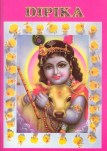
Children like to question. And I appreciate it as an expression of their intense thirst for knowledge. I wrote this given-below dialogue in an easy, conversational style between an imaginary child and myself. This is, of course, based partly on an actual discussion with a group of children, and later written for Dipika 2008. It is an annual spiritual magazine especially for children, regularly brought out by Sri Sarada Devi Ashram at Asherville in Durban. My grateful thanks go to Sister Pravrajika Ishtapranaji for according her kind consent to reproduce it here.
Priyanta: Pranams Swamiji.
Swamiji: Welcome Priyanta, how are you?
Priyanta: I am well, Swamiji. Could you spare some moments to answer my queries?
Swamiji: What are you worrying about? Do you perform regular prayers?
Priyanta: Oh! I wanted to ask you exactly about prayer, Swamiji.
Swamiji: Okay what’s your question?
Priyanta: Swamiji, in prayer if we ask something from God, will God give it to us? Suppose what God gives me turns out to be unsuitable, then what happens?
Swamiji: Indeed, our Master Sri Ramakrishna says that God can hear even the foot steps of an ant. If you pray with diligence, sincerity and love, then God will give you whatever you pray for. It is true that many devotees do not know what to ask God for.
Priyanta: Is that so? I thought people ask for those things that they need!
Swamiji: That’s how it should be. But what they need and what they want are entirely different. Okay, now I will tell you a story from our Puranas.
Priyanta: What are Puranas, Swamiji?
Swamiji: Puranas have the insight of the Hindu scriptures called the Vedas, retold for the easy understanding of the common folk. The teachings are primarily taught in a very easy and interesting way. They are given through inspiring stories and parables. Do you know that in total there are eighteen Puranas?
Priyanta: Thanks Swamiji! Do you have an apt story with regard to my question on prayer?
Swamiji: Yes Priyanta. I will tell you the story of an asura (demon) called Bhasmasura. This demon performed severe penances to obtain the favour of Lord Shiva. Pleased with him, Lord Shiva appeared before Bhasmasura and said: ‘Dear devotee! I am pleased with your austerities and therefore I am willing to grant you a boon. What do you want?’ Bhasmasura folded his palms and sang the glory of Lord Shiva. Then he said: ‘O Lord! If I place my hand on someone’s head, that person should be burnt to ashes immediately.’
Priyanta: Oh! What a destructive boon!
Swamiji: Yes, what an ignoble boon did this Bhasmasura ask for! Not only that. He told Lord Shiva that he wanted to test it. He rose from his seat and rushed near Shiva trying to place his hand on the head of Lord Shiva! See what a danger!
Priyanta: Then what did Lord Shiva do, Swamiji?
Swamiji: You see, God is always bound by His devotee’s love. He even becomes a servant of His devotee, just to please him. So, Lord Shiva ran to Lord Vishnu who calmed Lord Shiva and said that he would deal with the demon Bhasmasura. Lord Vishnu then took the form of a beautiful damsel and stood on the pathway of Bhasmasura who was trying to test his boon on Lord Shiva. The demon was charmed at the beauty of the dancing girl. Now, do you know Priyanta, what dance Lord Vishnu performed in the form of Mohini?
Priyanta: Swamiji, is this dance called Mohini-aattam?
Swamiji: Yes, truly so! This Mohini-aattam is very popular in Kerala, in the southern part of India.
Priyanta: Okay. Then Swamiji, what happened?
Mohini directing Bhasmasura in dance…Painting by Raja Ravivarma
Swamiji: Lord Vishnu disguised himself as the world bewitching Mohini and then showed the demon this dance. Bhasmasura, captivated by her beauty and grace, wanted Mohini to be his wife. Mohini informed him that she would marry only that man who could perform the dance as well as she could. So the demon king requested Mohini to teach him the steps of the dance. Mohini then showed him the movements of the hands and, in the heat of the moment, Bhasmasura copied her hand gestures and placed his hand on his own head. Thus see how Bhasmasura was destroyed!
Priyanta: So Swamiji, the boon from God may turn out to be dangerous!
Swamiji: Yes, if you do not know exactly what to ask for. You see, this simple story from the Puranas has many good messages for all of us. Can you tell me a few morals from this story?
Priyanta: Yes Swamiji. Firstly God will definitely give us what we pray for. Secondly, I think that we should not pray to God for anything that is destructive. Thirdly we must know that we should not harm anybody with our prayers.
Swamiji: Well said Priyanta! Suppose you ask your father for a pistol, he will not give it to you. Why? Because, if you should get angry with someone, you might shoot that person with it or you may even accidently hurt yourself. So, if you seek something destructive, you are sure to harm others and yourself too. And finally what is the best form of prayer? Harmless as well as beneficial to everyone is the prayer for auspiciousness, peace, fullness and goodness. Like this one for example:
May there be auspiciousness to all
May there be peace to all
May there be fullness to all
May there be good to all.
——————————————————————————–
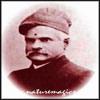
Raja Ravi Varma
Raja Ravivarma, one of the greatest Indian artists of the 20th century
Raja Ravi Varma (1848-1906) was born in Kerala, India. At the age of seven he started drawing on the palace walls using charcoal. The talent of the child was noticed by King Thirunal Maharaja. Most of Ravi Varma’s paintings are based on Hindu epic stories and characters. His illustrations of the Ramayana and Mahabharata became the standard visual representation of the classics. His paintings are famous for vibrant colours and textures as can be conceived in the famous painting depicting Mohini directing Bhasmasura in dancing art.
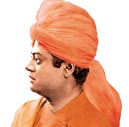
Swami Vivekananda
Swami Vivekananda saw the beauty of the paintings of Raja Ravi Varma at the palace of the Gaekword of Baroda. Swamiji noticed the characters coming to life in these paintings and was moved by intense emotion. In 1893 Swamiji met Ravi Varma in America at the famous Chicago exhibition during the Parliament of the World’s Religions held there. Swamiji’s considered views on Art can be read here. ————————————————————————————
In the ALL TIME stats as on today, the top Post was about Rama and the Post on Hanuman runs third. Hence I have brought these two old posts also in the front so that reading consecutively may be of interest to people. This is the result of a suggestion received from one devotee-reader Havasen Reddy, SA.
The Ramayanis a masterpiece of Divine Love to Sri Ram. Throughout the verses of the Ramayan, the learned find knowledge, the singers get celestial music, the writers revel in rich poetry and the righteous, a storehouse of Dharma. In this respect the Ramayan is a storehouse of all sarva-mangala without parallel.
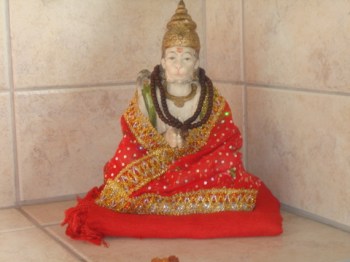
Sri Raama dootam shirasaa namaami – Pawanasuta Hanuman ki Jai ! – courtesy Sri Sunil Parthab
Here, my mind is humbly reverting to Sri Hanumanji. A perfected soul of sterling character, his matchless valour and invincible strength, self dedication and his devotion to Lord Ram is second to none! A true Karma yogin, he discharges his duties with utmost sincerity “Ram kaaj karibe ko aatura”. An ardent Bhakti yogin, he derives immense bliss in listening to his Lord’s story, “Prabhu charitra sunibe ko rasiyaa” Yes! all these wonderful traits are very important, especially if we are seeking to lead healthy, peaceful and spiritual lives. In this entire journey of life – our merciful Master is with us, eager to help when we stumble, forgive us when we make mistake, and encourage us when we falter.
Every devotee is precious to the Lord, and He is ever ready to help us succeed.
Every Hindu home must have a copy of the Ramayan, and regular reading of this sacred Book will enable us to emulate the exemplary and immaculate lives of Sri Ram, Mother Sita, Hanumanji and a host of bright and wonderful characters found in this gem of our scriptures.
So, dear devotees, on this very auspicious Day of Sri Ram Navami, let us all take a resolve to cultivate faith and love for our dear Lord Ram. Did not our Master say over and over again that “The One who became Rama and Krishna, has now come into this case (showing his body)”? May all who are tuned to our Master be Blessed with spiritual love and enlightenment!
Swami Saradaprabhanandaji also joins me in wishing everyone of you, abundance of love and healthy life.
With love and prayers
Swami Vimokshananda
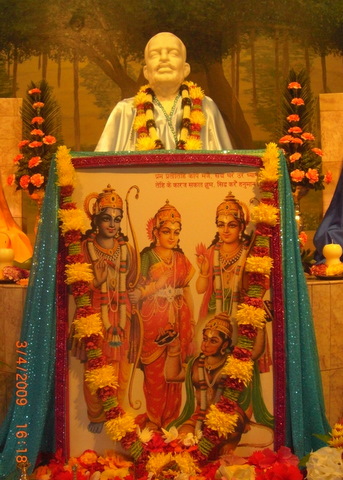
Rama Navami decoration at Ramakrishna Temple in HQ


 Children like to question. And I appreciate it as an expression of their intense thirst for knowledge. I wrote this given-below dialogue in an easy, conversational style between an imaginary child and myself. This is, of course, based partly on an actual discussion with a group of children, and later written for Dipika 2008. It is an annual spiritual magazine especially for children, regularly brought out by Sri Sarada Devi Ashram at Asherville in Durban. My grateful thanks go to Sister Pravrajika Ishtapranaji for according her kind consent to reproduce it here.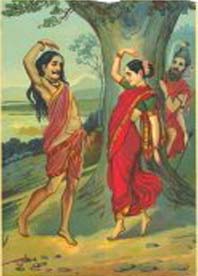
 Vedanta in Practice