Vedanta in Practice

A Micro-Blog from Swami Vimokshananda – earlier at Durban, Singapore and Dublin – now at Yelagiri Hills, Tamil Nadu, India – "A private diary for public consumption!"

  • 60cimg4633.jpgFor me this was the very first Mahashivaratri in South Africa. The nostalgic past impressions of Belur Math mahashivaratri festival were humming in my mind. The holy occasion was celebrated on the night of 6 March, 2008 at the Main as well as at all the Sub-centres in South Africa with due solemnity. Nearly 400 devotees participated at the Main centre in Glen Anil, Avoca from 6 pm to next 6 am. Programme included puja to Lord Shiva at every prahar (3 hour per session) thus 4 pujas, bhajankirtan singing, discourse, arati by a couple devotee, hawan etc.
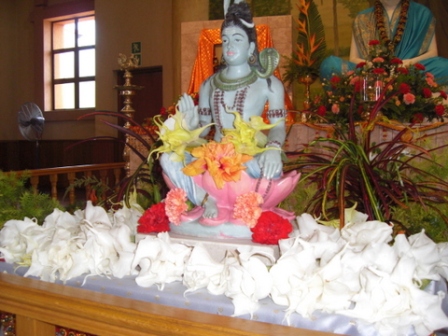
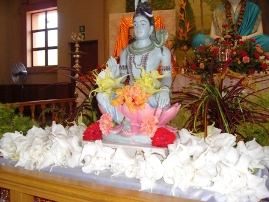
    60cimg4711.jpgA Shiva image was arranged in front of the Holy Trio at the altar. Outside the altar there was a stone shivalinga. The entire altar was tastefully decorated with flowers by our women devotee-volunteers. I was pleased to see a huge collection of datura flowers that are said to be the favourite of Lord Shiva.

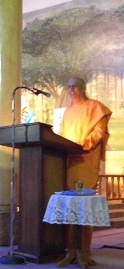
    In the first session after the opening bhajans I was invited to address the gathering. In my Talks, I traced a little of the legend of Shivaratri celebration and how the whole episode could be interpreted in terms that are understandable for a spiritual aspirant. In the second session Saradananda spoke about the symbolism of Shiva and how the worship of Shiva could be brought out in serving the suffering humanity. The rest two sessions by learned devotees – Smt Veena Daya and Sri Pravesh Ramlal highlighted various aspects on Shiva and Swami Vivekananda. 

    Before the fourth session ended there was a hawan also. Fasting and night vigil were scrupulously followed. On this occasion I visited Chatsworth Sub-centre which had organised night-long puja and other items of programme. I could see a charming dance recital by a student to the cassette-played song of ‘ambalatharase….‘ In the second session my talks centred on the mythological stories on the glory of Holy ashes. 
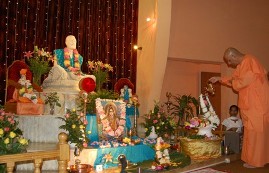
    60dsc_0462.jpgAsherville Sarada Devi Ashram  in the third session was my next stop and there I addressed the gathering on greatness of Shiva devotees.

    I was taken in his car by Pravesh, an Exco member and a long-time devotee of the Centre to visit these centres. On my way back first we halted at the one of the oldest Temple in the town called Umgeni Hindu temple founded in 1883. The entire pilgrims had just come out and we had darshan of shivalinga unhindered.
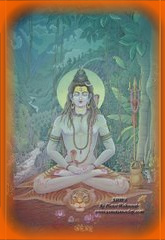
    shivapainting.jpgShiva’s grace! Shiva there was having jala abhisheka (water bath). From there we went to another temple called Sri Ranganadar Temple where we saw a good number of devotees listening to the traditional South Indian karnataka vocal music with the accompanying mridungam. Lord Sriman Narayana who is the presiding deity of this temple was found decorated with beautiful patterns of flower garlands.

    We returned to Avoca just before the beginning of the fourth session. The hawan was completed by Saradananda to the delight of all assembled devotees. After every session of course devotees were provided with glasses of milkshake. Mahashivaratri was indeed a soul-satisfying experience. The sacred mantra Om Namah Shivaaya would continue to reverberate in the air for more time to come.

  • Who can know Shiva in full? And that too except by His grace? But a preliminary idea can be gained from reading a booklet “Lord Shiva” written by Swami Shivapadananda. He was the Second President of the Ramakrishna Centre of South Africa. You will appreciate the intrinsic worth of this booklet.

    May Shiva bless all!

    Holy ashes offered to and accepted as prasada from Lord Shiva can indeed do wonders – from removing obstacles to bringing peace of mind. The following is adapted from the weekly Talks on Gita by Swami Vimokshananda at Ramakrishna Centre of South Africa, Durban. 

    Aum Namah Shivaya!

    This panchakshara – five lettered – mantra is potentially efficacious in warding off evils and bestowing grace and peace of mind. Sages, saints and innumerable devotees of Lord Shiva have chanted this mantra repeatedly all through the ages.

    In the life of the Master, Sri Ramakrishna we find his mother Chandradevi used to visit frequently the temple of Jugi Shiva in Kamarpukur. Once she suddenly saw a divine effulgence coming from the holy image (linga) of the great Lord Shiva. This bright light filled the temple and rushed towards her in waves. Engulfing her all of a sudden, the light swiftly entered into her body. Stunned with wonder and initial fear Chandradevi fell down unconscious. After recovery she felt that she was pregnant with a child. The maid Dhani was helping Chandradevi during the pangs of labour. When the baby was born Dhani kept the baby aside and was rendering necessary help to the mother. When Dhani came back she was surprised to find that the baby had disappeared from the place where she had kept it.

    In alarm she took a lamp and found to her great surprise that the baby had rolled down the ground into the hollow fireplace. It was simply lying there with its little body fully smeared with ashes like Shiva and still not crying!

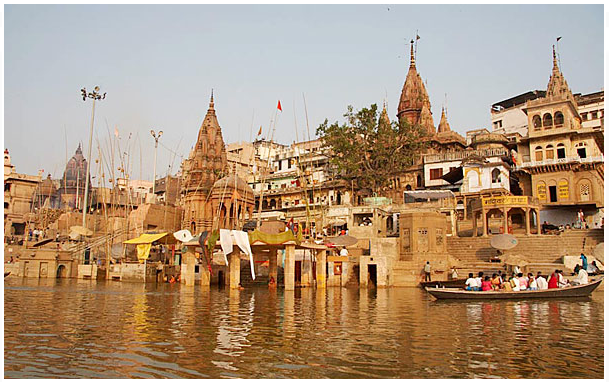
    the present manikarnika ghat wherein Master witnessed Lord Shiva and Mahakali

    Shiva’s ashes had a great charming effect on the mind of the Master. Indeed under the Naga sadhu Tota Puri, Sri Ramakrishna while practising meditation would smear Shiva’s ashes all over his body. At ‘golden’ Varanasi Sri Ramakrishna had the vision of Shiva. In the words of Master, ” I saw a tall white person with tawny matted hair walking with solemn steps to each pyre in the burning-ghat, raising carefully every jiva and imparting into his ear the mantra of supreme Brahman. On the other side of the pyre the all-powerful Mahakali was untying all the knots of bondage, gross, subtle and causal of the jiva produced by past impressions and sending hm to the indivisible sphere by opening with Her own hands the door to liberation.”

    In Puranas we find once the great Muni Durvasa while chanting the mantra‘Sarvaatman Shivashankara! Srimaatar Bhuvaneshwari!’– was moving on the sky and came to a halt before Yamaraja. Yamaraja welcomed Durvasa Muni and showed him the entire city which was called Dharmapuri. While discussing with Yamaraja, Durvasa Muni off and on heard noisy sounds of weeping and wailing. Surprised at that Durvasa Muni asked Yamaraja from where these crying sounds were coming.

    The dispenser of Justice Lord Yama explained to Durvasa Muni that under his control there were fourteen heavens and twenty-eight hells. The cries that Durvasa Muni heard emanated actually from one of the hells called Kumbhipaka Naraka. People of sinful nature who did not properly respect their elders and ancestors by not offering pinda and udaka (riceballs and water) were the cause of the ancestors’ downfall into Kumbhipaka Naraka.

    Hearing the heart rending cries of the ancestors, Durvasa Muni requested Lord Yama to allow him to visit Kumbhipaka Naraka. Accordingly Lord Yama arranged his men who took Durvasa Muni to that hell.

    Durvasa Muni was greatly surprised to find that Kumbhipaka Naraka was not looking like a hell. Neither weeping nor wailing! Instead the manes were found cheerfully relaxing on comfortable beds having their drinks and meals, served by host of attendants. The Yama’s men were also taken by surprise.

    They immediately rushed back to Lord Yama and informed him of the wonderful sight they had seen in Kumbhipaka Naraka. Yamaraja thereupon informed Indra , the Lord of the Devatas, about the sudden change of the nature of the hell into heaven. Not knowing the reason thereof Indra came to Kumbhipaka Naraka on his airavata (celestial elephant).

    On inspection, Indra too got bewildered how the hell could change into a heaven overnight. The Devatas led by Indra approached Brahma, the Lord of Creation. Lord Brahma could not give any answer; so the Devatas turned to Lord Vishnu from whom they could also not elicit any answer.

    a marble murti of Shiva, brought from Varanasi sitting majestically at HQ

    When finally they approached Lord Shiva for an explanation, Lord Shiva smiled and said that it was the visit of Durvasa Muni to that hell that brought about the wonderful transformation. Surprised at this the Devatas asked Lord Shiva what Durvasa Muni did to enable the change of hell into a heaven.

    Lord Shiva proclaimed that Durvasa Muni was indeed a great Shivabakta– devotee of Shiva. Everyday after having bath, Durvasa Muni would smear the holy ashes of Lord Shiva on his forehead and upperbody. Due to Durvasa Muni being jolted on hearing the suffering, particles of the holy ashes fell on the grounds of Kumbhipaka Naraka.

    Lord Shiva continued to say that whoever applies holy ash on his body would remember that from ashes came the creation and finally all will be reduced to ashes. By wearing ashes on one’s body, a devotee can develop detachment with his body/mind complex. This would make him realise the Truth behind all these changing phenomena because Shiva is Truth (Satyam). Shiva is also Auspicious (Shivam) and indeed Beauty (Sundaram) itself.

    Jai Shiva Shankara! (Hail Victory to Lord Shiva Shankara!)

    Aum Namah Shivaya!

  • Public Meeting on “Service as Worship of the Divine” held in Ramakrishna Mission, New Delhi on the occasion of Golden Jubilee Celebration of Sri Ramakrishna Temple. Here is a video of an address by Swami Vimokshananda given on the above occasion on 18 November 2007. Of course the Address was delivered in Hindi.

  • Swami Vivekananda in Chicago
    Swami Vivekananda in Chicago

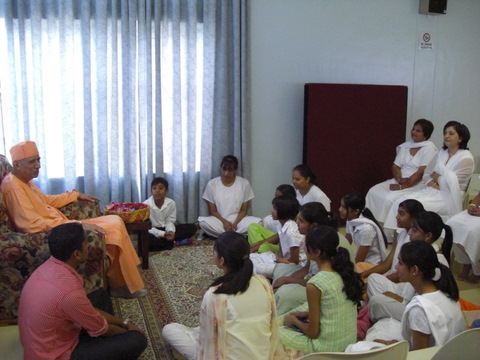
    During my Northern Natal tour in connection with the Swamiji’s birthday celebration, I had a refreshing meeting with youngsters of Ladysmith Branch of Ramakrishna Centre of South Africa on 10th January 2008. All of them along with their parents were volunteers and had worked very hard to organise the next day morning meeting in the Civic hall. A little more than 800 people were expected to attend where my key-note address was scheduled. Though they were eager to continue the discussion in that late night, I felt that I could cut short of my discussion to give them a reprieve from the tiresome work they put up practically the whole day. In order not to disappoint them, I asked them to field questions. All were, unlike the other days, silent (shy? or tired?). So I raised this query and asked them to keep the reply ready when I would meet them on my return trip from Dundee on 14th January.

    cimg1082.jpgMy query to the young members was this. One of the oft-quoted line of Swami Vivekananda is ‘Arise! Awake! And Stop not till the Goal is Reached!’. We normally see that after the night sleep, we first ‘wake up‘ – ‘open our eyes’ and then only ‘rise up‘ – ‘get up’ from our bed. But Swamiji strangely calls up first to ‘Arise!’ and later to ‘Awake’. Is it not a contradiction to what we are used to? Would Swamiji, being the ‘nitya siddha’ – the Ever Perfect, make such a silly mistake? No, the youngsters in one voice said, no, it cannot be a mistake. Then, I asked: what does this mean? 

    Ladysmith Ramakrishna shrineUnfortunately, on 14th January at the scheduled ‘Thanksgiving Satsang’, we could not take up this question for discussion due to lack of time as I dealt with the topic ‘Divine aspects of Swamiji’. So, I told them to send their replies by email to me. The replies that I received by email were indeed fascinating. Below you will find one of them, written by Nirmala Balkaran from Ladysmith, South Africa  : 


    “At the outset… I must honestly and humbly confess that it is not possible to comprehend even a fraction of Swamiji’s profound gospel. It is with this in mind that I offer an attempted response to the question. Swami Vivekanandaji speaks of “awakening” after “arising” because this is not a reference to the kind of physical wakefulness from a state of sleep as we know it. We are all obviously “awake” when we read this quotation by Swamiji; however the kind of wakefulness to which we are exhorted, is a higher awakening of the spirit. This is preceded by the call to “arise” which is a call to action. It is through action and effort that we can arrest the state of sleep into which we have fallen and make possible a spiritual awakening. After having arisen (as we do after a physical awakening), we are still guilty of being asleep, or oblivious of our inherent spiritual nature and the real goal of life, for having arisen we go about our secular duties in a state of spiritual slumber. Hence the need to awaken after arising.”