A Micro-Blog from Swami Vimokshananda – earlier at Durban, Singapore and Dublin – now at Yelagiri Hills, Tamil Nadu, India – "A private diary for public consumption!"
Please listen to Ram dhun “SriRam JayaRam JayajayaRam” .
It was the time when Sri Ramachandra decided to leave this earth once and for all. He convened a meeting of all his brothers and Sita. And told them: “Look, now our sport (lila) is going to be over. So we are going to merge into our nature (swarupa).”
As that very moment came Narada. Wherever Narada goes, some disturbance happens. So Lakshmana was very apprehensive on seeing Narada. He said: “Brother, Narada has come.”
After seeing Narada, Sri Ram got up and made him seated and worshipped him and then Rama asked: “O! Narada, O! great devotee! What service can I do to you?”
Narada said: “Just now you have been discussing, you want to close your ihalila, that is the lila you have been enacting on this earth. But you should not go away simply like that. You should call a big assembly sabha – call everybody in Ayodhya and all of the world. Invite all the rishis and munis. Invite all the devas, yakshas, gandharvas. Invite everybody and announce your decision.
Sri Rama agreed and duly a sabha was called. It was a big sabha – all were coming and lot of arrangements had to be done for that. So each one of Rama’s brothers was given duty. Sita was given duty of looking after the guests – all of them must be fed. So the kitchen was given to her.
Like that, each one was given a responsibility. Shatrughna was to receive at the sabha, all the rishis and munis and give them chandana tilak and then give them a garland – a very good garland has to be put on their shoulders. And then give them proper seat asana – that was his duty.
Everything was arranged on the appointed day. All have started coming.
So Shatrughna was very busy. Suddenly Narada called him and said: “O! Shatrughna! Do you see in the distance? Durvasa is coming – a great danger is coming!”
Shatrughna wondering replied: “Why? He is coming to see my elder brother Rama and Rama is his chosen ideal ista devata – whenever Durvasa sits for meditation, he meditates upon Rama – and from him no danger will come here.”
Then Narada advised him: “No, great danger is about to happen to you by Durvasa… I can see this. So what you do is don’t disturb Durvasa in any way. When he comes you take him to his asana – but no tilak and no garland is to be given to him because the moment he is seated, he will meditate on Sri Rama and merge in samadhi and when Sri Rama arrives, it is my responsibility to raise Durvasa. So don’t worry about it.”
So Shatrughna thought a great rishi is telling. He simply took Durvasa, showed his seat and came away. And Durvasa sat and started meditating on Sri Rama.
And when everything was alright, the right propitious time came, Sri Rama, Lakshmana, Bharata and Sita; all four entered. All the people got up to welcome Sri Rama. Only one person was sitting and that was Durvasa.
Narada raised Durvasa slowly telling him in his ear “Sri Rama has come, please get up”. So Durvasa came down from his intense samadhi and then opened his eyes. One thing that struck him was that every rishi and muni has got chandan tilak and beautiful garland. But he didn’t have. So he asked Narada the reason for his not having been given. And Narada became very serious. He said: “Look Durvasa! It was Shatrughna’s duty to give you garland and tilak. He must have something in his mind to dishonour you. I think you should report this to Sri Rama.”
So the drama of Narada has started. Durvasa, unhappy with what had happened to him, stood up and said: “O Rama! In your sabha, I have been dishonoured. Why I did not get a proper welcome?”
Sri Rama called Shatrughna but he was not there. Surprised Sri Rama said: “What has happened to him?” Then Rama found that his parama bhakta, Sri Hanuman was also missing. Then Narada asked: “What is you decision regarding Durvasa’s dishonouring?”
Rama said: “I will give punishment to Shatrughna for dishonouring him. So first let us find out where Shatrughna is”. Then Narada said: “Let us go and visit Hanuman’s house because his mother Anjani has come here and he must have been busy with his mother. Let us go and see first Hanuman.”
So a chariot was called and Rama took his bow and arrows. When they arrived at Anjani’s house Anjani came and made pranams to Sri Rama, and Sri Rama asked: “Is Hanuman here?”
“Yes , Lord! Should I get him?”
“Definitely. Call Hanuman.”
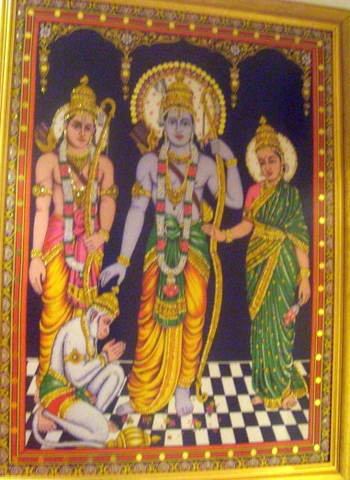
Then Hanuman came and stood there – he saw his Master, standing on his chariot with bow and arrows. He left his mace gada and made pranams.
“O Prabhu! I touch your holy feet, please bless me!”
Sri Rama was, as ever very happy to see Hanuman. He said: “Hanuman, where is Shatrughna? Do you know?”
“Yes Prabhu! I do know where he is.”
“Where is he?”
“He’s inside this house.”
“Get him out! Ask him to come out!”
“No Prabhu – I cannot ask him to come out.”
Greatly surprised, Sri Rama exclaimed:”What! I am your prabhu Ramachandra speaking! To my parama bhakta Hanuman! I am ordering you to get Shatrughna out.”
“No, Master! I cannot bring him out!”
“Do you know the repercussion? Do you know the effect?”
“Yes Prabhu! If you want Shatrughna from my house, you must fight with me first. Defeat me and then take Shatrughna.”
Stunned Sri Rama said: “What! I have to fight with you!”
Prabhu and bhakta both are now on the battlefield and the Master has to kill his devotee! All the gandharvas, yakshas, devatas and rishis and munis wondered at the scene that has been enacted there.
Not able to get what he wanted, Sri Rama finally took one of his arrows and aimed at Hanuman. All prayed to Sri Rama: “Please do not use your Ram Baan. If Hanuman is killed will there be any devotee left? No more worshipping of God will be done – because God has killed his own bhakta; this is just not possible. So put down your astra.” Ram Baan – a term commonly used in India for anything that does not miss its target, because Ram Baan is always sure – it must aim and reach the target.
But then Sri Rama was determined, “No. I must aim.”
And there standing on foot, Hanuman challenges Sri Rama, “Aim, aim your arrow, please!”
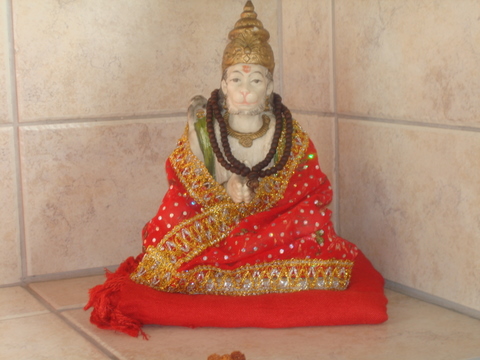
The three lokas were stunned and were worried about what was going to happen. And the arrow went straight to Hanuman. He stood there krita mastaka anjali bowing down with his head, hands together joined and said “Jai Sri Ram, Jai Sri Ram, Jai Sri Ram!”
Surprisingly Rama’s arrow went around Hanuman three times and came back to Rama. His arrow failed. Hanuman went on chanting the name of the Lord “Jai Sri Ram.”
And then Rama looked at Narada – was he behind all this drama?
Narada smiled, as if to say ‘yes’, and then said, “No more aiming, my Lord!. Put down your arrow.” Then Narada added: “You see, when I learnt that you are going to finish your sport in this earth, I thought that you will go away, your form will go away, your body will go away. But your name must remain. Today the entire universe has seen that through your name, your devotee is protected, even from your own arrow. Even God is utterly helpless if His name is taken. It is proved that devotee never perishes; always protected.”
(na me bhakta pranashyati – My devotee is never destroyed. Bhagawan Sri Krishna in Gita)
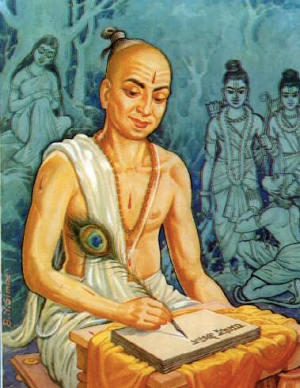
A devotee Samiksha Panday from Pietermaritzburg has sent me these selected lines from the KISHKINDHA KAND of SHRI RAMCHARITMANAS by Goswami Sri Tulsidas to be read BEFORE the Hanuman Chalisa is recited to dispel the curse placed upon him by the rishis. Between Doha no. 29 and Doha no. 30
KAHAI REECHAPATI SUNU HANUMAANAA /
KAA CHUP SAADHI RAHEHUBALAVAANAA//
PAVANA TANAYA BAL PAVANA SAMAANAA /
BUDHI BIBEKA BIGYAANANIDHAANAA //
KAVANA SO KAAJ KATHINA JAGA MAAHEEN /
JO NAHIN HOI THAATATUMHA PAAHEEN //
Pawanasuta Hanumani ki Jai ! – courtesy Sri Sunil Partab
Hanuman on to Lanka
Hanuman, Angada, Jambavan and others went towards the South in search of Sita. Sugreeva had given them only a month\’s time to find her. They wandered far and wide and grew utterly weary. At last they came to the sea. They stood before the vast, roaring sea.
The period granted by Sugreeva was over. So what were they to do? The brave soldiers of Sugreeva sat bewildered. If they returned to Kishkindha, Sugreeva would certainly punish them. So, Angada suggested that they should fast to death on the seashore. But Hanuman replied, \”Angada, that would not be right. Surely Sugreeva will not punish us if we return.\” He tried to persuade them in many ways. But the others in their pessimism would not listen to him. All of them spread some darbha grass and lay down on it, determined to die.
Just then Sampathi came there. From him they learnt that Sita was Ravana\’s prisoner in Lanka. Their joy knew no bounds. They danced about shouting, \”Oh! Now we know about Sita! \”With great enthusiasm, they turned to the sea. But who could cross the ocean?\”
One of them said, \”I can jump across ten yojanas.\” (The \’yojana\’ was the old unit of measurement of distance.) Another said, \”I can jump twenty yojanas.\” Jambavan was a mighty warrior, but now old. He said, \’When I was young, 1 could leap over any distance. Now I am old, and can leap ninety yojanas. But this is a hundred\”. Angada went further – I can cross a hundred yojanas, and reach Lanka. But I do not know if 1 will have strength left to come back.\”
The old Jambavan consoled them all and said, \”Hanuman is the only great hero who can leap over the sea to Lanka and come back. Let me go and cheer him up and encourage him.\” Hanuman was sitting apart from the others and silently gazing on the sea.
The Celebrated Curse
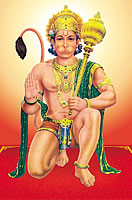
Some sages had pronounced a curse upon Hanuman, when he was a young boy – which he would not be aware of his own strength unless others told him of it. As a child Hanuman flew about freely and was quite mischievous. In fun, he leapt over trees and peaks of mountains, uprooted trees, hurled them on wild elephants and lions, entered heritages of sages, broke away their utensils, uprooted and snatched their beards, disturbed their mediation and committed sportive exploits which troubled sages very deeply. Even his parents were at a fix and could not realise what to do with him. Finally the sages anathematised (pronounced a curse) Hanuman in these words \”O Hanuman! you will forget all those powers and boons that have been bestowed upon you. You will regain your vigour and vitality only when some one eulogises your greatness and glory.\” The anathema made Hanuman staid and tranquil. Hence, Hanuman would never know how powerful and strong he was. Others would have to explain to him his strength. Only then would he be realizing it.
Jambavan now praised Hanuman\’s strength and ability. He said, \”No other living creature has your strength, wisdom and radiance. -Why are you sitting quiet, not knowing yourself.? You can certainly jump over the ocean.\”
As Hanuman became aware of his own powers, being reminded, great enthusiasm welled up in him. He stood up and after glancing at them and began to grow. His companions were astonished. As they went on praising him, his stature grew. He grew so tall that he could jump across the sea. Still he was very modest. He bowed to the elders and said, \”I am the son of the Wind God who can move in the skies without touching the earth. If need be, I can throw skyward all the water of this ocean and make the three worlds float on water. I will go like lightning and surely find Sitadevi.\”
With these auspicious words, I greeted this monk, on his arrival at Durban airport from India this morning. No, not any new monk from Belur Math, our international HQ in India but our well-known brother Saradananda – the Vice-President of our centre – who has been re-christened with a new name “Swami Saradaprabhananda”!
Henceforth he shall be known in this new name only. In India, he spent a little more than two months recently visiting different centres there.
The new name “Swami Saradaprabhananda”, was bestowed on the holy birth tithi of Bhagawan Sri Ramakrishna on Friday, 27 February, 2009. That was the day he was inducted into the Ramakrishna Math & Ramakrishna Mission as a regular member of the Ramakrishna Order of Monks, when Most Revered President Maharaj – Srimat Swami Atmasthanandaji– was pleased to bless him with the “yoga-patta” of the new name.
On his arrival at Durban, Swami Saradaprabhananda was given a befitting welcome reception by the devotees and self at HQ’s Ramakrishna Temple at Glen Anil. In his reply to welcome address, Swami Saradaprabhananda explained his holy tour of Belur Math and other centres of the Ramakrishna Math & Mission in India and thanked everyone who had come to greet him.
It is well-known that the august Ramakrishna Order of monks was started by Sri Ramakrishna himself when he distributed the ochre cloth to his disciples in 1885. Explaining the raison d’être for the change in the name, I spoke about the tradition of this Order, as per which the names of the direct disciples of Sri Ramakrishna, and the names of the Presidents and Vice-Presidents of the Ramakrishna Math and Ramakrishna Mission and also the names of the Trustees were not to be used again. As such, the erstwhile name Swami Saradananda, – that was the name of Sharad Maharaj, a direct disciple of Sri Ramakrishna – had to be replaced with a new name Swami Saradaprabhananda on his joining this holy Order.
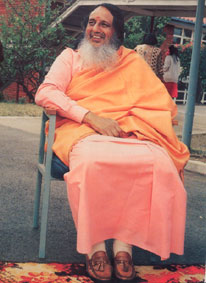
Swami Nischalananda -The Gurudev
The Trustees of the Ramakrishna Math had accepted the affiliation of the Ramakrishna Centre of South Africa which was formalized when I was appointed the President on Sri Rama Navami 2007. With the admission of Swami Saradaprabhananda into the Belur Math, the integration of the local Ramakrishna Movement started by Sri Swami Nischalanandaji Maharaj in 1942 into the worldwide Ramakrishna Math and Ramakrishna Mission is complete. This had been the vision and prayer of Swami Nischalanandaji Maharaj and his disciple Swami Shivapadanandaji Maharaj. Due to historical reasons this integration was not possible earlier in our history.
Swami Shivapadananda
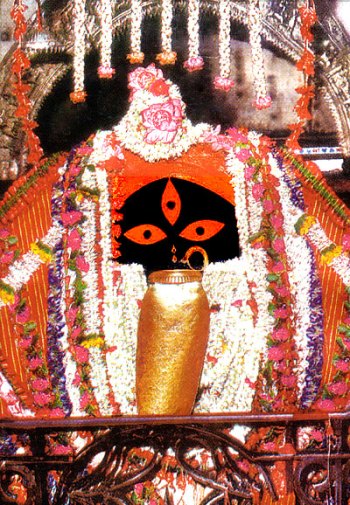
I am here reminded of the earnest prayer of the holy saint Swami Shivapadanandaji at thefamous shakti peethaKalighat Kali temple in Kolkata some years back. This was retold by a reliable source which I narrate for those who have not heard of it.
During one of his visits to the temple of Divine Mother Kali, Swami Shivapadanandaji stood silently at the barricade in front of the Mother doing his japa. The plate wherein the puja articles and a garland were placed was being carried by an attendant-devotee. As usual it was terribly a crowded day. Scores of people – men, women, children in their traditional costumes – have been queueing up in front of Mother Kali. Even the mantras uttered by the worshipping pujari (priest) was not audible. The pujari was seen taking the garlands from each and every devotee’s plates and placing them over the shoulder of the Divine Mother.
Divine Mother Kali of Kalighat in Kolkata, India
Swami Shivapadanandaji had only one prayer…that was the Ramakrishna Centre of South Africa had to be duly affiliated with Belur Math. When?… was not the question, but, it had to be done. So, when he saw his attendant-devotee taking the garland plate to the pujari, the Swami made a prayer and wanted to know mentally from Mother, whether She had accepted his prayer! He wished in his mind that if the pujari took the garland and kept it at the holy feet of Kali, then, that would be a definite indication that She has granted his prayer. This was not expected as the pujari was wont to place the garland on the neck of the Mother.
But, lo! the Mother confirmed! When the pujari received the Swami’s garland, suddenly he turned and amidst the din and bustle of the crowd, he simply placed the garland at Mother’s feet instead of placing it on Her shoulders. That was enough for Swami Shivapadanandaji. He narrated this incident to Swami Saradaprabhananda and told him to keep up the confidence in Mother’s grace by which one day this Centre’s affiliation to Belur Math would be an accomplished task.
May Mother Kali bless all the devotees here and everywhere!
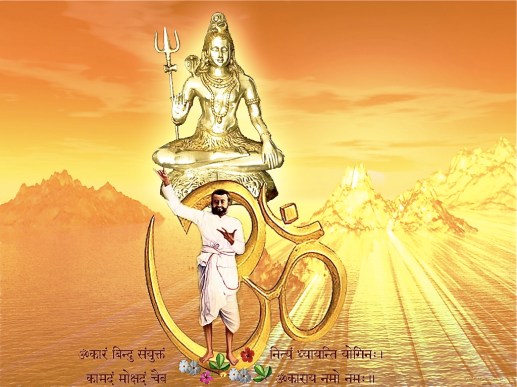
Maha Shivaratri is a momentous occasion for most of the Hindus in South Africa. It favours a deep fervour to their religious feelings in as much as for long twelve hours in each phase of day and night, devotees not only keep vigil in the night but also follow fasting to ritualistic performances.
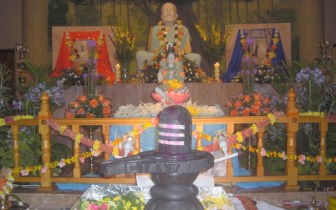
Lord Shiva at Ramakrishna Temple HQ
Our Ramakrishna Centre observes Maha Shivaratri from 6 pm to next 6 am. The period is divided into four sessions of three hours each. And each session has puja, pouring of milk, curd, ghee, honey in respective four sessions, pasting of chandan, offering of vilva leaves, garlanding of flowers etc, arati, discourses, a combination of bhajan and kirtan. After attending initial puja at HQ, I spent my first session at Phoenix sub-centre where more than 400 devotees had assembled. A large number of devotees had to be accommodated in the adjoining covered space where CCTV had been installed for that occasion. The topic of my Talk was ‘Shiva-shakti’. The second session was at HQ where the theme of my Talk was on Maheshwara and the Monk, comparing the salient features between Lord Shiva and Swami Vivekananda.
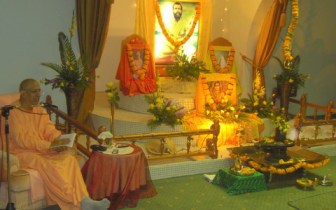
Discourse on 'Shiva Panchakshara Stotram' at Chatsworth Subcentre
Third session was at our Chatsworth sub-centre where I took up the panchakshara mantra (Five-letter mantra) of Shiva, “Om namah shivaaya” for discussion. This was based on the stotram composed by the great Adishankaracharya.And in the fourth session I was at Asherville Sri Sarada Devi Ashram where I spoke about Master and Shiva. Back at HQ at 5 am and witnessed the havan ceremony where devotees performed the yajna.
Offering holy Vilva leaves to Shivalinga at Sri Sarada Devi Ashram
Devotee Pravesh took me by his car to all these places hopping from one to another in quick succession so that everywhere I was present timously. And the day being spent on fasting and thinking of Lord Shiva, the night spent again in speaking about Him and His glory. Indeed a very soul-fulfilling experience!
Let me narrate how a poor woman in one place of pilgrimage, illiterate yet knew what is real worship of Shiva.
When I went for darshan of the famous jyotirlinga at Bhimashankar in Maharashtra state some years ago, from the bus I could see the distant black clouds hovering the hills. Walking from the bus stand to the temple through the small vendors’ shops and watching the selling of all and sundry items of worship and interest to pilgrims was, as enchanting as drenching in the drizzle.
It was noon by the time I reached the holy temple. After darshan, when I was sitting at the entrance in utter quietness, I saw a lady coming towards me. She briskly asked me, “baba, have you had your meal?” I replied in the negative. Undoubtedly I was indeed hungry but had no inclination to go to the roadside eateries. She then asked me to accompany her to her home which, as she showed, was up in the hills. I was, obviously hesitant – should I go or not? Was it proper to go with an unknown woman? and what dangers might be lurking? – as is known well that the places of pilgrimage do have the usual human perils too.
Yet, finally I decided to go as I felt Master is with me and was confident that no evil shall befall. Reaching her home, in that biting cold and amidst the rains, I found her child playing with her little brother. It was easy for me to establish rapport with those children. Within half an hour the lady served me hot rotis with alu sabji. Did I feel it was nectar like? Yes, the love and affection that beamed in her face while feeding me cannot be forgotten.
After food, she raised some questions about some puranic tales. My answers seemed to be satisfying to her. In my narration, I drew some of the similes spoken by Sri Ramakrishna to her attention and she ran inside her kitchen and brought a small photo of Thakur with great joy! I felt that Master only brought me to her home as He knows where to feed His son!
And taking leave of her and thanking profusely for her cordial, hearty hospitality, I offered a few Rupees that I had. The unlettered village woman’s face turned sour and she quipped angrily whether I am paying the charges for the meal that she supplied. She scolded me saying, was it not that she served me thinking that Lord Shiva had come to her home as atithi (honoured guest)? It was quite difficult to convince her of the necessity to have that amount. Finally when I said that she should spend the money on her children’s dress for the ensuing Diwali, she hesitantly relented.
Poor indeed but with what a rich heart; ever ready to serve a sadhu signifying that Rural India is such that it cannot see a monk in ochre robe go unfed. India is not a punya bhumi (blessed land) merely on poetical terms…
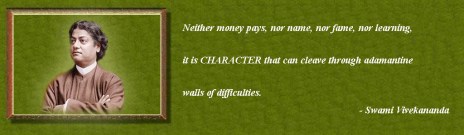
Swami Sunirmalananda has given some serious thoughts to the recent economic recession that had devastating effects in many parts of the world. Is there any vedantic angle to this plaguing ill? Can we at least prevent such maladies? As a student of Vivekananda literature, he delves deeply into the subject and has brought forth truth nuggets that when as an applied science may rejuvenate the entire world.
 The three lokas were stunned and were worried about what was going to happen. And the arrow went straight to Hanuman. He stood there krita mastaka anjali bowing down with his head, hands together joined and said “Jai Sri Ram, Jai Sri Ram, Jai Sri Ram!”

 Vedanta in Practice