Vedanta in Practice

A Micro-Blog from Swami Vimokshananda – earlier at Durban, Singapore and Dublin – now at Yelagiri Hills, Tamil Nadu, India – "A private diary for public consumption!"

  • Happy Krishna Ashtami !

    Last year when I was posted to Durban Centre, I hardly knew how the various celebrations were conducted in South Africa by the Hindus in general and particularly by our Centre. So to my great pleasant surprise, I found our Durban centre and all its affiliates celebrating Rama Navami for 9 days and Krishna Ashtami for 8 days and Navaratri for 10 days contiguously.
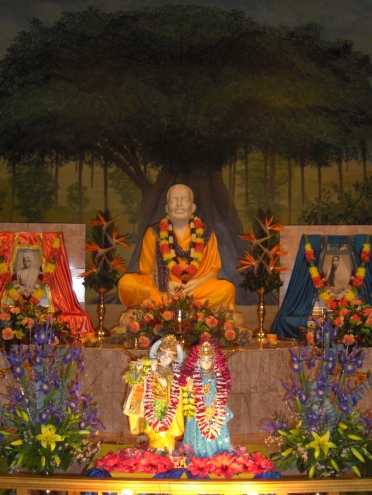
    Radhakrishna at Temple altar of Ramakrishna Centre of South Africa, Durban
    Radhakrishna at Temple altar of Ramakrishna Centre of South Africa, Durban during 8-day Krishna ashtami celebration

    Take for instance the Krishna Ashtami celebration that went by at our Durban centre! There were Satsangs every evening from the first day to the last Ashtami day i.e. for all eight days with clock-wise precision! Satsang had a definite pattern. It consisted many items like kirtans of mahamantra, bhajans on Sri Krishna in Hindi, Gujarati, Tamil and Telugu languages, chanting of selected shlokas from Bhagavad Gita, discourse by monks and lay scholars, readings from Srimad Bhagavatam, deeparati (waving of lights) and prasad distribution. On the evening of the ashtami, Satsang had two sessions.

    The Janmashtami day prog starting at 6.00 pm with Puja to Lord Krishna by a devotee couple within the temple, went on to past midnight. Another couple did the last midnight arati. There were lot of bhajans and kirtans till the end of the prog. The temple was beautifully decorated. A yugal-murti of Radha Rani and Sri Krishna adorned the altar on all days. Finally with arati to BaalaGopaala and offering of flower to Him by every assembled devotee the prog came to an end with distribution of prasad. What new I saw was the keeping of a little cradle wherein a small murti of baby Sri Krishna was kept. And at the end of the prog at about 00.30 am, starting with self, every devotee just rocked the cradle and offered a flower at the holy feet of the baby Lord.

    This year Swami Saradananda spoke for four days on the teachings of Sri Krishna as contained in the Gita. On ashtami night, in the first session during my speech, the birth incident as depicted in Srimad Bhagavatam was presented to the packed audience. To my pleasant surprise again, when I completed the chronicling of Lord’s birth, it was midnight 12 in India!   

    In India, in no centre of ours, I had witnessed such an elaborate festival! The devotion of the devotees is worth noting; what a verve and vigour in singing bhajans! And faith and fervour in performing worship! And the day-long fasting and sitting in the temple for such long hours – absolutely maintaining utmost discipline – no chitchat, no gossip and all are tuned to the discourse and songs, well, I was greatly pleased and impressed with a new kind of experience that gave a boost to my devotional practices!

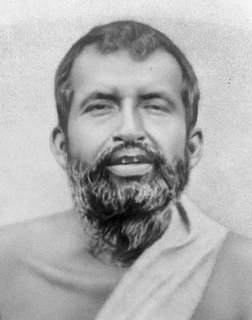
    On this auspicious occasion I remembered how Sri Krishna was intimately inter-woven in the life of Swami Brahmananda, the manas-putra (‘mind-born’ son) of Bhagavan Sri Ramakrishna who recollected one of his visions thus:

    “Just a few days before Rakhal’s coming I saw Mother putting a child into my lap and saying, ‘This is your son: I shuddered at the thought and asked her in surprise, ‘What do you mean? I too have a son?’ Then She explained with a smile that it would be a spiritual child, and I was comforted. Shortly after this vision Rakhal came, and I at once recognized him as the boy presented by the Divine Mother.”

    Sometime in the middle of 1881, Sri Ramakrishna had another vision. He saw two boys dancing on a full-blown lotus floating on the Ganges. One of the boys was Krishna and the other was the same boy whom the Mother had previously placed on his lap. That very day Rakhal, crossing the Ganges, came to Dakshineswar from Konnagar; the Master immediately recognized him as his spiritual son.

    And on the previous day of his departure from this world at 9:00 p.m. a very heart-rending incident occured. This excerpt has been taken from Swami Chetananandaji’s book God Lived with Them.

    Swami Brahmananda…..he touched the hand of his attendant, who was seated nearby, and blessed him. A deep silence pervaded the room. The monks and devotees encircling Maharaj were anxious. He opened his eyes again and began to speak: “I am floating on the banyan leaf of faith in the ocean of Brahman. Vivek my Vivek – Vivekananda-dada [brother]! Baburam-da, Baburam-da [Premananda]! Jogen – Jogen [Yogananda]! I see the feet of Sri Ramakrishna!” Thus he was seeing and addressing the deceased disciples of the Master.

    In the meantime Saradananda arrived. When Saradananda suggested that he sleep after drinking a little lemonade, Maharaj said: “My mind is in the realm of Brahman. It does not come down. All right, pour lemonade into Brahman!” After sipping a little he said: “Aha-ha, Brahman – the Reality – the vast ocean! aum Parabrahmane namah [salutations to the supreme Brahman]; aum Paramatmane namah [salutations to the supreme Atman]!” When Maharaj described his experience of Brahman, all felt peace and serenity in their hearts. He slowly calmed down. His face was glowing with joy and he gazed without blinking as if he were meditating, or seeing something.

    After a while he exclaimed in his sweet voice: “Ah! here is the full moon – Radhakrishna! I want the Krishna of Ramakrishna. I am the cowherd boy of Vrindaban. Put anklets on my feet. I want to dance holding the hand of my Krishna. jhum – jhum – jhum! [It refers to the sound of the anklets.] Krishna, Krishna, Krishna has come. Can’t you see him? You don’t have the eyes. Aha-ha, how beautiful! My Krishna – on the lotus – of Vrindaban! It is not sad-Krishna. My play is over now. Look, the child Krishna is caressing me. He is calling me to come away with him. 1 am coming. . . . Om Vishnu, Om Vishnu, Om Vishnu! Maharaj greeted Shivananda and Abhedananda who came to see him.Temple of Swami Brahmananda 

    Saradananda later said: “This time we shall not be able to keep Maharaj anymore. His vision of Krishna on the lotus, which the Master forbade us to disclose to him, has come out from his own lips.” Ramakrishna’s prophecy about his spiritual son Rakhal proved to be true. At 8:45 p.m. on Monday, 10 April 1922, Swami Brahmananda passed away. The next day his body was carried from Calcutta to Belur Math and cremated on the bank of the Ganges. Later a temple was built on that spot.
     

  • In criticising another, we always foolishly take one especially brilliant point as the whole of our life and compare that with the dark ones in the life of another. Thus we make mistakes in judging individuals.

     – Swami Vivekananda in Notes from a lecture on Bhakti Yoga 

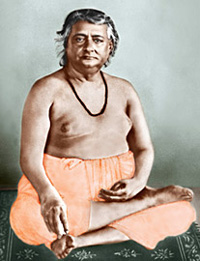
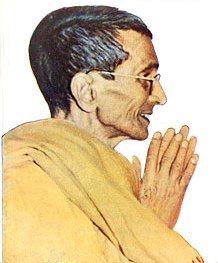
    Swami Akhandananda "Baba Maharaj", a direct disciple of Sri Ramakrishna
    Swami Akhandananda

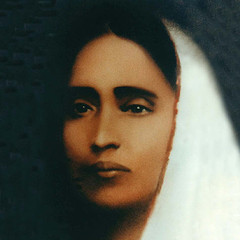
     How many of us can refrain from critisizing others in spite of reading again and again the wonderful precept of Holy Mother Sri Sarada Devi who advises ‘not to find fault with others’? Most Revered Srimat Swami Vireswaranandaji Maharaj was once the butt of criticism and of all persons, the ‘fault’ was reported to no less than a direct disciple of the Master, Sri Ramakrishna. He was Swami Akhandanandaji, the popular ‘Baba’, known otherwise ‘Gangadhar Maharaj’ (Swamiji named him ‘Ganges’). He was childlike and was quick to correct himself when his actions ran contrary to the definite words of Swami Vivekananda, even when pointed out by junior monks. He bore great love for Swamiji. The following reminiscences by Swami Vireswaranandaji are indeed interesting and instructive, and bear testimony to “Baba” Maharaj’s love of Swamiji. Swami Vireswaranandaji was the Tenth President of the Ramakrishna Order and my holy sannyasa Guru. These excerpts were taken from the new book “Swami Akhandananda – As We Saw Him” published by Advaita Ashrama, Kolkata.

    Bespoken behind does, it gives pain but also seems to do some good to the receiver of criticism! When ‘wounded to his depths’ which means deeply hurt because someone spoke wrong things in your back, how does a man reacts? Let’s hear what Swamiji wrote to “a dear one”:

     “the whole of life is only a swan song! Never forget those lines:

    The lion when stricken to the heart, gives out his mightiest roar.

    When smitten on the head, the cobra lifts its hood.

    And the majesty of the soul comes forth,

    only when a man is wounded to his depths!

    written by Swami Vireswarananda

    I shall now recount one or two incidents to illustrate the Swami’s deep love and reverence for Swami Vivekananda. Once when I was staying at the Advaita Ashrama, Gangadhar Maharaj was for some time at the Kolkata residence of the Rani of Puntia, whose grandsons were the disciples of Swami Saradananda. A devotee who was staying for one or two days at Advaita Ashrama, spent a little money and fed the monastics with rasagollas and green coconuts during the noon-meal. As we finished our meal, a monk arrived from the Udbodhan. He too had a share of sweets and coconuts.

    Later he met Gangadhar Maharaj and said to him, ‘Maharaj, today there was a sumptuous feast at the Advaita Ashrama. There were plenty of rasagollas, what to speak of green coconuts!’ And then he added, ‘Maharaj, you are here and there was such a big feast at Advaita Ashrama, and they did not invite you?’

    On hearing this, the Swami said like a boy, ‘How strange! I am here so near, and Prabhu did not invite me? Wait, let him come!’

    The monk came back and said to me, ‘I have lodged a big complaint with Maharaj against you. Wait, when you meet him this time, you will see the fun.’

    A few days later, I went to visit Gangadhar Maharaj. After I saluted him and sat at his feet, the grandchildren of the Rani of Puntia and one or two monks – among whom was the one who had reported against me – all sat down there, eager to see what would transpire. Gangadhar Maharaj sat very grave, uttering not a word. I too kept mum.

    After a while he said, shaking his index finger at me, ‘I have something to say against you.’

    ‘I too have something to say against you,’ I replied.

    ‘What have you got to say against me?’

    ‘Please tell me first what you have to say. After looking into your charge-sheet, I shall speak out what I have to say.’

    ‘Then fix up a judge,’ said Gangadhar Maharaj, like a little boy.

    ‘You will be the best judge,’ I said.

    ‘How can I be the judge when I have brought an accusation against you?’

    ‘I have faith in you only, rather than in anyone else present here.’

     ‘Well, then, let it be so.’

    Then he said, ‘You had such a big feast over there and I am staying so near. Yet you did not care to invite me?’ ‘It was not really a feast, Maharaj,’ I said. And then I explained the whole matter to him. Finally I added, ‘This monk here has, for nothing, reported to you against me. And you too expressed a grievance without enquiring from me what actually had happened.

    Swamiji has said, ‘If anyone is at fault, call him and speak to him; don’t tell anything to anyone else.” But, Maharaj, you have acted differently.’

    No sooner did I refer to Swamiji than Gangadhar Maharaj declared, ‘You have spoken rightly. It was my mistake.’ Saying this he pointed to the monk who had lodged the complaint and said, ‘This fellow has created all the rumpus.’ And everybody began to laugh.

    Two things are to be marked in this episode: firstly, the profundity of Gangadhar Maharaj’s reverence and devotion to Swamiji; and secondly the trait of a great soul manifest in him – that is, acknowledging his mistake to a junior brother like me. None of us would have acted like that.

    Then I said to him, ‘Maharaj, I have won the case. Now I will have to claim damages from you.’

    ‘All right, tell me what you want as damages.’

    ‘You have to pay a visit to the Advaita Ashrama. There you will have to take your lunch, take some rest, and then after having your afternoon tea, return before the evening.’

    ‘All right, I’ll go,’ Maharaj agreed. Thus, one day he came to the Advaita Ashrama in the morning and stayed on. But just after his lunch he said, ‘Now I shall leave.’ It was summer time. In those days there were no taxis as there are nowadays. The entire distance from Wellington Lane to Shyambazar he would have to cover by horse-cab. Realizing that it would be very hard for him to go in that scorching sun, I said, ‘The agreement was, Maharaj, that you would go back towards evening, after taking your afternoon tea here. You can’t possibly leave now.’ ‘No no, I must go right now,’ he said.

    In order to hold him back, I felt compelled to say, ‘Maharaj, kindly stay on. If you do, I’ll feed you with a new thing you have never tasted before.’ ‘What new thing can you feed me, boy? I was the guest of so many kings and wealthy persons. I have travelled in so many lands, eaten many a variety of food. What new thing can you possibly give me to eat or drink?’

    ‘Whatever you may say, the thing I am going to offer you has surely never been tasted by you before.’

    ‘Well, let me see what you are going to give me. I am staying on.’

    I felt much relieved thinking that, at all events I could at least stop his trip in this hot sun. As soon as it struck four, Maharaj called out to me, ‘Where is the new thing you promised? Bring it quick.’ After he had gone for his rest, I had prepared some coffee and kept it on ice to cool it. In those days, there were neither coffeehouses nor refrigerators in Kolkata. I offered him glassful of that cold coffee. He drank it and was very glad. He said, ‘Really, such a thing I had never tasted before.

  • Grade XI Learners attending Motivation Class conducted by Swami Vimokshananda
    Grade XI Learners attending Motivation Class conducted by Swami Vimokshananda

    I expected it to be an interesting experience when I accepted the invitation from Ferndale Combined School at Phoenix to conduct a ‘Motivation class’ on Self-confidence. It turned out much more than that. It was held in the School’s auditorium on Monday, 21 July, 2008 between 1 and 2 pm for the Grade XI learners.

    111 students assembled there to whom I talked in an inter-active style. 20 of them were of Indian origin and the rest 91 were African Black children. A number of Educators were also present. There were students from other communities like Muslims and Christians, besides Hindus.

    Quoting Nelson Mandela’s strong determination to free this great country from the shackles of apartheid, I explained how much ‘self confidence’ in one man could turn the course of the history of a country. I narrated what kind of hardships he had to face at Robben Island prison for long 27 years and how he tackled every adverse circumstance into a positive one. His 90th birthday was recently celebrated by all his admirers throughout the world.

    Swami Vimokshananda addressing the Pupils and Educators
    Swami Vimokshananda addressing the Pupils and Educators

    Then I dwelt on the great Saint of India, Swami Vivekananda who instilled the confidence in self, humanity and God as indispensible for the progress of the individual and the society. Inspiring incidents from his life were explained.  I also spoke of the Jesus’ saying and an incident from Mohammed’s life. I could not but admire deeply the high discipline that the pupils exhibited during the course of the class.

    Thereafter Pastor Dixon, a member of the Governing Body of the School and also the Head of Ecclesia Family Church in Phoenix spoke.

    The Dy Principal Mrs Naidoo gave a vote of thanks while the students honoured the guests with flowers. At the end of the class, students recited Vedic, Bilblical, Koranic and Zulu prayers.

    One of the Educators later distributed “Deepika” the Children’s spiritual magazine to the interested students. This is an annual magazine brought out by Sri Sarada Devi Ashram, Asherville.

  • Sri Swami Nirvananandaji Maharaj (Sujji Maharaj), a disciple of Swami Brahmananda, was one of the Vice-Presidents of the Ramakrishna Order. I had the blessed fortune of being initiated by him. On this auspicious occasion of Sri Guru Purnima, I am happy to recollect one wonderful incident in my Guru’s early life – how Holy Mother Sri Sarada Devi guided him. Originally published in Sri Sri Mayer padaprante (Vol. III), in Bengali, these reminiscences are translated by Mrs. Maloti Sengupta.


    Holy Mother – the Guide

    by Swami Nirvanananda

    It was March or April of the year 1915. I was then engaged in attending on Brahmanandaji Maharaj at Belur Math. I used to notice monks and brahmacharis of my age set out for tapasya with the permission of Maharaj. They would go off to the Himalayas or go elsewhere and spend a year or so there in spiritual practices. One day I too approached Maharaj and asked permission to go for tapasya. At once he said: ‘What else are you doing here? Your serving here is much more effective than tapasya. You don’t need to go anywhere else.’ In spite of these words when I kept pressing him for permission he suggested that I obtain permission from Mahapurush Maharaj. As soon as Mahapurush Maharaj heard my prayer he exclaimed: ‘Are you crazy? Where else will you go for tapasya? Be assured that everything can be gained by just serving Maharaj.’ Still I persisted with my request. At last he said: ‘Well, go to Baburam Maharaj. You may go only if he gives permission. When I went to Baburam Maharaj his response was the same but more vehement. He cried out: ‘Have you really gone mad, Sujji? Don’t you see that Thakur dwells within Maharaj? Will you be in such close proximity to the spiritual son of Bhagawan Sri Ramakrishna anywhere else?’ Finally he gave in to my pleadings and said: ‘Okay, Mother is now at Udbodhan. If she allows you, then you may go. But at first go to Kalighat and worship Kali there. Then go to Mother for her blessings. Know that she who is in Kalighat and the one who is at Bagh Bazar (Udbodhan), are one and the same.’
         Having visited the temple at Kalighat I reached Udbodhan. I was the last in the queue of devotees desiring darshan of Mother. From afar I observed Mother sitting with her face veiled and blessing everyone who offered pranams to her. Finally all the devotees departed and it was my turn. When I stood up after prostrating at her feet I found that Mother had uncovered her face completely. All smiles, she said: ‘Take this sweet, son, eat it.’ She herself gave me the prasad. I gave her an account of activities at the Math. Lastly I placed my appeal before her. After giving me a patient hearing Mother said: ‘Thakur did not like the practice of going out and indulging in harsh disciplines, my child. Besides, where will you go for tapasya leaving the Math and Rakhal? You are serving Rakhal, isn’t that sufficient?’ But I went on insisting childishly on having her permission and blessings for tapasya. Finding me adamant Mother yielded: ‘Well, you may go for tapasya, but go to Kashi. However, you have to give me word that you will not undertake austerities intentionally and needlessly. If on the way help comes unasked, you will accept it. Even during tapasya at Kashi if anybody offers you anything, you will accept it. You will stay at the Sevashram and if the urge is very strong you may beg your food outside. This will serve both purposes – Kashivas (dwelling in Kashi, a centre for pilgrimage) and tapasya.’ I gave her word that I would abide by her instructions. However, I sought her permission for travelling to Kashi on foot. I did obtain her consent but I was aware that the proposal was not to her liking. After offering my pranams to Mother and receiving her blessings I returned happily to the Math and reported everything to Maharaj, Mahapurush Maharaj and Baburam Maharaj.
         A few months later, having bathed in the Ganga before daybreak I set out for Kashi with only a little cloth-bag. I had a staff in one hand and a kamandal (water pot used for religious purpose) in the other. Being then a brahmachari I was clad in white cloth. I tore the cloth into two pieces, wearing one half around my waist and wrapping the other half round my shoulders. I was on my way to Kashi, alone, along the Grand Trunk Road. It was the month of Bhadra (August-September), the weather, therefore was sultry. As I trudged on I realized that my walking down to Kashi was against Mother’s will. On the way I was rather unwell and grew weak. For two days I had almost nothing to eat. At times I felt a little aggrieved that I was in such a predicament in spite of her blessings. On the third morning I lay exhausted under a large mango tree on the wayside. Silently I complained to Mother about such an outcome of her blessings. A little later a car halted under the tree. A family alighted from the car intending to have their food under the shade of the tree. I lay down as before, not interested in them or their activities. Suddenly I heard a familiar voice: ‘Isn’t it Sujji Maharaj? What brings you here?’ On looking up I saw a well-known face, that of a devotee who was a frequent visitor at the Math. When he heard that my destination was Kashi he said: ‘Come with us in our car. We are going to Madhupur. We’ll take you along as far as we can. I thanked him and said: ‘But I have resolved to walk all the way.’ At that he had food served to me first – some parathas, fruits and sweets from what they had brought and filled my kamandal with water. I ate what he offered but despite their entreaties I neither boarded their car nor accepted their money. When they also had eaten, they departed and I resumed my journey. It seemed to me that I was walking endlessly. Due to walking barefoot, blisters had developed in my feet, and the whole body was aching. I walked mostly at night, because walking during the day was painful. Three more days passed during which I had only a few guavas to eat. It struck me then that those people had wanted to take me along some distance in their car but I had not agreed. Mother had said: ‘Don’t undertake austerities intentionally and needlessly.’ By turning down the devotee’s request I had disobeyed Mother, so my suffering may be due to that. When I asked for alms people mocked me. Being clad in white was perhaps another reason for alms not coming my way. However, I used to walk about 20 miles each day. Travelling in this manner in the evening of the seventh day, I reached a village on the border of Bengal and Bihar, in the district of Hazaribagh.
         The name of the village was Birpur [sic]. After much searching I succeeded in finding a temple of Shiva where I took shelter for the night. The place was swarming with mosquitoes. I realized that it would be impossible to spend the night there. As I sat there warding off the mosquitoes, once again the potency of Mother’s blessings was revealed to me. At about 9 o’clock the priest, a young man, arrived. He took a close look at me and put some questions to me. Then he sat down to worship and when that was over, said to me in Hindi: ‘Come home with me. Bears and other animals come here at night.’ I was about to say ‘No’ but Mother’s words came back to me: ‘don’t undertake austerities intentionally.’ So I accompanied him without further delay. I found a quite well-to-do family. His widowed mother was very pleased to see me. She took me to their shrine to perform my japa etc.

    I was startled when I noticed a picture of Sri Ramakrishna amidst those gods and goddesses. I stood there overwhelmed, and tears filled my eyes. How did he come to be there, an obscure village on the border of Bihar and Bengal? I can hardly describe the joy and the faith that surged in my heart. The old lady detained me for three nights with her loving care. She herself prepared khichuri, malpua and so many other things for me to eat. She applied some ointment to the blisters under my feet and smeared a paste of turmeric and lime on my sprained foot to reduce the pain. After three days I felt that I was quite well and could resume walking. The old lady, however, objected. She said: ‘No, my child, you are still weak. You can’t walk alone such a long distance to Kashi and do penance there. Here is your ticket, you will travel by train.’ Remembering Mother’s words this time too I did not refuse. They helped me board a train at a nearby station.
         The old lady and her son recounted to me the story behind the picture of Thakur in their shrine. Once the son had made a trip to Kashi. Seeing the picture of Thakur on a calendar hanging in a shop selling homeopathic medicine he had asked for it and brought it home. I think it must have been M. (Mahesh) Bhatta-charya’s shop. He had learned at the shop itself that the picture was of Sri Ramakrishna – ‘Ramkishan, perhaps some Bengali avatar.’ Both mother and son stated: ‘However, after bringing this picture home everything has taken a turn for the better.’ When I asked the son why he had asked for the picture, he answered: ‘There seemed to be some magic in Ramakrishna’s eyes. His eyes drew me irresistibly, so I asked for the picture. Then I had it framed.’
         I reached Kashi by train. The old lady and her son had wanted me to spend a few more days with them. I somehow succeeded in leaving on the fourth day, much to their disappointment. Till I reached Kashi everything went smoothly. I realized then that after leaving the Math, Mother had been constantly with me.
         Mother had stated: ‘Stay at the Sevashram and if the urge is very strong you may beg your food outside.’ But my impetus for tapasya being excessively strong I decided that the period of my tapasya I would spend outdoors. If I put up at Sevashram the sense of security would affect my tapasya. So I resolved to stay outside and also to beg my food. I found a suitable place in an old garden house near the Ganga and I earnestly devoted my time to meditation, japa and tapasya, while depending on alms for food. The place was not a healthy one. It was infested with insects and mosquitoes which hardly let me be in peace. I understood why Mother had advised me to stay at the Sevashram and to live on alms ‘if the urge was very strong’. The alms in North India, consisting of dal (lentil soup) and chapattis did not suit my constitution. Soon I started to feel quite worn out. I felt my enthusiasm was fast declining. To revive my fervour I visited revered Latu Maharaj (Swami Adbhutananda) who used to dwell on a ghat on the banks of the river. Seeing me he asked very tenderly: ‘Sujji, what has come over you? Why do you look so weak? I fear that begging does not suit you. Well, take these two rupees. Master Mashay (M.) sends the money to me every month to have milk. Take these two rupees and have a little milk everyday.’ As he himself used to practise severe austerities, it hurt me to accept the money. However, Mother’s words: ‘don’t undertake austerities intentionally’ recurred to me. So I was compelled to accept it. This expression of his love brought tears to my eyes.
         My health did not improve, rather it declined further. I contracted dysentery which aggravated due to my living on begged food. One day my condition was so bad that I just lay down in that garden house alone. I had nothing to eat and there were frequent evacuations. Suddenly I heard the sound of some people nearby. The owner of the house – a lady – entered my room. She had come to see the house after several years. At the sight of me, in that state, everything was clear to her. She may have heard about me from the caretaker of the house. Immediately she gave orders for a good room to be fixed up for me and added that rice, vegetables, milk, etc. – everything essential for my diet, should be provided to me. This time too I was about to refuse but remembering Mother’s instructions, I accepted all. It seemed to me that Mother herself had come in the form of that lady and made arrangements for my food and rest.
         In a few days I recovered. By then I had realized that instead of doing tapasya I was accepting service from others. Calling Mother’s instructions to mind, I now took shelter at the Sevashram. After 6 or 7 months had passed in this manner, packing up my scanty belongings, I returned to the Math where Maharaj had been awaiting me with the anxiety of a father. I fell at his feet. That was the end of my desire to leave the Math and engage in tapasya.

  • Swami Smarananandaji with Swami Saradanandaji at Newcastle in deep discussion

    Sri Swami Smarananandaji Maharaj, one of the Vice-Presidents of the world-wide Ramakrishna Order completed his South African tour on 4th June, 2008. He and his Secretary Swami Jnanavratanandaji left Durban on 5th June morning by a homeward bound SA flight to Mumbai and onto Kolkata. Here is a short Report on his memorable visit – the Last Six days (30th May to 4th June) in South Africa. The holy visit brought about a remarkable enthusiasm among the Ramakrishna devotees and Hindus in general. The spiritual atmosphere was palpable wherever he went. Many sincere spiritual seekers got his invaluable guidance. 

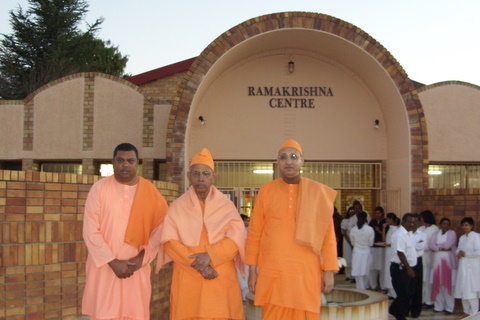
    Swami Smarananandaji with his Secretary Swami Jnanavratanandaji and Swami Saradanandaji of Ramakrishna Centre of South AfricaThe morning of 30th May saw the departure for Northern Natal centres. The team – consisting Most Revered Vice-President Maharaj accompanied by Swami Jnanavratanandaji, Swami Saradanandaji, Dr H B Parbhoo, Dr Seebaran and Bhavanesh – arrived at Newcastle by 1 pm. In the evening a special Satsang was arranged in the Centre’s Shrine where to the packed hall, Swami Smarananandaji Maharaj spoke on ‘Peace in Daily Life’. Next day morning after breakfast, the team drove to Ladysmith where the poor children of Ramakrishna Quedisisi Crèche, situated in the Black Settlement Area warmly greeted Revered Maharaj. He distributed packets of breads, biscuits, cakes and juices along with writing materials among the children.

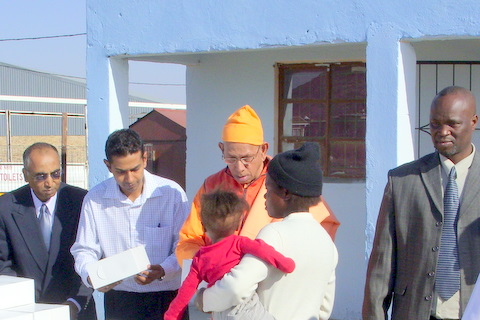
    Swami Smarananandaji giving breads etc to the Black children of Ramakrishna Quedisisi CrecheAt 11 am he reached a School premises where more than 500 indigent Black/Indian people gathered. He gave away the hampers and also spoke a few words of consolation first in English and then for a few minutes spoke, to the delight of the aged people assembled there in Tamil and Hindi. In the evening, he visited the Ladysmith Sub-centre and prostrated at the beautiful shrine before the Holy Trio. He met devotees and also the newly initiated disciples and gave them spiritual guidance.

    On 1st June, a public Reception Programme had been arranged by the Ladysmith Sub-centre in the famous 115-year old stately Town Hall where Revered Maharaj spoke on ‘Contemplation in Active Life’. The centre’s children-devotees presented an interesting folk dance item.

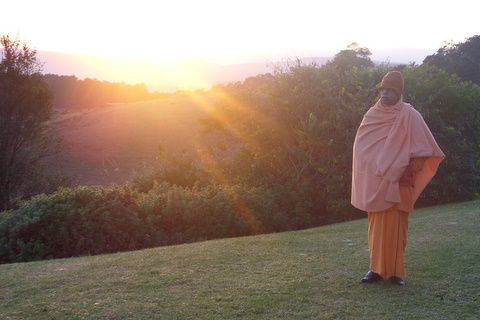
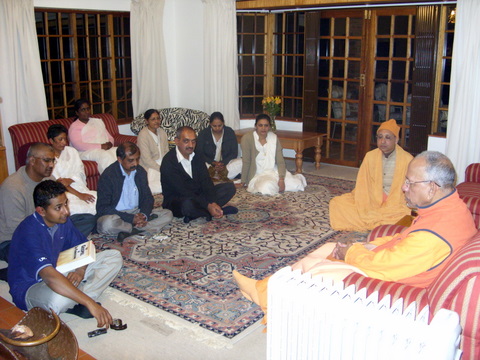
    Swami Smarananandaji at sunrise in DrakensburgIn the evening, he with Jnanavratanandaji left Ladysmith and reached Ramesh Ishwarlaal’s Retreat Home at Drakensberg. The assembled devotees had meditation and Readings from The Gospel of Sri Ramakrishna. 2nd June was spent on discussion on Upanishads, Conversations of Holy Mother and Meditation. In the day time Revered Maharaj and the devotee team went to see the Bird Show in Drakensberg where the well-trained birds like vultures, falcons, owls and also dogs performed to the delight of tourists.Swami Smarananandaji conducting a Retreat in Ladysmith

    On 3rd June, Revered Maharaj and the team while returning stopped for an hour at Pietermaritzburg Sub centre. In this beautiful shrine Revered Maharaj was received with arati and traditional welcome with garlands. While speaking to the devotees there he paid homage to Swamis Nischalanandaji and Shivapadanandaji for their endless efforts in spreading ‘Ramakrishna thoughts’ among the public. He added that Ramakrishna has become a ‘permanent citizen’ of this country.

    Reaching Durban back at the headquarters centre, he went to Sri Sarada Devi Ashram located at Asherville in the evening. He was accorded a warm reception by Pravrajika Ishtaprana and other nuns and women devotees. He spoke in the beautiful shrine on ‘Katha Upanishad’ underlying the prominent ideas chapter-wise.

    There was no outing on the 4th June which was the last day in his itinery. The day of course saw numerous devotees having darshan as well as receiving spiritual guidance from the Most Revered Vice-President Maharaj. His visit will ever remain etched strong in our memories as it gave enormous opportunity for all of us to see, walk and laugh too, besides drawing inspiration in our onward spiritual journey.